Spring Sale: Get 1 Year, Save 58%

Joe Manchin joins with Tom Cotton to reroute $8 billion in climate funds to weapons systems

Sen. Joe Manchin, D-W.Va., was the lone Democrat to join Republicans in a vote to approve a motion filed by Sen. Tom Cotton, R-Ark., on Wednesday to strip billions of dollars from a green climate fund in order to increase spending on a military weapons system.

The 50-44 vote, first reported by C-SPAN, would have the Senate siphon off $8 billion from the Green Climate Fund Authorization Act, a bill introduced by the House of Representatives last year to authorize $4 billion this and next year for “a fund established under the United Nations Framework Convention on Climate Change to finance projects that address climate change.” According to C-SPAN, that appropriation is now poised to finance the Defense Advanced Research Projects Agency (DARPA), which develops emerging military technologies. Manchin, who has become notorious for torpedoing President Biden’s agenda, was the only Democrat to vote “yea.”

RELATED: Big Tech is fueling an AI “arms race”: It could be terrifying — or just a giant scam

The vote was one of 28 addressing non-binding motions to instruct conferees on a science and research bill, dubbed the “United States Innovation and Competition Act” (H.R.4521), which was introduced last year. The massive legislation would, among other things, provide future funding for semiconductor manufacturing; prohibit federal funding for the Wuhan Institute of Virology; address China’s “influence on institutions of higher education”; impose sanctions on China over cybersecurity concerns as well as human rights abuses; and address foreign aid for countries in the Indo-Pacific region. In total, twenty motions total were bought by Republicans, while just eight were filed by Democrats.


Want a daily wrap-up of all the news and commentary Salon has to offer? Subscribe to our morning newsletter, Crash Course.


During Wednesday’s floor session, the Senate also approved a motion to instruct a federal government to establish a minimum number of oil and gas drilling permits to be issued through 2027. That motion, passed with a 53-44 vote, saw support from a total of four Democrats, including Manchin, Sens. Kyrsten Sinema, D-Ariz., John Hickenlooper, D-Colo., and Mark Kelly, D-Ariz.

The upper chamber also rejected a motion by Sen. Bernie Sanders, I-Vt., to block semiconductor manufacturers that would receive funding from outsourcing their employees’ jobs and preventing staffers from unionizing.

RELATED: Senate Democrats join with Republicans to vote down Bernie Sanders’ effort to stop outsourcing

More than margaritas: What Cinco de Mayo is actually about

While Cinco de Mayo is typically celebrated in America as a holiday dedicated to frozen margaritas and guacamole, there is a deeper history behind the day that often gets erased stateside. 

Cinco de Mayo, also known as Battle of Puebla day, celebrates the victory of the Mexican army over France on May 5, 1862. It’s important to note that this is not Mexico’s Independence Day, which falls on September 16. 

Related: This one-pan Mexican dish is the epitome of comfort food — and it comes together in only 15 minutes

The story goes as follows: Mexico was in dire financial straits after the country defaulted on loans owed to France under Napoleonic rule. France chose a path of aggression, viewing the debt owed as a larger opportunity to take a slice of the South American nation.

And so, thousands of French soldiers descended upon Veracruz, Mexico, to begin the David and Goliath-esque matchup. After successfully forcing the President to retreat, they set their sights on Puebla, where Texas-born General Ignacio Zaragoza gathered his own rag-tag army to hold down the fort. 

The Battle of Puebla itself was a face-off between 6000 French troops and 2000 Mexican soldiers, with the latter sorely under-armed and unprepared to hold off the invaders. The battle raged from morning until evening. Miraculously, the Mexican fighters were able to hold their own and force retreat from the French. It was a symbolic victory for the resistance movement within Mexico.

CInco de Mayo is a cause for celebration in Puebla itself — often marked with traditional foods like molé poblano, tamales and caldo de pollo — but is actually not a huge holiday nationally in Mexico. 

In the U.S. it has, however, evolved into a celebration for Mexican-Americans to pay homage to their heritage as well as their indigenous roots. While the victory of Zaragoza and his soldiers may have little to do with their neighbors up North, it is a testament to the tenacity of the Mexican people. 

Related: 

The murky origins of the Mother-in-Law, a Chicago tamale-hotdog hybrid

There’s a well-worn joke about how the Chicago Mother-in-Law got its name. Both the sandwich — a just-shy-of monotone creation made by serving a chili-covered tamal on a hotdog bun — and one’s mother-in-law have the distinct ability to cause heartburn. Anthony Bourdain went with a different familial cliché, once calling it the “evil stepbrother of the hotdog.” 

It’s a meaty, carb-heavy mess, primarily sold these days at Fat Johnie’s Famous Red Hots, a rough-around-the-edges hot dog stand sandwiched between a Popeye’s and a used car dealership on the city’s southwest side. The owner, John Pawlikowski, is clear about the fact that he didn’t create the dish. Rather, he first tasted something like it when he was in 8th grade after a Lithuanian-American vendor sold him a tamal on a bun, which was topped with ketchup, for a nickel. 

The further back one goes, the more tenuous the Mother-in-Law’s roots become. What quickly becomes clear, however, is that those roots, if charted, illuminate the ways in which Mexican immigration has forever changed our country’s foodways. Indeed, Chicago is full of sandwiches with roots that tell the history of immigrants — such as the city’s Italian Beef and Gym Shoe sandwiches — stories that are often nuanced and complex.

As Gustavo Arellano wrote in his book “Taco USA: How Mexican Food Conquered America,” tamales have been served in Chicago since before the World’s Columbian Exposition in May 1893. Robert H. Putnam, a San Francisco businessman who founded the California Chicken Tamale Co., sent representatives from his company to Chicago as it was preparing for the Exposition. They were planning on selling “hot chick’n tamales, tensentsapiece.” 

“Putnam created a hit,” Arellano wrote. “Within five months, he was hiring two to three men a week until he amassed a force of more than five hundred working Chicago’s streets.” 

RELATED: How Knorr seasoning became a staple in Mexican American kitchens

Peter Engler, a Southside food historian, points to a letter written by José María Velasco, a celebrated Mexican artist who was in town to assist with the display of art. 

“When passing through these streets, we ran into a man who had a tin box and a white cloth in front of it that said ‘ ‘Mexican Tamales,”’ the letter reads. “We got closer and asked him if he was Mexican and he answered that he was; I bought ten cents worth of tamales which he sold to me at one cent a piece.” 

Velasco took the tamales to a “place where they sold beer” and proceeded to try one. “They were delicious,” he concluded, though they were “a bit small and with too much aniseed.” 

Chicago’s Mexican population wasn’t very robust at that point; Engler said there were only about 500 documented Mexican residents in the city up until about 1910. However, those who were there sustained food traditions from home — and it made a big impact. As Engler wrote for “The Chicago FoodCultura Clarion” in 2020, tamales become deeply interwoven with the city’s culinary fabric. 

RELATED: The only sugar-rimmed margarita worth drinking is in Chicago

Steven Alvarez, a professor at St. John’s University and the originator of the popular “Taco Literacy” course, said tamales were a natural recipe for immigrants to bring with them because the dish was so central to Mexican cuisine. 

“It really comes back to corn and the various ways to prepare corn,” Alvarez said. “The chemical process by which corn was transformed into hominy is called nixtamal. So the word ‘tamal’ is in the word for that process.” 

Alvarez’s Taco Literacy course focused on the social evolution of Mexican food in the US. That said, he jokes that the course could have easily been called “Tamales Literacy” instead. 

“It’s an ancient food, and it goes all the way from Tierra del Fuego all the way up to up to North America. It also has so much relevance because in Latin America, different groups have their own variations of tamales — and the same is true in the United States.”

“You still really get the roots of understanding people, the movement of food,” Alvarez said. “It’s an ancient food, and it goes all the way from Tierra del Fuego all the way up to up to North America. It also has so much relevance because in Latin America, different groups have their own variations of tamales — and the same is true in the United States.” 

To that end, a Chicago-style tamal, often referred to in the singular here as “tamale,” is distinct from both the tamales served in Mexico, as well as those available in the Mississippi Delta, which are made with cornmeal (as opposed to masa) and boiled, rather than steamed. A Chicago tamale is a slim, machine-extruded tamale, also made with cornmeal. It’s often wrapped in paper, as opposed to corn husks, and is sometimes fittingly cooked in a hot dog steamer. 

“And now, any hotdog stand — well, most classic hotdog stands — in Chicago sells these tamales,” Engler said. “Either Supreme or Tom Tom brand.” 

As for how those tamales ended up on hot dog buns, slathered with chili? Engler said it’s almost impossible to point to a single point of origin — especially as many of the old-school joints that once served them are slowly disappearing, a process the pandemic only seemed to hasten.


Want more great food writing and recipes? Subscribe to “The Bite,” Salon Food’s newsletter.


“When I talked to the owner of Tom Tom tamales, he said he remembered them being sold off a place off of 51st in the early 50s,” Engler said. 

Likely, the sandwich was more widely adopted during the Great Depression as a means to stretch cheap ingredients and minimal meat into a filling meal. However, Alvarez said there’s definitely a Mexican corollary that may have provided inspiration. 

“The sandwich you are describing is interesting because in Mexico, and particularly in Mexico City, there’s a tamale sandwich called the guajolote,” Alvarez said. “It’s this carb overload, usually a breakfast food that’s two tamales inside a bolillo, which is a big roll. It’s kind of the same idea. Tamales and their utility for working people as food on the go, it’s just cross-cultural.”

More Mexican-inspired dishes from Salon Food: 

How will “Evil Dead” and “Spidey” director Sam Raimi fare in the MCU? It’ll swallow his soul

On May 6, the latest film in the Marvel Cinematic Universe will arrive: “Doctor Strange in the Multiverse of Madness.”

As you may have heard, it’s directed by Sam Raimi. At first blush, the return of the man who helmed the original blockbuster Spider-Man film trilogy as well as the riotously campy “Evil Dead” trilogy seems like a coup for comic-book fanatics. Awkward wonder-boy Tobey Maguire ushered in the tentpole superhero franchise for a new millennium, replacing the genuine cartoonishness of Tim Burton‘s Batman films with stylized set-pieces and performative angst befitting a generation reeling from the ’90s.

Yet the example of recent Marvel flicks and a glance at the trailer reveals a more depressing probability: an auteur who once pioneered transgressive and goofy takes on the fantastical has been swallowed by the corporate machine.

His foray into the MCU seems bound to wipe any trace of his distinct touch from the final product. Bigots have recently been going on pathetic tangents targeting the content of  parent company Disney for promoting LGBTQIA+ perspectives and love stories, among other things, and have totally missed the mark on what kinds of critiques should be leveled against the spreading Disney empire – and why it’s worrying that legacy directors like Sam Raimi are surrendering to it. 

Why should Raimi’s history as a fiendish troublemaker and purveyor of gonzo violence stand apart from the MCU? It bears mentioning again that he got his career off the ground with the cult classic “The Evil Dead.” This is a movie that was X-rated when it came out in 1981 and re-rated NC-17 13 years later, since it was still too graphic to be R-rated despite changing norms. It remains that way today. Unlike an MCU film, it’s strikingly honest about its intentions and its ironies. The voluminous gore of the low-budget movie came from painstakingly applying pounds of make-up to achieve the right nauseating effects, and required considerable buy-in and self-discipline from the cast. 

RELATED: “Amazing Spider-Man 2” could’ve been great – if it weren’t a superhero movie

The thing about modern MCU films, especially the Tom Holland-starring “Spider-Man” trilogy, is that they all have been workshopped into a state of claustrophobic innocence.

In addition to being both gross and quite funny, the movie has a lived-in artisanal charm; although perhaps perverse, there’s something truly admirable and creative about the craft applied to such grotesquerie. Most importantly, this transferred through to his work even as he came to embrace blockbusters like “Spider-Man,” creating a subversive effect. Think of the truly nasty way Willem Dafoe’s Green Goblin meets his demise in the OG Spider-Man, or the freakish hospital scene in “Spider-Man 2.” Aesthetically and practically, they feel rooted in Raimi’s horror past — and add up to a suitably brazen depiction of the grittiness that often finds full expression in the comic-book source material. 

Tom Holland in “Spider-Man: No Way Home” (Marvel Studios/Sony Pictures)The thing about modern MCU films, especially the Tom Holland-starring “Spider-Man” trilogy, is that they all have been workshopped into a state of claustrophobic innocence. There’s little in a movie like the recent “Spider-Man: No Way Home” that comes across as provocative. It exists in the same imaginary realm all other MCU movies do, one where being a superhero is like entering a Disney theme park; everything is anodyne and bloodless. It erases the uncomfortable violence inherent to the superhero mythos, the celebration of vigilantism – and therefore perhaps fascism.

RELATED: Marvel’s best TV shows are about women

In contrast, Matt Reeves’ recent iteration of “The Batman” from the DC Comics Universe, for example, depicts Bruce Wayne as an antisocial trust-fund baby and monomaniacal dispenser of brutality in an earnest and accurate deconstruction of superhero worship. Such a blunt narrative would never pass muster in a Disney boardroom. Tom Holland, with his bookish people-pleaser charm, is the quintessential Marvel poster boy: cute and harmless, wracked by guilt over how much he’s called to save the world. Taking on Mysterio or Sandman or The Lizard is all color and pop, PG-13 SFX galore. Family-friendly profit margins demand erasing the collateral damage of Spidey run amok. 


Want a daily wrap-up of all the news and commentary Salon has to offer? Subscribe to our morning newsletter, Crash Course.


Intriguingly, in “No Way Home,” Holland’s Spidey initially feels tortured that his web-slinging ways have brought the death of his Aunt May, that maybe everything he touches turn to s**t — maybe his naivete and ego have got the best of him this time, a classic case of superhero overreach. Yet this is quickly supplanted by a narrative of overcoming the desire for revenge (against the Green Goblin, of course), of making sure one’s gift does not become a curse. Holland eventually chooses to use his power for Good, and not for Evil, and in doing so salvages the sacrosanct purity and moral reputation of Marvel superheroes.

The patent unreality of the incoming “Doctor Strange” could not be at a farther remove from the carefully stitched and pustulant demons that haunt Ash Williams in “The Evil Dead” series.

Other modern-day Marvel films can feel like endless reiterations of the same underlying aesthetic, interchangeable and structured around similar plot arcs and punchlines. One gets the feeling that it’s all rather formulaic. “Black Widow,” for instance, may contain the foundations of an extended reflection on nonconformist families, oppressive patriarchy, and coping with past trauma. It’s a setup for weighty themes that could resonate with any demographic of filmgoers. Yet its sketch of these ideas often falls victim to the same issues that plague other MCU entries: thinly written villains, forced jokes, endless and mind-numbing action sequences that mistake CGI excess for entertainment. Nothing feels fluid or measured. Relationships between characters are often cloyingly sentimental and one-dimensional, reflecting plot lore rather than fleshing out extended emotional sketches. Hero Natasha Romanoff (Scarlett Johansson) has a disturbing origin story in the Red Room, but it’s mostly reduced to highly stylized flashback sequences that communicate totalitarianism in flat and sensationalist terms (flashing images of stormtroopers and microchip mind control). 

RELATED: In “Black Widow,” here’s why a simple vest with pockets means so much

It seems likely that this sterilized trend is bound to continue with the latest “Doctor Strange.” The trailer seems to feature giant alien shellfish creatures and glowing space mummies, impressively foreboding monsters to be sure. Yet, to return to Raimi and emphasize what production methodology made him great, CGI underlines the whole shebang. Yes, “The Evil Dead” was a product of artifice, but it was a notably human artifice. The patent unreality of the incoming “Doctor Strange” could not be at a farther remove from the carefully stitched and pustulant demons that haunt Ash Williams in “The Evil Dead” series, which feel unpleasantly alive. Yes, Raimi went digital many moons ago, but letting the algorithm rule the beasts of his mind feels like surrender. 

It’s likely that Raimi couldn’t care less about all of this, since he’ll inevitably get butts in seats when Gen X eye candy like Benedict Cumberbatch dons his wizard’s cloak again. One might wonder, however, whether or not the distance from Raimi’s scrappy days as a low-budget enfant terrible privately torments him. Maybe he’s just eager to cash a fat check and put his name back on the big stage. The consequence of this will be that he may become indistinguishable from lesser directors, the Jon Watts and Marc Webbs of the world, who have resigned to being just another cog in Disney’s MCU machine. Raimi will also be indistinguishable from those that continue to make the superhero genre feel more and more morally whitewashed, a dangerous abandonment of the form’s roots as a cautionary tale. 

More stories about the MCU:

What’s the deal with finger limes?

Australian finger limes (aka citrus australasica) are one of the silliest types of citrus fruit — and we mean that in the best way possible. They resemble short, stubby fingers and bear the nickname “caviar limes.” Finger limes are a type of tiny citrus fruit — a microcitrus actually — that are native to Australia (specifically the coastal region of Queensland and New South Wales). Their name comes from the fact that they are about the size and shape of a finger (they max out at around 3 inches in length), and both the peel and the pulp come in a rainbow of colors. The pulp (more properly called juice vesicles) of most citrus fruit looks like elongated teardrops, but finger lime’s vesicles are tiny little balls — a tart, fruit “caviar” that holds its shape until the beads burst in your mouth (in case their diminutive size and wide range of colors weren’t enough fun for you).

Look for finger limes at specialty grocery stores — in some parts of California, you might be able to find finger limes at your farmers’ market. So how do you go about choosing the brightest, juiciest ones? Select finger limes with brightly-colored skin. Small brown patches won’t affect the flavor, but steer clear of specimens with dull, dry, shriveled skin (they’re past their prime). Like any other citrus fruit, store finger limes in the refrigerator, wrapped in plastic for a couple of weeks. If you don’t have any luck finding them locally, you can always order them online. Better yet, grow your own with the Via Citrus Finger Lime Tree from our shop. Each tree ships directly from Florida and includes clear care instructions so even novice gardeners can grow beautiful finger limes (assuming that you have a bright, sunny spot where the plant can thrive).

Cut your finger limes in half, and squeeze up from the bottom to release the pulp — anywhere you’d use a squeeze of lime juice, feel free to substitute a small amount of pulp. 

Garnish with abandon

Finger limes are cool, but how exactly can you cook with them? Do you just treat them the same as regular limes or key limes? Kind of, yes! Top oysters, scallops, or sushi (any seafood really) with finger lime pulp — aka the little beads that resemble caviar inside the lime. Treat your vegetarian friends to nigiri sushi with avocado or papaya and a flourish of finger lime pulp. Take cocktails to the next level; try them in a finger lime mojito or an elderflower gin fizz, or even a basic gin and tonic. Their sour flavor will be appreciated by anyone who doesn’t love a super sweet cocktail.

Elevate a salad

Top off a fruit salad with a sprinkling of finger lime pulp — just leave out any other citrus to let the finger limes be the star of the show. Or try them in a fancy fruit pairing, with persimmons and ginger or watermelon and whipped feta. Enjoy them in a savory salad too, or replace citrus juice in a vinaigrette with finger lime pulp for a burst of flavor with every bite.

Give your desserts some flair

Finger lime pulp can be used in a citrus curd or suspended in a cheesecake. Or, try finger limes in cookiesice cream, or on top of cream puffs.  It’s not the flavor or texture that most people will expect from a lime dessert, which makes it so much more fun to serve to guests.

You only need a few pantry staples to make tinned fish tacos — our favorite new quick and easy meal

We live about five miles as the crow flies from the Gulf of Mexico. In fact, for the majority of my life — including all of my adult years — I haven’t lived more than 30 “straight-line” miles away. Because of our close proximity to the water, hurricane season — which begins on June 1 and doesn’t end until Nov. 30 — is a time we take very seriously. There are some things we do ahead of time to prepare for the season in general, as well as other things we do when a storm is actually threatening us.

I’m in charge of many things, thankfully none of which require much heavy lifting. I would say two of my most important jobs are making sure that the liquor cabinet is well stocked, as well as that we have plenty of “pantry food.” Both need to be done long before the first named storm makes its way into the Caribbean.

Stocking the pantry during hurricane season requires having plenty of convenient, easy-to-prepare or even “no prep required” foods on hand. Over the years, convenience foods (aka ready-to-eat products) have improved greatly. We’re no longer stuck with Beenie-Weenies, sardines and the like to go with the chips, cookies and other junk food necessary for maintaining our sanity during times of weather stress.

RELATED: Caldo tlalpeño is the easy-to-make Mexican soup that should be a staple in every home

Nowadays, without even going to a specialty store, I can find all sorts of great-tasting, healthy foods packaged and ready to go for when I’m either short on time or trying to “cook” under less than ideal circumstances. Examples include being without power or being unable to leave home due to numerous fallen trees across the driveway, the latter of which happened in 2020 when the eye of Hurricane Sally literally passed over our house. But I digress.

One of my more recent discoveries while stocking up for hurricane season is Wild Planet’s tinned fish. I call it “tinned fish” to distinguish it from canned tuna or canned salmon, but mostly because I think it sounds fancier. I prefer Wild Planet’s products to any of the other packaged fish I’ve tried. It’s a sustainable seafood company — the first of its kind actually — that also sells pasture-raised, packaged beef and an organic canned chicken breast (which my mom says makes the best chicken salad she’s ever tasted). If you’re unfamiliar with Wild Planet, allow me to be the first to introduce you. Its packaged fish and fish filets are wild-caught and either canned in water or tinned in olive oil. I promise you they’re delicious.

I use Wild Planet’s tinned yellowtail in olive oil for these tacos, but I also keep plenty of yellowtail and mackerel (another tinned fish it sells in olive oil) on hand for easy snacks and lunches. It’s common for my husband to open a tin of mackerel or yellowtail and eat it with crackers, avocado and mustard. If you like fish, there’s no limit to what you can create with just these two varieties.

RELATED: This sweet and tart lemon cake is the easiest bake you’ll ever make

Full disclosure, I use “tacos” to mean not only traditional tacos in taco shells but also burritos, nachos, taco salads, tostadas or wraps — whatever I have on hand. The same goes for what I include in said tacos. Sometimes, I have lots of topping options, and other times I only have a few. 

The point is that it’s easy to keep the basics for these guys handy, such as jars of jalapeños and salsa, olives, an onion, maybe even cheese, lettuce, tomato and sour cream. Whatever you like and whatever you have available at the moment is fair game — especially when you find yourself at home in need of a quick lunch that doesn’t sacrifice on flavor

In the summer, I make fresh fish tacos, and I season my fish with fresh garlic, ground cumin, salt, pepper and lime before cooking. I mention that because if you’re so inclined, you can similarly season the tinned fish in these tacos. You can also heat these little filets up or simply add them to your tacos straight out of the tin. There are no rules (and isn’t that nice for a change?). Check out Wild Planet — and give this recipe a try. You deserve some fancy-feeling fish tacos for lunch.

***

Recipe: Tinned Fish “Tacos”

Yields
1 servings
Prep Time
10 minutes
Cook Time
0 minutes

Ingredients

Wild Planet tinned yellowtail (1 tin per person or more)

Possible toppings — choose any or all:

  • avocados
  • cheese
  • black olives
  • lettuce
  • jalapeños
  • onions
  • tomatoes
  • salsa
  • shredded cabbage or coleslaw mix
  • sour cream

Directions

  1. To heat or not to heat the fish is entirely up to you. It really is good either way!

  2. Create with what you have — you can use taco shells, tortilla chips, tostadas, a wrap, a bowl of lettuce.

  3. Layer it all together and enjoy a satisfying meal in a snap.


Cook’s Notes

Want to try my simple upgrade? Season the yellowtail with cumin, garlic powder and lime juice.


Want more great food writing and recipes? Subscribe to “The Bite,” Salon Food’s newsletter.


More recipes from Bibi’s kitchen: 

Salon Food writes about stuff we think you’ll like. Salon has affiliate partnerships, so we may get a share of the revenue from your purchase.

Samuel Alito cancels appearance at judicial conference after abortion draft leaked

During the 2000s and 2010s, some of the most talked-about majority opinions coming from the U.S. Supreme Court were being written by Justice Anthony Kennedy — a right-wing libertarian and Ronald Reagan appointee who was fiscally conservative but was protective of abortion rights, gay rights and other civil liberties. Now, in early May 2022, the most talked-about majority opinion is one from socially conservative Justice Samuel Alito, who makes an argument for overturning Roe v. Wade in a leaked majority opinion first reported by Politico. And Alito, according to Reuters reporter Nate Raymond, has canceled an appearance at a judicial conference following Politico’s bombshell reporting.

Raymond reports, “Alito had been set to appear at the 5th U.S. Circuit Court of Appeals’ judicial conference, a gathering of judges from the New Orleans-based federal appeals court and the district courts of Louisiana, Mississippi and Texas, a person familiar with the matter said. But he has since canceled, the person said, and Patricia McCabe, a spokesperson for the Supreme Court, on Wednesday, (May 4) said he was not attending. The spokesperson gave no reason for why Alito, who is the justice assigned to hear emergency appeals from the 5th Circuit, was not going.”

The conference is set to begin on Thursday, May 5, according to Raymond.

Alito’s draft opinion was written back in February, but it didn’t become public knowledge until Politico reported on it on Monday night, May 2. Abortion rights protests have erupted all over the United States, from Seattle to Philadelphia to Los Angeles to Atlanta, following that bombshell.

“The unprecedented leak from the High Court sent shock waves through the United States,” Raymond notes. “U.S. Chief Justice John Roberts, on (May 3), confirmed the draft’s authenticity but emphasized it was not final, and said the Court will investigate the leak, which he called a ‘betrayal.'”

Alito, a George W. Bush appointee, joined the High Court in January 2006 and has represented the Court’s theocratic wing, along with Justice Clarence Thomas and the late Justice Antonin Scalia. Alito, during the Bush and Barack Obama years, often had major disagreements with Kennedy, Justice Stephen Breyer and the late Justice Ruth Bader Ginsburg — and his leaked draft opinion in favor of overturning Roe v. Wade shows how vehemently he disagrees with the right-to-privacy doctrine that Kennedy, along with Ginsburg and Breyer, championed during his decades on the High Court.

In the draft opinion in Dobbs v. Jackson Women’s Health Organization, Alito declares, “Roe was egregiously wrong from the start…. We hold that Roe and (Planned Parenthood v.) Casey must be overruled.”

Dolly Parton is ready to rock ‘n’ roll “just to show that I can do it” after joining Hall of Fame

Dolly Parton may have initially said no to the Rock & Roll Hall of Fame nominations but on Wednesday, the queen of country was officially inducted into the 2022 class of musicians.

“I guess we’re making more news!” Parton said in an exclusive interview with Billboard.

Back in March, the acclaimed “Jolene” and “9 to 5” singer had voluntarily bowed out of  consideration, believing she was both undeserving and unworthy of the accolade. Parton claimed she wasn’t much of a rock ‘n’ roller but said the nomination had encouraged her to “put out a hopefully great rock ‘n’ roll album at some point in the future.”

In her most recent interview, Parton reiterated those sentiments but clarified her intent was never malicious.

“I feel honored that all the people that voted for me did. And I appreciate the Rock & Roll Hall of Fame people for staying there with me,” Parton told the outlet. “I never meant to cause trouble or stir up any controversy.”

RELATED: When Dolly Parton’s critics said she looked “cheap,” she doubled-down to look like “the town tramp”

“It was just always my belief — and I think millions of other people out there too — always thought the Rock & Roll Hall of Fame was just set up for the greatest people in the rock ‘n’ roll business, and I just didn’t feel like I really measured up to that and I don’t want to take anything away from the people that have worked so hard,” she continued.

She’s also usually considered herself to be a country singer, such as her late colleague Naomi Judd.

Shortly after receiving the news of her induction, Parton took to Twitter to express her joy and thank her fans and supporters.

“I am honored and humbled by the fact that I have been inducted into the Rock and Roll Hall of Fame,” she wrote. “Of course I will accept it gracefully. Thanks to everyone that voted for me and to everyone at the @rockhall. I will continue to work hard and try to live up to the honor.”

Parton joins a prestigious nominee class, which also includes artists such as Eminem, Beck, Duran Duran, A Tribe Called Quest and Lionel Richie. In addition to the Rock & Roll Hall of Fame, Parton is an honorary member of the Country Music Hall of Fame, making her the second woman to be in both after singer Brenda Lee.   


Want a daily wrap-up of all the news and commentary Salon has to offer? Subscribe to our morning newsletter, Crash Course.


“I found out later there’s more people than I knew are in there, and I found out more about what the Rock & Roll Hall of Fame really stood for. . . . I even have a lot of my rock ‘n’ roll friends and people that are, you know, to the point of being bitter about the fact that they’re not being nominated or in the Rock & Roll Hall of Fame,” Parton explained.

She added: “So it’s like, ‘If they’re not able to be recognized in the Rock & Roll Hall of Fame, where do they go?’ I was trying to be nice and good about not trying to take something away from somebody that had truly earned it.”

At this time, Parton isn’t sure if she’ll be attending the induction ceremony. If she does, the leading lady of country said she’s “going to sing the hardest style rock ‘n’ roll song I could ever muster up just to show that I can do it.”

More stories you might like:

The corrupt nostalgia of “My Old Kentucky Home”

This week, 150,000 people will gather at Louisville’s Churchill Downs for the 148th running of the Kentucky Derby. Millions more across the country will be watching live when the crowd rises to its feet, roars with excitement and sings the traditional opening song, “My Old Kentucky Home.”

Few realize that this nostalgic anthem is about the internal American slave trade, which terrorized generations of parents, children, and siblings — and broke up millions of Black families.

White people and institutions need to hit a hard pause and reflect on the song’s history.

Indeed, for close to two centuries, white America has played the strains of “My Old Kentucky Home” to demarcate and police racial boundaries, to feel better about Black pain, to meet its own needs for emotional expression, tradition, even patriotism. In the city where police killed Breonna Taylor in her Kentucky home, white people and institutions need to hit a hard pause and reflect on the song’s history, then consider whether singing it this way is appropriate. We should be guided by Black Americans in Kentucky and beyond, whose views on “My Old Kentucky Home” have been roundly ignored.

RELATED: How African Americans disappeared from the Kentucky Derby

The composer and songwriter Stephen Foster, a white Pittsburgher, wrote the 1853 melody, which blackface minstrels made into a hit. The opening phrases use a word we now consider a slur to describe the main characters: “The sun shines bright in the Old Kentucky home / ‘Tis summer, the darkies are gay.” Enslaved people are shown enjoying the stereotyped humble pleasures of possum hunting and moonlit jam sessions. But then, the song goes on, “Hard Times comes a knocking at the door,” and destruction follows. “The Darkies have to part” because one of them is being sold down river to the Deep South, to die in a sugarcane field, never again to see his family. Such is the fate of enslaved Black people, according to the fatalistic lyrics: “The head must bow and the back will have to bend / Wherever the darky may go.”

loubing · My Old Kentucky Home (full lyrics performed by multiple artists)

The plot echoes Harriet Beecher Stowe’s bestselling abolitionist novel, “Uncle Tom’s Cabin” (1852), but Foster was no abolitionist. He needed to sell, and he succeeded by fusing a song of home with blackface, the most popular entertainment of his time.

Nostalgia for life on any plantation (the refrain calls on us to “sing one song for the old Kentucky home”) was an emotion unique to white America. As one Black newspaper in Kansas reminded readers in 1900, “We have long thought there has been a little too much bragging about the joys of the old Kentucky home.”

White people were captivated by the “dream of a happy past” that “My Old Kentucky Home” evoked for them.

For white listeners, though, it offered a soothing tonic, and for many, still does. So soothing that in 1921 civic and business leaders decided to use the tune to lure visitors and enhance Kentucky’s image. The melody sounded notes that were personal (“My”), reassuring (“Old”), exotic (“Kentucky”), and universal (“Home”). Amid mass immigration, indus­trial strife, women’s suffrage, world war and racial unrest, it evoked a genteel-sounding, rural past where everyone knew their place.

White people were captivated by the “dream of a happy past” that “My Old Kentucky Home” evoked for them. The song became a symbol of Kentucky tradition, culture and pride. A defeated planter class had attained “Lost Cause” nobility built on false memories of benign, even benevo­lent, chattel slavery, and in 1923 the state purchased a big brick house called Federal Hill forty miles south of Louisville and christened it The Old Kentucky Home.

RELATED: A brief history of the “Lost Cause”: Why this toxic myth still appeals to so many white Americans

The only dwelling mentioned in “My Old Kentucky Home” is a slave cabin, and no shred of evidence connects Foster or his song directly to the site. Yet millions of schoolchildren and tourists from all over the world have strolled through Federal Hill’s spacious rooms. On this hallowed ground, they were told, Foster penned the beloved melody. One promoter called it “the happy home of slavery.” Another fan from across the Atlantic (Foster’s music circled the globe) said the tune described “a happy home that can never be destroyed.” It was all a lie, pure promotional propaganda, and seven years later those in charge at Churchill Downs officially embraced it.


It was all a lie, pure promotional propaganda.

Corrupt mythmaking is not unique to Kentucky. “My Old Kentucky Home” is not history or even memory, but rather entertainment that normalized racial hierarchy. It has allowed its singers to view human bondage as picturesque and people held against their will as docile. From the 1870s into the Civil Rights era, Black performers everywhere were expected to deliver its soothing tonic, as when Bill “Bojangles” Robinson, acting the role of a butler, whistles “My Old Kentucky Home” to distract a pouting Shirley Temple from her troubles in “The Little Colonel” (1935).

RELATED: We still lie about slavery

When 20th-century superstar singers Marian Anderson and Paul Robeson began dropping “darkies” from their renditions, many whites responded as though something holy were being desecrated. In 1972, after decades of objections from the NAACP, the slur one step removed from the N-word disappeared from the Kentucky Derby program. From then on, crowds would sing a new line, “Tis summer, the people are gay.”


Want a daily wrap-up of all the news and commentary Salon has to offer? Subscribe to our morning newsletter, Crash Course.


“Any good man will cloud up when they play ‘My Old Kentucky Home,’ the legendary sportswriter Frank DeFord once wrote, “and cry outright when he realizes he is standing in one of those rare places where beauty and history bisect for an instant.”

DeFord captured an experience that Churchill Downs has distilled for millions and is reluctant to give up. But whose beauty, whose history, does the song invoke? Simply removing “darkies” does not change its loaded meaning — or the appropriateness of singing about the atrocities of slavery at a modern sporting event. As Lonnie Ali told me about her husband, Kentucky’s greatest sports hero, “I never heard Muhammad sing that song, ever.” Ali’s friend Bob Coleman was blunter: “It’s a white song. It’s your song.”

It was my song. For most of my life “My Old Kentucky Home” had the power to make me “cloud up” or weep “outright.” As this nation struggles with the shared legacy of its racist culture, white Americans must leave this song to Black Americans to do with as they please. The pain at the core of a song about a man sold for cash and sent away from his family to die deserves neither nostalgia nor celebration. “My Old Kentucky Home” isn’t mine anymore.

Read more:

“Insulting punk”: Geraldo Rivera gets into heated exchange with Fox News colleague Greg Gutfeld

Although Fox News’ Geraldo Rivera is a Fox News talking head, he doesn’t always blindly parrot the party-line nonsense coming from his colleagues. Rivera, for example, once got into a high-decibel shouting match with former Fox News host Bill O’Reilly over illegal immigration. And during a Wednesday May 4 broadcast of the Fox News program “The Five,” Rivera slammed colleague Greg Gutfeld in response to his comments on abortion.

The heated exchange between the 78-year-old Rivera and far-right commentator Gutfeld came two days after Politico reported that U.S. Supreme Court Justice Samuel Alito, in a leaked majority draft opinion, laid out an argument for overturning Roe v. Wade. Gutfeld was dancing with joy over the likely demise of Roe, saying that American women should fully embrace motherhood — and Rivera countered that motherhood should be voluntarily.

Gutfeld told Rivera and others on the panel, “It’s something to celebrate, to cherish, to shout” — and Rivera angrily responded, “That’s baloney. That’s baloney. Cherish the wire hanger stuck up their privates?”

Gutfeld mocked Rivera for reminding viewers that dangerous back-alley abortions were common before the U.S. Supreme Court handed down its Roe v. Wade decision in 1973, and Rivera responded, “You are an arrogant…. You insulting punk.”

Rivera is being applauded on Twitter — even by some of his critics — for calling out Gutfeld’s idiocy. Here are some of their responses:

Life after Roe: Republicans are already targeting the right to a public education

Despite glib right-wing claims to the contrary, as many legal scholars and constitutional experts were quick to point out, Supreme Court Justice Samuel Alito’s leaked draft opinion ending abortion rights opens the door wide open for the reversal of decades of human rights litigation. At issue is Alito’s rejection of the ninth amendment, which states that the “enumeration in the Constitution, of certain rights, shall not be construed to deny or disparage others retained by the people.” Or, in plain English: Plenty of rights are guaranteed by implication in the Constitution — such as a right to privacy — even if not explicitly delineated. Despite his alleged “originalism,” however, Alito was quite clear that he feels the opposite is true: If it ain’t singled out by name in the Constitution, it’s not a right. 

“The Constitution makes no reference to abortion,” he writes in the draft opinion that was leaked to Politico. As political scientist Scott Lemieux noted, this is a “junior high school debate society” argument unworthy of anyone with a law degree, much less a Supreme Court seat. But it does open the door to repealing birth control rights, same-sex marriage, and decades worth of social progress that religious zealots like Alito deplore.

Already, excited Republicans are drafting bills that would throw women in prison for “homicide” for abortion and end same-sex marriage rights. (Meanwhile, they are also restoring the “right” of parents to marry an 11-year-old off to an adult man.) But while Republicans are dusting off their obsessive desire to police American bedrooms, they are starting to notice that Alito’s argument has implications for all the human rights they wish to end. 

RELATED: Samuel Alito’s leaked anti-abortion decision: Supreme Court doesn’t plan to stop at Roe 

On Wednesday, Texas’s Republican Governor Greg Abbott announced that his administration wishes to “resurrect” a 1981 Supreme Court case that guarantees the right of all children to public education. The case in question is Plyler v. Doe, in which the court looked at a Texas law that withdrew funds from public schools that enrolled undocumented immigrants as students. After determining that undocumented immigrants are, indeed, “persons,” the court struck down the Texas law. 

While Republicans are dusting off their obsessive desire to police American bedrooms, they are starting to notice that Alito’s argument has implications for all the human rights they wish to end. 

That’s where the GOP is, circa 2022: Arguing that zygotes are “persons,” but living, breathing children of immigrants are not.

Indeed, the entire segment of the Joe Pags show that Abbott appeared on was nauseating in its preference for cruelty over common sense. The host whined that “public property tax dollars” are being spent on “children who are 5, 6, 7, 10 years old, who don’t even have remedial English skills.” Of course, that is what schools are there to teach. Kids that age also don’t know how to read or write or do math. Pags clearly needs remedial education in what schools are for, if “teaching kids stuff” is not on his list of imagined purposes. 


Want more Amanda Marcotte on politics? Subscribe to her newsletter Standing Room Only.


This is likely just the beginning of a feeding frenzy of right-wing challenges to 70 years, or possibly more, of decisions securing human rights.

Alito’s draft opinion involves both sneering at “the latter part of the 20th century” and a lengthy, bitter diatribe about how the court is not bound by precedent. It’s an open invitation for conservatives to “resurrect” any case going back to the 1950s, no matter how settled it is in the public view. VDare editor Peter Brimelow, who the New York Times reported once worked directly for Fox News owner Rupert Murdoch, was exuberant about the possibilities. 

If that sounds improbable, I invite readers to once again read Abbott’s comments about his intention to end public education for the children of immigrants. The same racism puts the educational rights of Black children on the chopping block. Conservatives already won one pro-segregation case before the GOP-controlled Supreme Court in 2006. With Alito inviting more cases like this, things are likely to get quite hairy. 

RELATED: Salon investigates: The war on public schools is being fought from Hillsdale College

This is likely just the beginning of a feeding frenzy of right-wing challenges to 70 years, or possibly more, of decisions securing human rights.

Nor should anyone assume this will be limited by racial grievance politics.

As Kathryn Joyce has extensively reported for Salon, the long term goal of the radical right — of which Abbott has strenuously tried to demonstrate he is a member — has been the total destruction of public education. It makes sense, of course, that the same people who think that government should play no role in providing health care also object to the government providing education. Those cards have been traditionally held close to the chest, concealed by stalking horses such as “charter schools.” But lately, more conservatives have been forthright about their ideological opposition to the concept of public education. 


Want more Amanda Marcotte on politics? Subscribe to her newsletter Standing Room Only.


Just last week, Fox News host Lisa Kennedy argued that another Supreme Court case challenging the secularism of public schools offers an opportunity to “rethink whether or not we have public schools.” She added, “Maybe we should not have the government involved in education at all.” And, as Joyce reported last week

In 2021, Florida Commissioner of Education Richard Corcoran declared that Republicans would win the political “war” in education, while sketching out a plan to lure so many students out of public schools that the damage to the system would be permanent. This month, Chris Rufo, the Manhattan Institute fellow who turned “critical race theory” into an amazingly effective political scapegoat, bluntly explained that “to get universal school choice you really need to operate from a premise of universal public school distrust.” 

“Resurrecting” long-forgotten cases like Plyler plays into this scheme. The far-right Supreme Court has already elevated the claim that rights not explicitly named in the Constitution aren’t real. Now they may have an opportunity to declare that children do not have a right to education and states do not have an obligation to provide it. The whole thing would be sold to Republican voters through racial grievance, as a way to deny children of color educational access, of course. But the Supreme Court deciding that the right to education doesn’t exist would naturally make it much, much easier to end public education altogether. 

RELATED: Betsy DeVos and Ron DeSantis: GOP dynamic duo team up to defund public schools

Despite all the whining and crying from Republicans about the “leak,” what’s evident is that the right is stoked about Alito’s draft opinion. It folds in decades of specious right wing arguments that posit that the government has absolutely no obligations to its citizens: No duty to protect human rights, no need to provide services like education or health care. This ideology has long been called “libertarianism,” but in truth it’s just uniquely American flavor of fascism. There’s no planet where “liberty” is expanded by forcing women to give birth or keeping children illiterate. Republicans can see their dystopian agenda for the United States coming into view, and they couldn’t be more excited

READ MORE: 

Republicans’ war on education is the most crucial part of their push for fascism

How this tiny Christian college is driving the right’s nationwide war against public schools


“Julia” was just renewed — here’s what to watch, eat and read while waiting for Season 2

On Wednesday, HBO Max announced that “Julia,” the story of titular chef Julia Child starring Sarah Lancashire and David Hyde Pierce, would be returning for a second season. 

Julia Child tends to make people happy,” said executive producers Chris Keyser and Daniel Goldfarb in a statement. “In a bleak world, she is a welcome balm. Making this show has done the same for us. Working with our cast — with Sarah and David — our production team, writers, directors and editors, who have become our friends, makes us happy.” 

However, the first season of the newly-beloved show concludes on May 5, leaving fans of the series facing a bit of a wait before the next batch of episodes are fully-baked (the press release did not indicate a release date for season two). Thankfully, there are a lot of other ways to get your fill of Julia Child thanks to an enduring love of the French Chef that has resulted in a lot of recent projects. 

Here are our tips on what to eat, watch and read while waiting for Season 2 of “Julia” to arrive. 

What to eat 

Get in touch with your inner Julia Child by bringing some of her most well-known recipes into the kitchen. Of course you could take a stab at some of her more complicated multistep stunners, like canard a l’orange or her souffle, I’m a big fan of her more simple recipes. Try vichyssoise, Child’s favorite soup (which also tells a lot about her philosophy on cooking), or her simple roast chicken

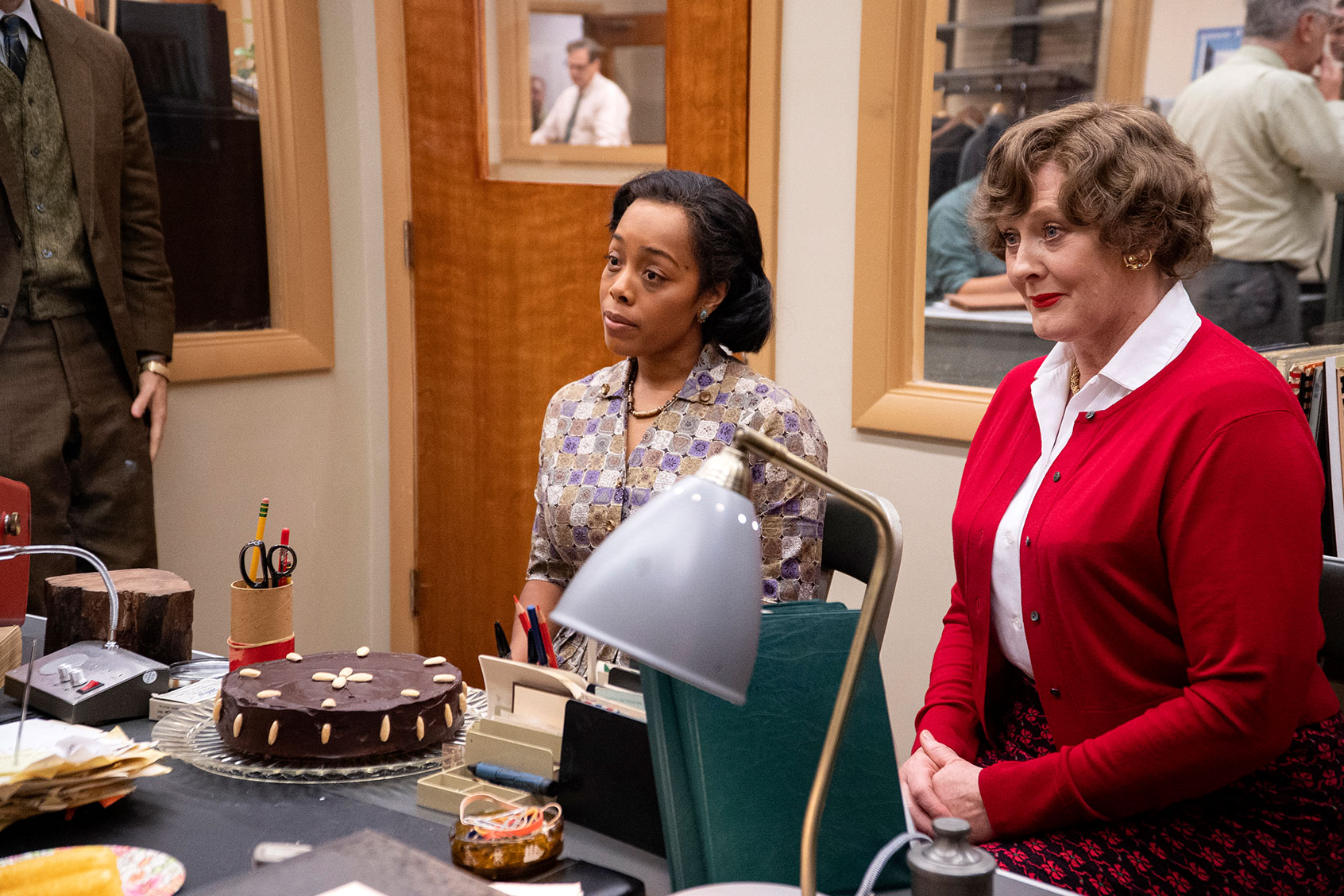
JuliaQueen of Sheba cake from “Julia” (Seacia Pavao / HBO Max)

Have a sweet tooth? Perhaps you remember the appearance of Child’s Queen of Sheba cake in the first episode of “Julia.” Believe me when I tell you that cake is simple enough for anyone to make, even a kid. As Salon’s Melanie McFarland wrote in her review of the series, “The recipe’s simplicity also is why I could make that cake in grade school, having copied down the ingredients from a recording of ‘The French Chef.'” 

What to watch 

Speaking of “The French Chef,” do give it a watch while waiting for “Julia” to return. Many of the episodes are posted to YouTube and provide both really delightful cooking instruction, as well as context for the series. If you’re looking for additional insight into Child’s life, I’d definitely recommend checking out the 2021 documentary film “JULIA.” Co-directed by Betsy West and Julie Cohen, this film is packed with never-before-seen archival footage, personal photos, first-person narratives and gorgeous cinematography to trace Child’s decades-long journey to revolutionize the world of food.

Once you’ve watched it, here is a conversation with West and Cohen about Julia’s feminist marriage to Paul Child, how Child’s views on homosexuality evolved during her lifetime and the lengths they went to meticulously replicate Child’s iconic kitchen.

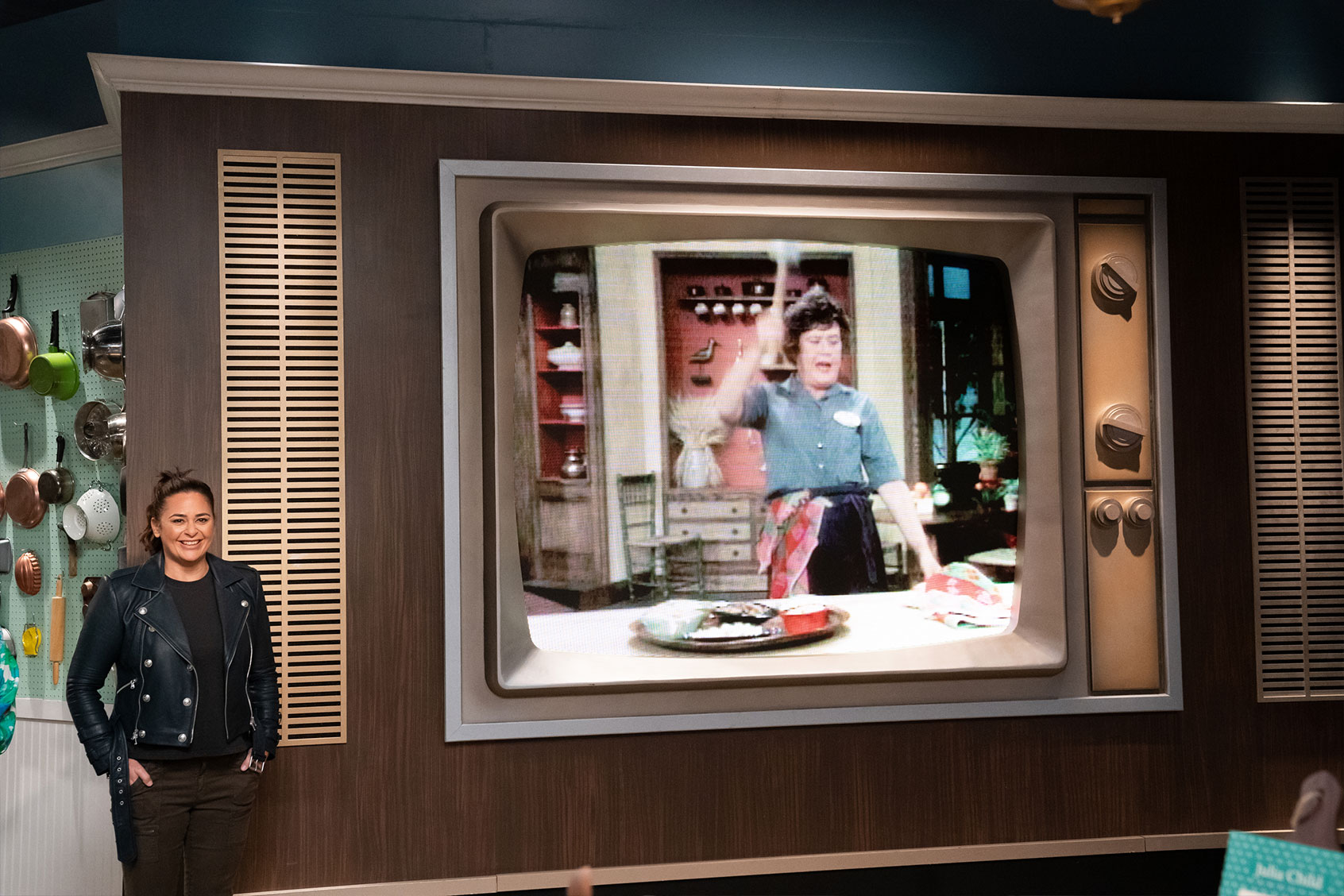
The Julia Child ChallengeHost Antonia Lofaso wathces LED Julia Child on the TV, as seen on The Julia Child Challenge (Photo courtesy of the Food Network)On that note — here is a Salon-exclusive video about how the creators of “Julia,” the series, recreated that same kitchen, detail-by-detail. 

If you’re looking for something a little less studious, flip over to discovery + to catch up on “The Julia Challenge.” Julie Powell, the author of the hit blog-turned-book-turned-movie “Julie and Julia,” recapped the competition series for us. 

What to read 

There are many, many books about the life of Julia Child, but one that I really enjoyed recently was “Warming Up Julia Child: The Remarkable Figures Who Shaped a Legend.” Written by Pulitzer Prize finalist Helen Lefkowitz Horowitz, this book peels back the curtain on an unexplored part of Julia Child’s life — the formidable team of six with whom she collaborated to launch her legendary career. 

I spoke with her approach to researching this book, Julia Child’s unexpected disdain for (certain types of) television and how destiny led her to write a previously underexplored story about pop culture’s favorite chef. 

Read more stories about Julia Child:

Montana Republicans poised to abandon school lunch assistance amidst hunger crisis

President Biden is set to host the first food insecurity conference in the last fifty years, raising awareness of the fact that nearly 14 million American households still do not have reliable access to food. 

The upcoming event, first reported by CNN, will mark the first conference of its kind since 1969, when then-President Richard Nixon hosted the White House Conference on Food, Nutrition and Health. 

“Too many families don’t know where they’re going to get their next meal,” Biden said in a video this week. “Too many empty chairs around the kitchen table because a loved one was taken by heart disease, diabetes or other diet-oriented diseases, which are some of the leading causes of death in our country.”

The event comes as millions of Americans continue to buckle under the weight of rising food prices, driven largely by corporate profiteering as well as the COVID-induced supply shock. 

Over the past two years, a handful of Republican-led states have missed deadlines to renew federal funding for food provisions, deeming them unnecessary now that schools have reopened as the pandemic peters out. 

RELATED: Free school meals for all children can improve kids’ health

In Montana, parents are reportedly worried that their children will lose out on $36.6 million in federal funding for food because the state has not yet submitted a plan to the U.S. Department of Agriculture for another round of school-year funding, according to The Daily Montanan. The program, called the Pandemic Electronic Benefit Transfer (P-EBT), allows school children to purchase food through EBT cards that make them eligible for temporary emergency nutrition benefits.

Wren Greaney, advocacy coordinator with the Montana Food Bank Network, told the outlet that P-EBT has made a “big difference” for parents in the state. “We’re definitely aware that it’s important to parents,” Greaney said. “It did help them make ends meet.”

Nevertheless, the state has no apparent plans to replenish the funds because the state’s need for the package has allegedly dropped by as much as 50%, according to Montana Health Department spokesperson Jon Ebelt.

“Should the Biden Administration provide states with P-EBT flexibility and allow Montana to design a plan that meets its needs, DPHHS will reconsider participating in the program,” Ebelt told the Montanan in an email last month.

Meanwhile, the Missoula Food Bank and Community Center, which offers emergency food assistance in Missoula, said that April was the busiest month in its entire history. “We hope that the state will do the right thing and continue to support families through these challenging times,” said Jessica Allred, the food bank’s interim co-executive director. 

To make matters worse, the Biden administration also appears slated to let a slew of pandemic-era school lunch waivers expire, which could bring millions of kids who have been receiving free and reduced-price meals closer to food-insecurity, as Salon reported last month.

“This has not been the recovery year that we thought it would be. School nutrition programs are still struggling families, and kids are still struggling. We’re still transitioning back,” Crystal FitzSimons, Director of School and Out-of-School Time Programs at the Food Research and Action Center (FRAC), told Salon in an interview. “Providing another year of these waivers will be critical to support kids and families, to support education, and to support the school nutrition operations.”

RELATED: Everybody blames Mitch: McConnell scrambles to avoid blame for end of popular school lunch extension

WATCH: Legal expert turns Republican senator’s attempted grilling around on him

A Republican senator pressed a legal expert to explain ethical responsibilities for U.S. Supreme Court justices, and she turned his arguments against him.

Sen. John Kennedy (R-LA) repeatedly asked Amanda Frost, a law professor at American University and a critic of existing recusal provisions, whether it was improper for then-Senate minority leader Chuck Schumer to put public pressure on the court to uphold abortion rights, which he suggested undermined their integrity.

“Unfortunately, over the last decade, particularly the last five years or so, I have seen the court come under attack from so many different sources,” Frost said, before Kennedy interrupted to rephrase his question. “I would certainly not support a senator criticizing the court. It’s also a problem when the Senate of the United States will not confirm a nominee for over a year, leaving the court with eight justices.”

Then-Senate majority leader Mitch McConnell refused to allow nomination hearings for Merrick Garland, whom Barack Obama had tapped to replace the late Antonin Scalia nearly eight months before the 2020 election, and GOP senators held the seat open until Donald Trump was inaugurated and selected Neil Gorsuch.

“It’s also a problem when Congress will not amend existing legislation to improve the process of recusal so that all the justices can weigh in on a recusal position,” Frost said, “and protect the integrity of that court. All of those are a problem.”

WATCH below:

Jalapeño popper grilled cheese is what dreams are made of

Big Little Recipe has the smallest-possible ingredient list and big everything else: flavor, creativity, wow factor. That means five ingredients or fewer — not including water, salt, black pepper, and certain fats (like oil and butter), since we’re guessing you have those covered. Inspired by the column, the Big Little Recipes cookbook is available now.

As someone who loves jalapeños, loves cheese, and does not love football, I reject any implication that jalapeño poppers are a seasonal snack. Super Bowl, sure, but any day of the year is worthy of their crispy-spicy-gooey goodness. Jalapeño poppers are timeless.

And in more ways than one. While some spots in Texas lay claim to the invention and Anchor Food Products even trademarked the name between 1993 and 2004, as Daniela Galarza writes in Eater, “It’s clear to me that an American jalapeño popper is a Mexican chile relleno — a pepper stuffed with cheese and cooked.” Such a smart combination has been around since long before recipes or trademarks.

This riff takes all the craveability of those contrasts — crunchy meets gooey, spicy meets creamy — and flips it on its head. Instead of stuffing cheese into a pepper, then covering with bread crumbs, we are stuffing peppers and cheese between bread. Which is to say: We are making a grilled cheese sandwich.

Of course, this being Big Little Recipes, we’re skipping some ingredients along the way. (Don’t worry, you won’t miss them.)

Lots of jalapeño popper recipes include more than one cheese, usually cream cheese and cheddar, and even Parmesan has been known to weasel its way into the mix. We’re not doing that. Instead, Pepper Jack is melty, punchy, and brings bonus jalapeños to the mix.

Likewise, onion, scallion, and/or chive are all respected but not needed here. An ample amount of jalapeños — two peppers per sandwich — provides more than enough bite.

Many, if not most, jalapeño poppers include bacon. Sometimes wrapped around the chile, sometimes crumbled on top. And if that makes your mouth water, go — find your joy. Bacon is great here, especially since you can use the rendered fat to toast the bread.

But for anyone who doesn’t eat meat — or anyone who does, you’re welcome, too — the recipe includes a bonus option: barbecue potato chips. Meaty in their own way and delightfully crunchy, these take the sandwich, buckle it up in a rocket ship, and send it to outer space. Look at it go.

Recipe: Jalapeño Popper Grilled Cheese

Historic “breach” puts abortion rights supporters and opponents on alert for upcoming earthquake

For an eventuality that’s been forecast and fought over for decades, no one truly has any idea what would happen if the Supreme Court overturns Roe v. Wade.

It was fairly clear when the court heard arguments in December over whether Mississippi could ban most abortions after 15 weeks of pregnancy that at least five justices supported upholding Mississippi’s law. It also seemed likely that they favored going significantly further to chip away at the right to abortion that women have been guaranteed since Roe was decided in 1973.

A leaked draft opinion published by Politico on Monday night — itself a historic breach of the court’s top-secret deliberation process — simply suggests what those who have followed the debate closely already suspected: Roe and the 1992 case that upheld it, Planned Parenthood of Southeastern Pennsylvania v. Casey, were soon to be no more.

Roe was egregiously wrong from the start. Its reasoning was exceptionally weak, and the decision has had damaging consequences,” says the draft opinion obtained by Politico and authored by Justice Samuel Alito. Politico said Alito was writing for a majority that includes Justices Clarence Thomas, Neil Gorsuch, Brett Kavanaugh, and Amy Coney Barrett, but not Chief Justice John Roberts.

Several caveats are in order here, even after the draft was confirmed as “authentic” by Roberts, who also said he has ordered an investigation into the source of the leak. First, draft opinions can and do change — majority opinions can even become minority ones. That’s what happened with the 2012 Affordable Care Act case — although the initial vote was to strike down the law as unconstitutional, a deal was eventually made to uphold the core of the ACA while making a key provision, the Medicaid expansion, optional for states. Those deliberations were detailed by Supreme Court reporter Joan Biskupic in her 2019 biography of Roberts, “The Chief.”

Even if the underlying votes don’t change, draft opinions are often changed significantly before they are released.

Also, the Supreme Court’s process is an iterative one: Justices circulate drafts back and forth and agree and disagree and edit. That’s why often there are multiple majority, dissenting, and concurring opinions surrounding a single case. As Roberts noted in his statement Tuesday, “Although the document described in yesterday’s report is authentic, it does not represent a decision by the Court or the final position of any member on the issues in the case.”

All of that said, however, it seems unlikely that any of the five justices on the draft decision to overturn Roe and Casey will change their minds on the threshold issue.

Which leads to the next question: What’s next?

Substantively, the answer is obvious. A number of conservative states already have anti-abortion laws on the books that will be triggered if the court overturns Roe. Red states lacking so-called trigger bans likely will rush to pass as many prohibitions and restrictions as they can. Blue states probably will attempt to make abortion more available to travelers from other states.

But politically the impact is murkier. Will women rise up and protest, as when President Donald Trump was elected, and then drive the midterm vote in November toward Democrats? Or will the reaction be more as it has been in Texas, where, as The Washington Post pointed out this week, “Republicans have paid no apparent political price for banning abortion after cardiac activity is detected, around six weeks of pregnancy.” The Supreme Court has so far declined to halt the Texas law, even though it directly contravenes Roe, which technically remains the law of the land until an opinion overturning it is issued.

The leak alone has changed the tenor of the debate.

“It concerns me a great deal that we’re going to, after 50 years, decide a woman does not have the right to choose,” said President Joe Biden, who has mostly avoided the touchy issue since becoming president. “If this decision holds, it’s really quite a radical decision.” (Biden did, for apparently the first time in his presidency, use the actual word “abortion” in his prepared statement and responses to reporters Tuesday.)

“My intention is for the Senate to hold a vote on legislation to codify the right to abortion,” said Senate Majority Leader Chuck Schumer on the floor Tuesday morning. “Every American is going to see on which side every senator stands.”

Schumer has so far resisted holding such a vote, mainly because not every Democrat would necessarily vote for such a bill, which could have implications broader than a reinstatement of Roe.

Republicans are, so far, downplaying the potential political impact. Senate Minority Leader Mitch McConnell, who largely is responsible for adding the justices to the court who would make Roe‘s overturn possible, focused his reaction on the leak. “Last night’s stunning breach was an attack on the independence of the Supreme Court,” he said in a statement.

But even GOP operatives say they are not that concerned about a voter backlash. “Consider me highly skeptical that the SCOTUS decision is going to have a meaningful impact on the midterms,” tweeted Brendan Buck, a GOP communications consultant and former top aide to House Speakers John Boehner and Paul Ryan.

Abortion opponents are among those celebrating, although even they realize this is not the final word. “If this opinion is adopted … the chaos of an erroneously decided decision 50 years ago that has had such a profoundly negative impact on our culture and all women, and men, would finally be set right,” tweeted Jeanne Mancini, president of the anti-abortion group March for Life.

One of many wild cards in all this is the role major corporations are playing in facilitating abortion for employees and their dependents. Some large companies, including Amazon, Citigroup, Yelp, Lyft, and Uber, are specifically creating benefits to help their workers obtain and pay for reproductive health care.

For the moment, both sides appear galvanized by the likely earthquake to come; abortion rights proponents and opponents have been crowding the sidewalk in front of the Supreme Court and the Capitol. But politically, this is going to be a marathon, not a sprint.

A final, official decision from the court is expected by the end of June.

HealthBent, a regular feature of Kaiser Health News, offers insight and analysis of policies and politics from KHN’s chief Washington correspondent, Julie Rovner, who has covered health care for more than 30 years.

KHN (Kaiser Health News) is a national newsroom that produces in-depth journalism about health issues. Together with Policy Analysis and Polling, KHN is one of the three major operating programs at KFF (Kaiser Family Foundation). KFF is an endowed nonprofit organization providing information on health issues to the nation.

Behind the mask: How racism shaped attitudes on the pandemic

Disasters reveal the character of a society. In such moments there are heroes driven to do what is right, who exemplify the best of what humankind can be. Those stories are emphasized, elevated and highlighted because they are aspirational and they give us hope. But in fact, it is the darkness, the failures and the bad behavior that are the most revealing.  

The COVID-19 pandemic has killed more than 6 million people around the world. Public health experts predict that at least a million Americans will be killed by the disease, and the ripple effects have touched virtually everyone. An unknown number of people, probably many millions, will suffer from “long COVID” and require health care decades into the future.

The pandemic has also empowered plutocrats and powerful corporations to further enrich themselves, literally at the expense of the public. For that class, every crisis is an opportunity. Social inequality and injustice have been dramatically worsened by the coronavirus pandemic. What could have been an opportunity to reinvigorate social democracy in the U.S. and around the world has instead become an object lesson in the failures of capitalism.

RELATED: Trump unleashed the poison of racism — new research suggests it will linger for years

Fascists, authoritarians and others who are enemies of human progress and freedom have used the misery caused by the pandemic to fuel their movement, targeting political opponents and marginalized groups as the “enemy of the people” and inflaming anxieties about a society in the midst of enormous change.

The human, financial and social destruction and disruption created by the pandemic have made Americans — and people around the world — feel increasingly lonely, isolated and alienated. These are emotions that fuel the global right and other extremist movements in a feedback doom-loop that is undermining the liberal-democratic project, along with any shared belief in or commitment to human progress and a better tomorrow.

As always, the global color line runs through the pandemic and the larger political, social and economic disasters it has wrought. And once again, as is almost universally true in America (and throughout the Western world) racism and white supremacy hurt white people too. That may seem counterintuitive to some people, but it’s clearly true.

I recently discussed these issues, and many more, with Allison Skinner-Dorkenoo, an assistant professor of psychology at the University of Georgia. Her research focuses on social biases (including implicit racial bias) and how such beliefs, attitudes, values and behaviors are established, taught and reinforced across everyday life and society.

She is the principal author (along with co-authors Apoorva Sarmal, Kasheena G. Rogbeer, Chloe J. André, Bhumi Patel and Leah Cha) of a new paper, “Highlighting COVID-19 racial disparities can reduce support for safety precautions among white U.S. residents,” published in the journal Social Science & Medicine.

Skinner-Dorkenoo’s research examines the relationship between racial attitudes, knowledge about the pandemic and the understanding of systemic racism and bias in American society. Her findings present a powerful and damning example of how white racism and white supremacy have enabled the spread of the COVID pandemic through widespread indifference among white people about the health and life outcomes of Black and brown Americans.

In this conversation, Skinner-Dorkenoo explains how white racial animus and “conservative” ideology correlated with a refusal to wear masks to stop the spread of the pandemic. As she explained to NBC News in a recent interview, many white people stopped caring about the pandemic because they (incorrectly) believed that it was “not a white people problem.” In her study, white people were even less likely to care about the pandemic, or to support efforts to mitigate its spread, when they learned that the disease disproportionately impacted Black and brown communities.

Skinner-Dorkenoo explains that white people in America have a lower sense of “linked fate” than Black Americans, which negatively impacts support for public health measures and an overall sense of care and concern for others.

Throughout this conversation, Skinner-Dorkenoo argues that racism and other forms of anti-Black and anti-brown sentiment have implications across a range of public policy areas, including health outcomes, a dynamic that has effectively turbocharged the spread of the pandemic.

This conversation has been edited for clarity and length.

Help us understand how to contextualize your new research, relative to what we already know about white racial resentment and racism more generally?

Our findings highlight how race has been and continues to be central to the organization of American society. In the United States, white people have always had the most power and privilege and societal structures have been set up in ways that perpetuate that fact. These structures are important because living in a society that is structured to favor a certain group — in this case, white people — can lead to expectations about how society should be.

We come to expect that societal outcomes should favor white people. So knowing that COVID disproportionately impacts people of color means it is consistent with the status quo.

In other words, we can come to expect that societal outcomes should favor white people. In practice, this means that people, especially those who are advantaged, will tend to favor the status quo and attempt to maintain it. When we think about this in terms of race, it means that people who grew up and were socialized in the U.S., especially if they are white, will be less concerned about social issues that appear to be consistent with the status quo of advantaging white people. In the end, knowing that COVID-19 disproportionately impacts people of color means it is consistent with broader societal expectations of inequality.   

Social scientists and other researchers have documented that Black Americans have a higher sense of what is called “linked fate” than do white Americans. Can you explain that? What do we know about this from your research?

From a “linked fate” perspective, I would expect white people to generally be less concerned about COVID-19 than other racial groups. This is because, as you mention, white people tend to have a weaker sense of linked fate than members of other racial and ethnic groups in the U.S.

For example, if I, as a white person, know that a white person died of an illness or was killed by police, that does not necessarily make me feel like those things will happen to me. But we know that for other racial and ethnic groups there is a much stronger sense of linked fate, where what happens to other people in your group has implications for what will happen to you. From that perspective we would even expect white people in the U.S. to be less concerned about COVID cases among white people, relative to how Black Americans might feel about COVID cases among Black people.  

Your research speaks to the extreme levels of racial segregation in this country and what we already know about white Americans as a group and their resulting lack of warmth, closeness and empathy toward Black and brown people.

The segregation of our schools, neighborhoods, workplaces and friendship networks means that lots of white people in the U.S. have very little contact with people of color. Because of this, we could anticipate less concern about direct exposure to COVID, but also less emotional impact as well. If COVID hospitalizations and deaths are just statistics we hear about on the news, it seems much less threatening than if it is something that directly impacts people in our social network. There was a poll a few months into the pandemic which showed that more than 30% of Black Americans knew someone who had died of COVID. In comparison, fewer than 10% of white Americans knew someone who had died. 

We have long known that social-dominance behavior, racial authoritarianism, hostility to “political correctness” and white racism overlap with party identification and political orientation. White masculinity and white identity-formation are also central here, in terms of political values and behavior. How does your research speak to these dynamics?


Want a daily wrap-up of all the news and commentary Salon has to offer? Subscribe to our morning newsletter, Crash Course.


Donald Trump seemed to present safety precautions like masks as a sign of weakness. It seems like safety precautions of all kinds have been framed as not masculine, like when conservative media outlets made fun of Barack Obama for wearing a bike helmet. Many of the public health mandates were framed as infringements on “freedom” and thus “anti-American.” In total, expressions of masculinity and patriotism were linked with the anti-mask movement.

Because of all this, we tested whether the patterns we observed in our studies could be explained by the political leanings of the people in our research sample. We did find that people who were more conservative were less fearful of COVID and less supportive of safety precautions. But the effects of awareness of racial disparity were still there. Even when we accounted for the effect of politics, white people who were more aware of COVID disparities were less supportive of safety precautions.

Race and racism are omnipresent social forces across all areas of American society. How do those forces impact mask-wearing or other measures meant to stop the spread of the pandemic?

What we observe in our study impacts many areas of health. For instance, Black women are 3.5 times more likely to die during pregnancy than white women in the U.S. The kind of action needed to address this public health issue is entirely different from COVID-19. But why aren’t we investing more in research and interventions to remedy this major public health issue? If the rates of maternal mortality were as high for white women as they are for Black women, I think we would be working a lot harder as a society to bring those numbers down.

We see similar patterns in other areas of society and public policy as well. For example, a series of studies has showed that when white people are exposed to information about the racial disparities in incarceration in the U.S., they are less supportive of policy reforms to the criminal justice system.

Were you surprised by your findings about white Americans and the backfire effect? That is, how making them aware of racial disparities makes them less supportive of public health measures, rather than more so? 

I had hoped that framing racial disparities in terms of broader systemic inequalities would lessen the “backfire effect.” Unfortunately, I was totally wrong. It actually made the levels of concern about COVID even worse.

No. We predicted that the information would lead to this kind of backfiring. In fact, that is why we did the studies — to test if we were right. From a psychological perspective, we saw lots of reasons to expect that if white U.S. residents were more aware of COVID disparities they would be less concerned. From the kinds of expectations we have in an unequal society like ours to evidence that people tend to be less concerned about things that seem farther away, all of that suggested that more awareness of disparities would mean reduced concern and support for safety precautions among white people.

The one thing that did surprise me was that I had anticipated, and hoped, that framing racial disparities in terms of broader systemic inequalities would help lessen this tendency. If we told white people that these disparities could be traced to broader systemic health inequalities, and to variation in terms of who tended to fill essential-worker roles (as opposed to personal negligence), I thought that would prevent the information from backfiring and reducing concerns. Unfortunately, I was totally wrong there. It actually made the levels of concern even worse.       

Some white Americans responded differently because of their knowledge of systemic racism and public health disparities. How do you explain that outcome?

Yes, this was actually a hopeful note from our findings. White people who knew about the systemic issues that led to the disparities we observed in COVID, such as disparate access to PPE and testing sites, or that people of color were disproportionately designated as essential workers, were the most concerned about COVID-19 and the most supportive of safety precautions. This suggests that if we educate people about the history of racial injustices that have been built into our societal systems, maybe we could see different reactions to information about disparities.    

I read this study as being one more example of how racism also hurts white people. America is literally sick with racism.

Even though people of color have been disproportionately impacted by COVID, the majority of people who have died from COVID were white.

Your point is an important one. Even though people of color have been disproportionately impacted by COVID, the majority of people who have died from COVID in the U.S. were white. Therefore, to the extent that knowing about racial disparities in COVID led white people to be less supportive of safety precautions, and therefore further perpetuated the virus, which sickened and killed more people, that hurts all of us. It perpetuated the disparities, but it also perpetuated the pandemic.   

Is it “rational” behavior for white people, given what we know about the pandemic and racial disparities, not to wear masks? Given that white respondents who measure higher on racial animus and resentment are hostile to Black and brown communities, does refusing to wear a mask reinforce feelings of white superiority and dominance? In essence, do mask mandates trigger anger about white entitlement being infringed upon or taken away?

Dr. LaFleur Stephens-Dougan conducted a study similar to ours, and she found evidence that is consistent with some of what you describe. She observed that among white U.S. residents who stereotype Black people as lazy — when they were exposed to information about racial disparities in COVID, they rated face masks as less important, and also seemed to show a heightened perception that COVID safety precautions infringed upon their personal freedom.

This was especially true among white people with explicit racial biases against Black people: Knowing about racial disparities seemed to make them feel like safety precautions were an unfair imposition, but also seemed to make them think masks were less important.

Where do we go next with your findings and research?

One of the most important things is to do more research to figure out how we as a society can share information about racial disparities in a way that does not trigger this kind of backfiring. Although our attempt at doing this was ineffective, I still think that educating people about history and systems can be a helpful path forward. In other words, we need to educate people — especially white people — about the historic injustices that laid the groundwork for the unequal systems that persist into the present.

This general idea is known as the Marley Hypothesis, which holds that if we know the history, we will better recognize racism in the present. In an entirely different research study, we recently tested whether educating people about racial injustices of the past would impact their perspectives on present-day policies. Promisingly, we found that learning about and discussing historical racial injustice made people more supportive of reforms to address present-day inequalities. 

Read more on racism — and how it hurts everyone:

We must defeat the enemies of democracy — but that doesn’t just mean Putin

As Vladimir Putin wrested Crimea from Ukraine in 2014, I wrote that although peace-loving liberal democrats must arm themselves and fight sometimes, the Crimea seizure was not such a time and that more serious threats to liberal democracy were coming from much closer to home. The 2008 financial meltdown and the accelerating pace of public massacres in American public and private spaces were only two instances of the implosion of a civic-republican culture without which a liberal democracy lies open to demagoguery, thuggery and grand theft.

Some Americans live only to fight threats from abroad, distant from our internal crises; they beat drums for war against external enemies: armchair warriors such as Leon Wieseltier and Robert Kagan line up with Kagan’s brother Frederick, a professor at West Point, and with other would-be combatants  — “Second Amendment people” or uniformed militarists craving what they envision as a clear, decisive defeat of democracy’s enemies. 

In 2014, I dismissed that view out of hand. I doubted even deeply researched, sober warnings from the historian Timothy Snyder that Putin’s Russia was a fascist dictatorship intent on shutting down a lot more than the independence of Ukraine and other former Soviet republics.

But while the drumbeaters have been relentless, and sometimes a bit over the top, there are times to acknowledge that just as a stopped clock is right twice a day, neoconservative publicists and historians fixated on Eastern Europe’s “Bloodlands,” as one of Snyder’s books calls them, are right at certain moments. 

RELATED: Too much reality: Putin’s Ukraine invasion summons Europe’s dark past

So what time is it right now? And whose clock is telling it reliably?

Barely a year before 9/11, Donald Kagan, a Yale historian of ancient empires and wars, and his son Frederick, the West Point professor, published “While America Sleeps: Self-Delusion, Military Weakness, and the Threat to Peace Today,” warning that “the collapse of an international system… will bring attacks on the American homeland” and that “the United States must begin to gird itself for the next round of conflict.”

Typical of neoconservative drumbeating though this was — critics dismissed it as just another re-enactment of Winston Churchill’s wise but ignored warning against appeasing Hitler in 1938 at Munich — 9/11 reinforced the Kagans’ dark summons. Two of the Kagans, along with Wieseltier and dozens of other would-be warriors signed a public letter to President George W. Bush from the neoconservative Project for the New American Century, urging that “even if evidence does not link Iraq directly to the attack … the eradication of terrorism … must include a determined effort to remove Saddam Hussein.” They even championed the 20-year occupation of Afghanistan as a good and necessary fight.


Want a daily wrap-up of all the news and commentary Salon has to offer? Subscribe to our morning newsletter, Crash Course.


History has discredited such responseswhich were sometimes as gratuitously destructive, corrupt and ineffective as Russia’s incursions in Afghanistan and Syria, and now in Ukraine. Yet like Pearl Harbor, 9/11 did vindicate the drumbeaters’ conviction that there are times when humanists must join with power-wielders and even with war profiteers to crush enemies who are willing to die for their convictions and rage. Are we willing to die for anything worth defending against them? At certain times, it’s a compelling challenge.

But even now, it’s the wrong question if the willingness to die and kill overwhelms sounder strategic judgments. Our punitive, supposedly corrective wars in Iraq and Afghanistan, like Russia’s in the latter, ended up posing a different challenge, one that the Vietnam War had shown us: “How do you ask a man to be the last man to die for a mistake?” Vietnam combat veteran John Kerry asked the U.S. Senate in 1971, as the war still raged. 

Proud though I am of my father’s service in World War II, when even stopped clocks were right about the fascist threat, I became a conscientious objector during the Vietnam War and would have gone to prison or Canada had the first option been denied. That war, like those in Iraq and Afghanistan, needn’t and shouldn’t have been fought. 

Is Ukraine different? Would risking a war between Russia and the West unleash a Götterdämmerung even more devastating than the Great War of 1914 and the Second World War, which ended partly because Americans alone possessed and used a nuclear weapon?

In 2014, I considered that Snyder might be more right than wrong to insist that Ukraine was pivotal to the West’s prospects. It’s clearer now than it was then that Putin is determined to do more than restore Russia’s sphere of influence. His invasion of Ukraine is even worse than our grabbing Texas from Mexico in 1846 or Puerto Rico from the Spanish Empire in 1898. The philosopher Jason Stanley argues that Russia’s intentions are genocidal, in that they truly mean to erase Ukrainian peoplehood, culture and language. Putin and Chinese leader Xi Jinping evidently mean to replace the whole post-World War II order. 

But here comes the hard part for Americans, who have been the progenitors and managers of that postwar order. Our neoliberal, global capitalist order is now a wrecking ball whose casino-like financing and degrading consumerism are fomenting climate crisis and deepening inequalities, forced migrations, cultural implosions and rampant fraud and violence. Absent a pretty dramatic reconfiguration, our “order” is no longer legitimate or sustainable on terms that any of us can continue to live in. 

One certainly needn’t idealize Ukraine (as I warned against doing during the first week of Putin’s invasion) to recognize that this is one of those times when the stopped clocks are right, if only because our own hypocrisies and cruelties have weakened our immune system against threats from beyond. 

Snyder’s most recent argument that Putin’s intentions are as intolerable as his brutality is profound but intensively linguistic and somewhat arcane. Perhaps this three-minute video of Putin entering the Kremlin is worth a thousand such words of warning. A society that seeds and suborns the postures and faces of Putin’s guards and elite nomenklatura, packed like sheep on either side of his swagger, is a failing, kleptocratic state running on oil, militarism, imperialism, cyber-theft and pure fascism. It will have to be defeated sooner or later — and not only by Ukraine, because his fascism is viral in killing truth and public trust wherever it enters our rapidly globalizing lives.

We have a two-front “war” to fight, both against brutal fascism abroad and the plutocratic, neoliberal version metastasizing right here at home.

I don’t know if the deeply flawed West can defeat this danger through a mix of sanctions and deft military strategies. World War II was ended and “won” only because Americans had the most terrible weapon and used it. This time, it’s Putin who’s threatening to use such weaponry. Even if he doesn’t, the West will have to sacrifice a lot for a long time to stop him. It will have to face down — as France has just done, barely, and without effectively correcting its own neoliberal turn — the fascism that has been metastasizing not only in its own right wing but also in America’s Republican Party. 

We have a two-front “war” to fight, not only against fascism from abroad but also against domestic drumbeaters and stopped clocks that have given our own sins too much cover and have made our challenges seem only one-sided. 

Our predicament bears some analogy to that of 1939, when the Bushes, Lamonts and other Americans were still doing business with Hitler and Mussolini instead of recognizing that they would have to be stopped. Putin must be defeated, and Xi contained, even though our own centuries-old financial and corporatist world order generated their resentments and resistance — and even if defeating them makes Western plutocrats and their duped mobs fatter and happier. A similarly tragic reality confronted Americans at the onset of World War II, which elevated propagandists for plutocracy like Henry Luce and imperialists like Churchill even as it crushed Hitler and the other Axis powers. 

“Humankind cannot bear very much reality,” T.S. Eliot observed, and it’s hard indeed for most of us to face these two incompatible truths at once:

“They” are truly evil in humanist, liberal-democratic terms, yet “we” are corrupt and brutal enough to have generated some of the evils they embody And “we” have no choice now but to stand up against what our own flawed system helped to create, because these enemies would destroy us even more quickly and brutally than we’re already doing by disrupting and dissolving our own civic-cultural and institutional lives.  

Staunch, unremitting opposition to Putin’s fascism and Xi’s totalitarian state capitalism is part of Eliot’s “very much reality” that we’ll have to bear, at the sacrifice of our own moral conceits and material comforts. 

Financial Times columnist Chris Giles writes that “the quickest and cheapest way to reduce dependence on Russia is simply to use less gas. if ever there was a win-win outcome for the energy trouble of our time, this is it. Lowering the temperature of our buildings in winter, from 20C to 18C across Europe would reduce energy use by between 20 and 25 percent.” Giles calls for emergency appeals plus price incentives that would make it more expensive to connect to gas and electricity grids but would offer double discounts to current users for every unit of energy they conserve compared to last year.

I favor challenging and reconfiguring the very corporate-capitalist system within which such measures could be taken, by nationalizing or otherwise severely constraining American oil companies that now pursue their shareholders’ profits über alles. At the risk of flirting with “state capitalism” — as the New Deal and the World War II regimen certainly did — we have no choice but to defeat and/or contain what Putin and Xi, his likely overlord, intend for all of us.

Read more on Putin, Russia and the war in Ukraine:

We celebrated “free speech” this week — just as it’s slipping away from us

Welcome to Kentucky Derby week.

In celebration, after you’ve had a mint julep and dropped acid in memory of Hunter S. Thompson, come join us by the fireside and let’s talk about free speech — before the eighth race claims all our money.

Last Saturday, President Biden paid tribute to journalists at the annual White House Correspondents Dinner. Comedian Trevor Noah cheered the efforts of the fourth estate while WHCA president Steve Portnoy recognized fallen journalists from around the world who died trying to bring the world the news from Vladimir Putin’s chosen war in Ukraine.

The dinner was quite the event. It celebrated journalism instead of calling us “fake news” and featured a president who is willing to sit and take a few jokes at his expense instead of one who refused to attend and instead hid out in the White House and called us “the enemy of the people.” Since the entire purpose of the night is to raise money for a scholarship fund for future journalists, it was nice to have a president who understands the need to educate our youth.

RELATED: Will we really let ourselves be governed by irredeemable idiots? That’s the choice, America

But what about free speech? Sure, the night celebrated it — but it almost feels like we’re celebrating the passing of a relative we loved from afar. You know, the relative everyone in the family says they love, but no one really wants around — which, oddly enough, is how many treated Hunter S. Thompson while he was still alive. Not that he ever appeared to give a shit about that.

Honoring “free speech” can feel like celebrating the passage of that relative the family all claimed to love, but no one really wanted around.

For many, the mere mention of free speech without saying the words “fake news” is such an improvement that the Biden administration is often applauded just for holding briefings at the State Department, the Pentagon and the White House on a regular basis. A video produced by the administration for World Press Freedom Day earlier this week, proudly tweeted out by press secretary Jen Psaki, praises itself for doing just that. 

Sure, after Donald Trump it’s nice to have regular and reasonable briefings. But Trump’s administration set a low bar, and no one should take too much pride in crawling over it. Yet that’s the central point of the video. 

It features walking and talking standups from three press secretaries. It looks like an airline video of flight attendants explaining how seat belts work. 

Biden has briefings. Wow.

There are serious issues regarding access to the president and the White House, and the administration’s horrible track record of returning phone calls or emails to anyone outside the dozen or so reporters who make up the protective pool around the president. And of course there are questions about control, contrivance and avoidance that accompany any administration. Biden and his administration often use Fox News as a foil, and happily point out Fox News reporters in the room. The Murdoch network knows this game and plays it well, having been denigrated for years by the Obama administration and others before Trump came along and the whole operation morphed into freakish Trump cheerleaders, in an incestuous relationship that culminated in Sean Hannity taking orders from Trump’s team during the 2021 insurrection.

Biden’s outward display of support for free speech cannot hide his administration’s wish to control how the press covers him. It’s not particularly wrong or surprising that he tries to put his best foot forward. As Sam Donaldson once told me, it’s the job of the White House communications team to do so, and it’s our job to hold the administration accountable for its actions.


Want a daily wrap-up of all the news and commentary Salon has to offer? Subscribe to our morning newsletter, Crash Course.


That’s the wild card. Today, more often than not, we fail to do our jobs, and the American people know that. That’s why Biden could joke this weekend about how happy he was to be in a room full of people whose favorability ratings are lower than his.

As you sip that julep, contemplate that “funny because it’s true” state of affairs, and what is being done to combat it. That would be nothing. Nothing is being done about it. Certainly none of the multinational media corporations who bought up most of the tables at the WHCA dinner have done anything to change the status quo — they’re doing OK.

To be fair, the responsibility to clean up the problem doesn’t rest on Biden’s shoulders alone. He’s inherited a large, often misunderstood problem that every president since Reagan has made worse. Even the Democrats’ beloved Barack Obama: He claimed to support journalism, but used the Espionage Act seven times to go after whistleblowers and leakers. Biden hasn’t done that. 

But Biden hasn’t done a hell of a lot to support us either. Jamal Khashoggi wasn’t even mentioned on Saturday during the WHCA dinner. He was a Washington Post columnist who was murdered, dismembered and cremated in Istanbul, by a team of killers connected to the Saudi government. We’ve done nothing about it, and nothing to dissuade future murders of reporters. When Biden says he’ll stand up for us, who can take that seriously? We all know that if the death of a journalist is tied to a powerful potentate, our government will do nothing. The rest of the world gets the message.

Jamal Khashoggi wasn’t even mentioned at the correspondents’ dinner. We’ve done nothing about his murder, and nothing to dissuade future despots from following suit.

As I say, you can’t just blame the president. Congress could pass a shield law protecting reporters from having to give up confidential sources. Rep. Jamie Raskin, D-Md., got his latest attempt at a shield law out of committee, but it’s doubtful it will ever see a floor vote. If it does, it’s even more doubtful it will pass the Senate. Everyone from Jim Jordan to Mike Pence to the most powerful Democrats have said they support the measure, which would immensely enhance a reporter’s ability to gather information. Yet it still hasn’t passed.

Meanwhile, large corporations continue to control the press. Ben Bagdikian, the former dean of the journalism school at UC Berkeley and former assistant managing editor of the Washington Post, famously said that if you want a greater diversity of reporting, you need a greater diversity of ownership. But no one in Congress and no one at the White House has suggested using existing antitrust laws to break up the robber-baron media monopolies. When I bring that issue up before lawmakers, they look at me as if I’m trying to steal their wallet.

There is another step that could be taken. Sam Donaldson, who appeared with me and CNN’s Jim Acosta in a panel at the National Press Club last week, argues  for the reinstatement of the FCC’s fairness doctrine, as a way to guarantee more accountability in the press. His voice is among the multitude of owners, reporters, editors, anchors and others in journalism recommending such a move.

Nothing has been done there either. 

This isn’t an issue untethered to reality.

The need for a stronger First Amendment was driven home this week by events at the Supreme Court. It was first reported, and later confirmed by Chief Justice John Roberts, that the court has already drafted an opinion, (“authentic” but not “final,” Roberts explained) that would overturn the landmark Roe v. Wade decision of 1973, which gave the country legal abortion and recognized a woman’s right to choose. 

Rep. Byron Donalds, a Florida Republican, called the release of this draft opinion “illegal.” He wants to prosecute whoever leaked it.

Roberts has acknowledged the draft’s authenticity, but hasn’t apologized for it. He apparently agrees with Donalds, and immediately ordered an investigation into the leak. That’s called shooting the messenger. It’s a deflection from the real issue. That makes you wonder if Donalds and Roberts are the type of people who’d show up at a comedy show just to attack the comedian. 

Roe v. Wade was one of the strongest foundations of bipartisan cooperation — but what worries Chief Justice Roberts is who told us that the Supreme Court is about to screw us.

More than 70 percent of the American public supports Roe v. Wade. It was one of the strongest foundations of bipartisan cooperation, and what worries the chief justice is who told us that the Supreme Court is about to screw us. He wanted to keep that quiet until it was a done deal.

That’s why what we do is important — and why those who give us valuable information, and those who report it, need to be protected.

Of course Roberts wants you to worry about the leaker. That way, he doesn’t have to deal with fallout from the fact that the Supreme Court has apparently seized an opportunity to overturn Roe v. Wade when it didn’t have to. 

Without the efforts of reporters, the world wouldn’t know what the Supreme Court planned to do until it was done. And mind you, while knowing ahead of time may change nothing about the court’s decision,, forewarned is indeed forearmed. Sen. Elizabeth Warren is among those already protesting with crowds outside the Supreme Court. 

As you celebrate the Run for the Roses this weekend (like every true American should) and drink that mint julep (perhaps followed by another), remember that the free press helps ensure everyone’s freedom.

The people have a right to know. 

The next time the Biden administration wants to demonstrate its commitment to that cause, I hope it produces a video dealing with a shield law, whistleblowers, the fairness doctrine and media monopolies. Those are the real issues that threaten free speech. 

Words and platitudes are great — at award dinners. Having comedians support us is just fine (after all, it’s an exercise of self-defense for the comedians). But today’s media not only reflects the division we see in our country, it obviously shoulders some  responsibility for it. 

President Biden, we need your help.

In memory of one of the wildest men I’ve ever personally known to exercise his free speech, I tip my mint julep in honor of Hunter S. Thompson and get on my knees and pray —  we don’t get fooled again. (With a tip of my wildest Derby hat to Pete Townshend.)

Read more from Brian Karem on the Biden White House:

Is Donald Trump Jr. okay?

Donald Trump Jr. is not coping well with Monday’s leak of the United States Supreme Court’s draft majority opinion ending abortion rights – but not because millions of his fellow citizens will lose their fundamental liberties.

On Wednesday morning, Junior posted a video to Rumble in which he completely freaked out over the fact that a forthcoming Supreme Court ruling was prematurely made public.

The three-minute video began with an overly stimulated Junior flailing around, shouting about privacy, and demanding a “criminal investigation” into the leak (there is no evidence so far that any laws were broken):

Well guys, you saw the leak from the Supreme Court, an unprecedented thing. This kind of stuff doesn’t happen. I don’t know that I’m ever aware of a leak. This is not like Congress where everything leaks, and trust me I’ve done enough testimony. Things are leaking during, uh, closed-door hearings. I get it. The Supreme Court doesn’t have leaks. If there’s not a thorough criminal investigation into who leaked privileged documents about a draft decision from the United States Supreme Court – where a small, small, tiny handful of people have access to it – then we live in a clown show state. We live in a clown show state, folks.

Junior said that the Federal Bureau of Investigation should spearhead his desired probe because it once looked into a suspected noose that was hanging from a garage door belonging to NASCAR driver Bubba Wallace, which turned out to be nothing.

There is no connection between the Wallace incident and the Supreme Court leak.

“If they don’t send people to investigate this, then again, we live in a clown show state,” he reiterated.

Next, Junior alleged without presenting any proof that a “pissed off leftist” for whom “the media will run cover” was behind the breach. He equated the leak to a “general coordinating with communist China, giving Chinese generals examples of what our response would be.”

Junior then boasted that “this may be the first time in history that a Supreme Court opinion has leaked. I’m not aware of another time and I dunno that any of you are either.”

This is incorrect, as the Court’s original Roe versus Wade decision was leaked ahead of time.

Junior then thundered over the following 90 seconds that the leak was part of a coordinated effort by “the left” to manipulate the November midterm elections. Here, again, he did not offer anything to support his manic assumption.

Watch below:

What captured the attention of observers of social media, however, was Junior’s ballistic behavior. The Twitterverse suspected that Junior’s rapid-fire rant was indicative of substance abuse.

Uncle Owen! A bounty hunter! 7 details you may have missed in the “Obi-Wan Kenobi” trailer

May the 4th marks the official day of celebration for all things “Star Wars” and to kick things off, Disney+ finally released the official trailer for its highly anticipated miniseries “Obi-Wan Kenobi.”

The six-part showcase from “The Mandalorian” director Deborah Chow is set 10 years after the hullabaloo of George Lucas’ 2005 film “Star Wars: Episode III – Revenge of the Sith.” The Jedi Order is now in shambles, giving rise to the autocratic Empire, Darth Vader and the Inquisitorius, aka the “Red Blades.” As a result, former knights and exiled padawans have no choice but to live as fugitives in hiding, just like Obi-Wan.

RELATED: “The Empire Strikes Back” originally had a darker ending

In short, danger is on the horizon and things are not looking so great on Tatooine. It’s also a known fact that when former friends become newfound foes, it doesn’t end well . . . 

Back in March, a teaser trailer for “Obi-Wan Kenobi” was first released, giving die-hard “Star Wars” fans just a few crumbs of what’s to come. In it, we saw Ewan McGregor reprising his role as the titular character, and Hayden Christensen is returning to play Anakin Skywalker. The latest and, probably, final trailer gives us a better idea of Obi-Wan’s adventures in the “Star Wars” universe. 

Here’s a closer look at seven details you may have missed from the official trailer:

1 The Grand Inquisitor, the Fifth Brother and the Fourth Sister all make their debut 

The Grand Inquisitor, played by Rupert Friend (lately of “Anatomy of a Scandal”), is seen strutting along the sandy streets of Tatooine in an opening scene from the trailer. He doesn’t say much in this moment, but his demeanor and appearance are enough to send shivers down our spine. 

In another exciting moment, the Fifth Brother is spotted from the back bearing a double-bladed spinning lightsaber that can behead an unsuspecting citizen in one clean cut. According to Den of Geek, the Inquisitor of the Galactic Empire first made an appearance in the animated Disney series “Star Wars Rebels.”

Lastly, we can’t forget about the Fourth Sister, who was once part of the Jedi Order before succumbing to the dark side and joining the Empire. The Inquisitor of the Imperial Era is played by “Home Alone 3” actor Rya Kihlstedt.

2 Owen Lars and Obi-Wan’s tense relationship

Uncle Owen (Joel Edgerton) is the stepbrother of Anakin and with Aunt Beru (Bonnie Piesse) raises young Luke Skywalker, who was separated from his sister Leia after their father pledged allegiance to the Empire. According to Nerd Stash, Owen has always been overprotective of Luke, even prohibiting the young boy from leaving the family farm out of fear that Luke will someday turn out like his dear old dad. In the 1977 film “A New Hope,” Owen also encourages Luke to completely forget about Anakin’s former mentor. It’s clear in the recent trailer that both Owen and Obi-Wan’s relationship is quite rocky as the former believes the latter is responsible for what happened to Anakin. 

Despite that, Obi-Wan is still keen on training Luke to become another young, powerful and strong Jedi, just like his father once was. 

3 The Third Sister also makes her appearance

Reva, another Imperial Inquisitor known as the Third Sister (Moses Ingram), is a force to be reckoned with and it’s clear from the trailer that she’s willing to do anything to take down the Jedi Master. 

“I want every bounty hunter and lowlife to squeeze him,” she says of Obi-Wan in one shot. 

In another scene, she’s seen conversing with the Fifth Brother, who asks, “You still want Kenobi? He’s gone.”

“Maybe you’ve been looking in the wrong places,” she replies.

Reva is not wasting any time when it comes to getting what she wants. 

4 A glimpse of a new planet called Daiyu

According to “Obi-Wan Kenobi” writer Joby Harold, the futuristic design of the city was largely inspired by Hong Kong. Daiyu features a dark, neon aesthetic and, in the trailer, it is also the setting of a fight between Obi-Wan, Reva, and the bounty hunters. 

Per Den of Geek, the city’s look was allegedly being planned for the proposed live-action television series “Star Wars: Underworld.” The show “would have explored the criminal underbelly of the galaxy far, far away, as well as brought back movie characters like Boba Fett and Han Solo, presumably in the years before ‘A New Hope,'” the outlet further explains. 

5 There’s another bounty hunter in town targeting Obi-Wan 

The Empire, inquisitors and even bounty hunters, like the insectoid droid 4-LOM, are all attempting to capture the elusive Obi-Wan. Den of Geek points out that 4-LOM was first introduced in “The Empire Strikes Back” as “one of the mercenaries hired by Darth Vader to hunt down Han Solo and the Millennium Falcon.” The droid also makes additional appearances within comic books, like Marvel’s “Bounty Hunters” series. 

The “Obi-Wan Kenobi” trailer reveals that 4-LOM has company and isn’t the only one looking to take down the Jedi Master. The rusty droid is teaming up with a Gand bounty hunter named Zuckuss, who is both an insectoid mercenary and a skilled tracker. 

6 Kumail Nanjiani is keeping it in the Disney family

Nanjiani, who was last seen on the big screen as one of the “Eternals,” is working some brand synergy by going on loan to Lucasfilm. His character is still a mystery as he’s not named in the trailer. “The Big Sick” actor told Rolling Stone last year that his role has never been seen before in the franchise and essentially is “like a new version of a type of ‘Star Wars’ character we’ve seen before.” 

Super clear, and yet we’re intrigued!

7 And behold, it’s Darth Vader!

The trailer ends on a sinister note with an intimate first look at Darth Vader and his cybernetic arms being screwed tightly into his body (ouch!). It’s a pretty unsettling scene that doesn’t stop there — Vader’s chest piece is then installed and each sharp pin is seen piercing into his torso. 

Den of Geek predicts that Vader will make his highly awaited appearance later on in the series, maybe around the end of Episode 3. Makes sense, can’t blow everything too early, but let’s hope it’s not held till the end.

“Obi-Wan Kenobi” premieres Wednesday, May 25 on Disney+. Watch the trailer for it below via YouTube:

More stories you might like:

“Ozark” recap: Go ahead and rain

Watching these last two episodes of “Ozark” ramping up to the finale felt emotional because I know what’s coming.

Although I haven’t watched Episode 14 yet, preferring to watch them as I write about them in an effort to harness a sincere reaction to what I just saw, I know what happens in it because of internet reasons. I know that the next time I sit down to watch this show for the first time, for the very last time, I’ll be bracing at the start of every scene, waiting to witness the death of a certain character.

But as of now, at least for the purpose of this recap, she’s still alive, supervising the construction of the home she daydreamed about with her cousin Wyatt (Charlie Tahan). For now the idea of having her whole life ahead of her feels like a good thing in a way she never would have even known to hope for, and it’s just so sad to know how short that life will end up being when, comparatively, a b***h wolf like Wendy Byrde (Laura Linney) will walk away from this with nothing more than one hell of a kiwi bump on her head, and two less children that she never really gave a crap about anyway.

It doesn’t seem fair. But life is only fair for a**holes, and that’s something that Ruth Langmore (Julia Garner) would tell you herself.

It doesn’t seem fair. But life is only fair for a**holes, and that’s something that Ruth Langmore (Julia Garner) would tell you herself.

RELATED: “Ozark”: Marty and Wendy are losing it

After Charlotte (Sofia Hublitz) and Jonah (Skylar Gaertner) pay $20,000 cash to bail their parents out of jail for their little road rage incident, Wendy (Laura Linney) and Marty (Jason Bateman) go home to discuss next steps. Wendy gives Marty the option to leave her after they’re finally out from under Navarro (Felix Solis), if they’re ever able to actually make that happen, but it feels like another attempt to get someone else to take initiative on an action that she wants to do herself, but is too sneaky to put herself in front of.

In the middle of the chaos taking place with Navarro and Camila (Verónica Falcón), who now knows that Navarro didn’t actually kill her son Javi (Alfonso Herrera) like she was told, the Byrdes also have to battle with Wendy’s dad, Nathan (Richard Thomas) who filed a court order to take her kids away.

When Wendy learns of her dad’s intentions she tries to combat him with her go-to method, threats made while smiling, but he has way more against her than she has against him. Sure, he used to beat her and keeps a collection of booze in a shoe box, but she had her own brother killed, and her dad knows it.


Want a daily wrap-up of all the news and commentary Salon has to offer? Subscribe to our morning newsletter, Crash Course.


All Wendy’s dad needs to officially win against her in court is testimony from ex-cop Mel Sattem (Adam Rothenberg) but Wendy finds a quick work-around there by pulling some strings and getting Mel reinstated in the Chicago police force. And, as luck would have it, he’s expected in Chicago immediately, so he won’t be able to show up in court. 

This maneuvering on Wendy’s part gets her dad rattled, to be sure, but the judge rules against her regardless because her facade of “family life” is no longer believable. We see the endgame of this play out in some of the best scenes in the whole series when, checking out of his motel, Mel eyes the cookie jar holding the ashes of Ben, the man he’s been looking for all the while; and then Wendy, after making an embarrassing scene of herself with her dad on the court steps, bashes the side of her head on the passenger window of the Byrde family car. We see blood trickle down her face, but her expression never changes. Two different lives headed deeper into darkness.

Richard Thomas as Nathan Davis, Laura Linney as Wendy Byrde in “Ozark” (Courtesy Of Netflix)Now that Camila knows that Navarro didn’t kill her son, and Ruth is pulling the Byrdes’ main method of laundering money away from them by taking over the casino, she’s about to be the focus of a lot of dangerous attention. But even knowing what’s to come, it’s hard to not feel happy for her as she’s enjoying luxuries she’s never had access to before like pricey booze, air travel with a window seat to look out of while sipping a cocktail, and a clean record  — the first in her family, courtesy of an emotional appeal to the town judge, who sees potential in her.
“I promise you. You clean me up and I will do whatever it takes to stay that way,” Ruth says to the judge. She won’t have to live up to that promise for long, sadly.

A storm is headed everyone’s way, in just about every way you can imagine

A storm is headed everyone’s way, in just about every way you can imagine, and Ruth and the Byrdes “hunker down” in their own unique fashions, for their own divisive reasons. 

“Go ahead and rain, you dumb b***h,” Wendy says, checking herself into the mental hospital as a mad grab for attention from her lost children. As she sits there, Ruth is being followed by Navarro’s hit man, Nelson (Nelson Bonilla) who then goes after Ruth’s friend and business partner, Rachel (Jordana Spiro) who gets a warning call from Ruth just in time to shoot Nelson before he has a chance to shoot her.

With Nelson dead, who’s left to go after Ruth? And will the last show she ever watches actually end up being “Duck Dynasty?” My God, she doesn’t deserve this. 

Read more:

Netflix’s “Bullsh*t: The Game Show” is the trivial pursuit that fits an era dominated by lies

Before dismissing Netflix’s trivia-based “Bullsh*t: The Game Show” as another passing fancy, remember that it is merely carrying on part of a larger quiz show tradition of lying. In fact, if shows like “Twenty-One” hadn’t been exposed for deceiving audiences by feeding answers to some contestants, general knowledge competitions such as “The Weakest Link” and “Jeopardy!” would not be held to regulatory standards prohibiting the rigging of TV contests of intellectual knowledge or skill. This is why we can trust that “Jeopardy!” champions like Ken Jennings or Amy Schneider legitimately earned their winnings. 

Oddly, though, such demonstrations of high-level ability elicit disdain from people who associate demonstrations of intellectual prowess with elitism. They prefer people who brag about clawing their way to the mountaintop using nothing but street smarts and guts, and without a fancy education. The honesty of their stories matters less than whether people believe in the myths they spin. 

A good enough story can make a man a fortune in the entertainment business, or in the pharmaceutical racket. It can even persuade tens of millions of believers to elect a massively unqualified man to the office of president and then refuse to believe he lost that position four years later. America loves a skilled winner, but it has vastly more affection for people who fake their way to success. This is the intersection at which “Bullsh*t” builds its hill.

RELATED: The sad lack of “Jeopardy!” options

There’s no phoning a friend for help if they don’t know something. They can only dial into how well they can lie to a stranger’s face.

The brilliance of “Bullsh*t,” which quietly slid into Netflix’s stream on April 27, is that if you’ve been alive and paying attention to how the world works since the turn of the 21st century, you know how to play it. Mimicking the basic structure of “Who Wants to Be a Millionaire?”, contestants are presented with a series of multiple-choice questions which, when answered correctly, net them cash winnings that start at $1,000. This is the starting point on a 10-rung ladder escalating at regular intervals up to $1 million. 

However, as the potential winnings incrementally increase – from $1,000 to $10,000, to $25,000, and so on – questions also become more esoteric. But as the show’s host Howie Mandel reminds the contestant in the “hot seat,” whether they know the real answer matters less than whether they can persuade the three challengers waiting to take their place that they are correct. So the true competition doesn’t test a person’s smarts. There’s no phoning a friend for help if they don’t know something. They can only dial into how well they can lie to a stranger’s face.

Challengers study the contestant for tells as they defend their answers, registering whether they believe the person or think their reasoning is B.S. The most accurate B.S. detector in the bunch moves into the hot set once the competitor walks away with their winnings or is eliminated. Watch a trailer for “Bulls*it,” via YouTube.

These rules level the playing field in ways most quiz shows don’t, in that it’s plain that the selection process isn’t entirely dependent on a person’s general knowledge. One’s innate entertainment value seems to have equal importance to their intellectual ability in the casting process and that makes Mandel perfect for this job. The entertainer brings the same cheerful “nothing really matters, so let’s laugh it up” mien to this gig that he brought to “Deal or No Deal.” Suitcase, bullsh*t, it’s all money for nothin’ at the end of the day.

To match his casual affability, challengers display a range of personalities that favor one role, i.e. the detector, more heavily than the other, the contestant. 

There’s the exotic dancer who proves to be excellent at sniffing out the pucky but slings it poorly.

There’s the lawyer whose job depends on persuading strangers to take his side, and . . . you’ll have to watch that one. But his run is way less entertaining than that of the bartender who hosts trivia nights at his establishment, tasked with winning over three especially tough challengers: a graduate student, a high school teacher, and a no-nonsense woman who immediately announces how disappointed she is that Steve Harvey isn’t hosting this show.

From here “Bullsh*t” mixes up disconcerting layers of moral complexity underneath the humor, beginning with its means of engaging its audience. Quiz shows aren’t designed to be passive viewing experiences; we’re encouraged to play along with the contestants, testing our natural intelligence and memory in a stakes-free setting. We don’t win or lose any money, but we may learn a few facts and get a better sense of what don’t know.

This takes the extra step of forcing us to evaluate how easily we can be bamboozled and how apt the most studious and academically lettered folks can be hoodwinked – and worst, how little we know about the most basic things. The contestant and challenger pool ranges from data specialists to grad students to a tech worker who studied rocket science, but the highest-earning winners in the episodes I saw each worked in careers that pay them to make up stories.

Bullsh*t The GameshowHost Howie Mandel in “Bullsh*t The Gameshow” (John Golden Britt/Netflix)Yet another unsettling veil envelops each moment, presented in the form of Mandel’s sanguine encouragement to contestants to assign an aura of neediness and worthiness to the entire enterprise. Many game shows do this, acknowledging that the only thing better than watching someone play their way into a windfall is knowing the person really, really needs it and will put it to good use.
In unsubtle ways, it encourages us to root for the liars to win.

“Bullsh*t” doesn’t overtly cast its contestants as heroes, the heartstring-tugging currency of chance-driven game shows like “The Wall.” But in unsubtle ways, it encourages us to root for the liars to win. One woman described her living circumstances in New York City as so desperate that she hangs towels over her windows instead of curtains. Another wept at the chance to realize her father’s lifelong dream of owning a horse. Telling adorable stories about one’s kids also is a popular tactic – there’s so much knowledge to be gained in the simple act of spending time with children.

The catch is that everyone’s sob stories and career descriptions might be bullsh*t, too. Which is all in good fun, save for parts where he hails an ace B.S.-dispenser with, “I’m so excited! You are so deserving!” and another who gets further in the game with lying than knowing facts by celebrating how well he’s doing despite how badly he’d perform in any other knowledge test.

I’ll be honest: “Bullsh*t” is a lightweight spree if you can divorce the show from the context of the times in which we’re living – and plenty of people can and do.


Want a daily wrap-up of all the news and commentary Salon has to offer? Subscribe to our morning newsletter, Crash Course.


But contemplate this: we’re a culture steeped in false equivalency presented that shuns critical thinking and scoffs at the notion of academically legitimized, peer-reviewed know-how. The producers of “Bullsh*t” know this; they were part of the creative team that brought us “Nailed It!” – another fantastically hilarious competition show. 

Where that show subtly critiques the demise of our respect for expertise acquired through study and practice over time, this one promotes the notion that actually knowing stuff has less merit in the public marketplace than pretending like you do. Of course, the most dangerous figures of all are the people who work both ends of the spectrum between absolute truth and made-up manure; we don’t need this show to explain Dr. Mehmet Oz or Dr. Ben Carson, or any other public figure who points to their advanced degrees as a means of lending authority their idiocy. 

Indeed, maybe we should be a little more surprised that “Bullsh*t” didn’t debut at least two years ago, if not before. 

Perhaps if it had, the cynical base notes wafting beneath the frivolity would not seem as sharp as it does in the era of The Big Lie – one of many, sadly, ripping our already faltering democracy to shreds.

Then again, it could be that Netflix’s almighty algorithm might have rejected that pitch before now. We frogs were still in the low simmer stage of the post-truth cook in 2020 – which is to say, long past being horrified at the Orwellian notion of “alternative facts” but too numbed by the never-ending stream of lies to handle anything more challenging than “The Floor Is Lava.” 

Bullsh*t The GameshowAshley Johnson in “Bullsh*t The Gameshow” (Netflix)Nowadays we may abhor how effective widespread misinformation campaigns have been in, for example, stoking unfounded rumors about election fraud or justifying an insurrection. But we also made hits out of grifter fables like “The Dropout,” “Inventing Anna” and documentaries like “The Tinder Swindler.” America loves a successful deceiver.

If more Americans had the most basic education about how viruses spread – and trusted that information, along with the same physicians who have more or less successfully treated them for years – the pandemic might have been over by now.

But the fact that a contestant wasn’t believed when she explained how she knew the correct answer to a very basic question about which is disease associated with rusty nails explains a lot. (Tetanus, dammit. The answer is tetanus. Unless you love lockjaw, get vaccinated.)

“Bullsh*t” has blossomed from the soft-brained fertilizer of American unconsciousness in 2022, letting us know exactly who and where we are. I wish I could say I expect better of us, but that would be a lie.

“Bullsh*t: The Game Show” is currently streaming on Netflix.

More stories like this:

Howard Stern slams Justices overturning Roe: “They can raise those babies that they want”

Howard Stern voiced his anger about the shocking leak of the Supreme Court draft to overturn the landmark decision established in Roe v. Wade.

In a Tuesday episode of his Sirius XM radio show, the outspoken shock jock said he was “livid” after hearing the news, which broke late Monday, and questioned how anyone could vote to nullify the 1973 decision.

“If guys got raped and pregnant, there’d be abortions available on every corner. Every street corner a different clinic that would take care of the problem,” Stern claimed, via Mediaite. “How women would vote for this agenda is beyond me. Who the hell wants to carry a baby that you do not want? And again, the people who carry these babies who don’t want them don’t raise these kids and then we’re stuck with them.”

RELATED: Howard Stern slams the right for supporting “scumbag” Putin: “I used to love the Republicans”

Stern’s co-host Robin Quivers added that abortion clinics “would be as plentiful as porta johns” if the issue at hand concerned men’s health rights.

“The people who are anti-abortion, they don’t give to charity, they don’t raise these kids. I don’t know who they think is going to raise them,” Stern added. “Men were ready to tear this country down because we asked them to wear a mask, let alone have some baby they don’t want.”


Want a daily wrap-up of all the news and commentary Salon has to offer? Subscribe to our morning newsletter, Crash Course.


He then called out the Supreme Court Justices who voted in favor of overturning Roe v. Wade: Samuel Alito, who penned the draft opinion, along with Clarence Thomas, Neil Gorsuch, Brett Kavanaugh and Amy Coney Barrett.

“They can raise those babies that they want.” 

“How did we get to this point?” Stern asked. “How much more are we going to take? How much more of this bulls**t that some hillbilly in South Dakota gets a more important vote ’cause he lives in South Dakota?”

“Let me tell you something. Here’s what I say,” he continued. “All the unwanted children should be allowed to live at the Supreme Court building with those Justices and they should raise every one of those babies. That crackpot Clarence Thomas and that wife and all of them. They can raise those babies that they want.”

More stories you might like: