Spring Sale: Get 1 Year, Save 58%

What my gay childhood in a “Don’t Say Gay” landscape was really like

Maria on “Sesame Street” was my first crush. I didn’t call it a crush at the time, of course, because I was only four or five years old. All I knew was my innocent and organic response to seeing her on the television set. My heart would lift, a grin would come upon my little face, and my attention would focus specifically on her, no matter which Muppet or other actor was also on screen.

Crushes on various women continued throughout my childhood and grew more intense. It wasn’t until I was 10 that I thought something was really wrong with me. Because, well, I was a Catholic school kid in Louisville, Kentucky, in Reagan’s America, where romance and coupledom were synonymous with a straight, male/female dynamic. My special feelings were not reflected anywhere outside of me. There were no out lesbians in my neighborhood, in my family, in my church, in the shows I was watching, in the books I was reading, in the romantic lyrics to any pop song, or in the class lesson on “sex and family life.” It was a complete and total void. I didn’t know that I was gay because I didn’t know what gay was. I didn’t know that gay existed.

With no context for my special feelings, my self-protective instinct kept those feelings carefully hidden away. I came to the conclusion that I would never have the opportunity to express or understand them really. I was all alone, as it were, in a secret closet.

RELATED: Betty White on “The Golden Girls” taught me queer self-acceptance

It was the first time that my secret, special feelings were given a context, were named.

One afternoon in sixth grade, my teacher — I’ll call her Miss Carter — instructed the class to silently read a chapter in our Social Studies textbook. The room quieted and I began to read and yawn along with my peers. But then I got to a paragraph that jolted me awake. It was about how the particular culture we were studying was something called “polygamist,” which was described as women living together and raising children together, separate from men. I read the paragraph over and over, swallowing hard. It was the first time that my secret, special feelings were given a context, were named.

A thrill ran through my body as I imagined a family unit with only women at the helm. That’s what my heart wanted! Could it be that I would grow up to be a polygamist? Was that the word that could finally explain my confusing feelings? I glanced around the room, wondering if anyone else was having a life-altering epiphany in social studies class. But, no, all the other kids were still yawning their way through the chapter. 

Around that same time, I noticed a thick band of gold on Miss Carter’s ring finger. This was Catholic school and the delineation between who was a “Miss” and who was a “Mrs” was crystal clear, so the ring perplexed me. It didn’t look like a regular wedding ring but it was, most definitely, on that finger. I got enough gumption to ask another teacher why Miss Carter wore that ring. The other teacher’s eyes grew wide. In a hushed panic, she said, “Miss Carter’s husband died in a terrible car accident! Don’t ever ask her about it! She doesn’t want anyone to know!”

So there I sat in my sixth grade classroom thinking that I was a polygamist, that Miss Carter was a secret widow, and that certain questions made grown-ups really jumpy so I’d better not ask them.

My uncle was a gay adult in my own family who was hiding in plain sight. He was considered a bachelor, showing up alone to every event and gathering. His “roommate” Paul was conveniently absent whenever we visited their home. I remember one day, when my uncle was showing us around his new condo, he pointed to what looked like a guest room and said quickly, “That’s Paul’s room.” I could sense that he was uncomfortable talking about his roommate but I didn’t know why.

RELATED: The all of “y’all”: On finally embracing my voice, country twang and everything

The first person I knew to be gay was Boy George. A friend of mine told me, while we were binging on MTV, that the pop star liked to kiss other boys. I remember thinking that was interesting but I never related it to my special feelings. It didn’t occur to me that I had anything in common with Boy George.

In eighth grade, my world got a little bigger. My liberal parents decided that we should, as a family, move from a conservative Catholic church to a rather unconventional Catholic church across town. This new parish was quite active in social justice movements of all kinds. It even had gay parishioners! I remember meeting lesbians there for the first time, which sent my internalized homophobia into overdrive.

I was acutely aware of my secret, special feelings — I still didn’t call them crushes — and I was sure that I was not a lesbian.

My brain did some serious compartmentalizing back then. I was acutely aware of my secret, special feelings — I still didn’t call them crushes — and I was sure that I was not a lesbian. Because, as sweet and dear as the women at church were, I didn’t identify with them at all.

Those five or six women, who sat together in the corner during mass, were the first lesbians to enter my space-time reality. So, in my adolescent mind, they came to represent All Lesbians Everywhere. Glancing over at them during mass, my first associations with and observations of lesbianism, I admit, came from a place of fear and judgment:

To be a lesbian, I thought, you had to wear mannish clothes and crop your hair short. You couldn’t have kids. You had to be androgynous and couple off with someone who was also androgynous. You had to stick together in a pack and be friends only with other lesbians. You had to seem kind of timid and uncomfortable to be in a public place, even when it’s your own progressive church. You had to be someone who was talked about in hush-hush tones by the world at large. And you had to be really, really brave because a lot of people weren’t going to like you.


Want a daily wrap-up of all the news and commentary Salon has to offer? Subscribe to our morning newsletter, Crash Course.


I didn’t aspire to or fit any of those attributes. At age 14, I identified as someone who was outgoing and well-liked. I perceived myself to be someone who belonged everywhere I went. I was already planning to be an actress and a mom when I grew up. And I knew, for sure, that actresses and moms were straight. And, even with the usual adolescent insecurity, I wanted to be pretty in a conventional way. I liked my long blonde hair and the eyeliner I carried in my purse. Sure, I had a mysterious attraction to certain women, but those certain women and I were nothing like the lesbians at church, I thought. So how could I be one of them?

I was also, in my early teen years, wildly in love with the idea of being in love with a man. Pop culture did some amazing propaganda on that front. It was All Straight All The Time. I had been inducted into the pervasive belief that straight equated with normal. Of course I wanted to be normal, so I tried convincing myself that I was.

A childhood spent in the Gay Void had infected me with a huge amount of shame.

It wasn’t until I was 19 that I first dated a girl. I went on to stand in the closet doorway for another three years before officially coming out (to myself, to my parents) at  22. Even with the incredible support of friends and family, the whole experience was terrifying. A childhood spent in the Gay Void had infected me with a huge amount of shame.

When I reflect back on that delicate time of young adulthood, I can see that there was one particular event that gave me the courage to finally accept myself as a gay person. It was when Ellen Degeneres came out, both in real life and as a character on TV.

I bought the Time magazine with her on the cover that said simply, “Yep, I’m gay.” I got a VHS cassette and taped the Diane Sawyer interview, the Oprah interview, and “The Puppy Episode” itself. I devoured them. That magazine and VHS cassette were instant treasures, arming me with the courage to go into battle with my shame.

I was 21 years old, no longer a child, when Ellen blasted through the Gay Void. Finally, there was a beloved public figure who shared my special feelings. Finally, there was a character on TV I could relate to. Finally, the experience of being gay was talked about in the mainstream sphere.

Now, here we are 25 years later with this damn “Don’t Say Gay” bill. According to legislators in Florida, conversations about gender identity and sexual orientation are “not age appropriate or developmentally appropriate” for children. In actuality, what’s inappropriate for and harmful to children are the homophobia, transphobia and ignorance that spew forth from the bill and its supporters.

RELATED: Florida Republicans revive deadly “queers recruit” myth with passage of “don’t say gay” bill

Homophobes tend to think of being gay as a behavior, as a sexual act only. They compare it to the sin of adultery and, therefore, want to keep it in the realm of grown-ups. I understand that detailed conversations about sexual acts (hetero, homo or otherwise) are not appropriate for young children. However, conversations about feelings, love, identity, diversity and self-expression are absolutely appropriate and necessary.

As a kid, my feelings for women weren’t sexual. They were emotional, energetic and loving. They were intense and they were real. I’m willing to bet that my straight peers had those same feelings for guys during their childhoods. But those little straight girls didn’t have to endure the trauma of a Straight Void. Their innocent feelings were easily expressed and accepted all along. I mean, my sister didn’t have to, at age 22, painfully confess to our parents that she was attracted to men. Isn’t the very notion of that absurd?

My straight parents were completely accepting of me when I came out. I’m one of the lucky ones. But they were deeply saddened, too. Learning that I had endured and hidden so much emotional pain for years was difficult for them. It still is. But they had grown up and lived in the Gay Void, too! How could it have occurred to them that their kid was gay?

Denying that LGBTQ+ folks exist, and have always existed in the human family, is harmful to us all.

Denying that LGBTQ+ folks exist, and have always existed in the human family, is harmful to us all. As a child, I desperately needed language, stories and role models that could help me to understand and celebrate who I was. My straight parents needed that too. We needed for society at large (our shared culture and communities) to show us that the gay part of me was as normal and natural and beautiful as my brown eyes.

Visibility matters. Conversations matter.

To the closeted adults in my childhood, to the lesbians at church, and to my little kid self, I see you and I admire you.

To the children of Florida, I proudly and joyously say, “Gay.”

And, to Maria on “Sesame Street:” Thanks for being my very first crush.

More essays on LGBTQ+ identity: 
Think chicken breasts are boring? You’re probably cooking them wrong

I’ve always been a huge fan of chicken breasts, but since giving up red meat (and because I’ve never been a fish fanatic), they have quickly become the centerpiece protein of my diet. 

RELATED: Think chicken is boring? These inspired takes on Italian-American classics will change your mind

As previously noted, I’m a real chicken advocate. I have grown tired of seeing it being maligned across food media — from Food Network and myriad cooking shows to countless articles throughout the landscape of the internet. When I hear people extol the virtue of chicken thighs or declare chicken breasts to be monotonous or dull, my love for a well-seasoned and well-cooked breast is only further crystallized. 

Now, I do get it — I’ve ordered far too many chicken Caesar salads that were topped with flaccid, arguably not-even-actual-chicken “strips.” However, a perfectly cooked piece of chicken is insurmountable: nothing dry, tough, or bland here. Chilled, sliced and served with cool, crisp lettuce or vegetables? Seared and properly seasoned and served with a rich, viscous pan sauce? Broiled under a hot flame and enrobed in perfectly bronzed cheese? I will opt for that any day. 

Of course, there are a few steps that must be taken to ensure the most satisfactory chicken breast experience:

Buy a high-quality option 

I tend to choose organic, non-“brand name” chicken, but that doesn’t mean you have to dole out an inordinate amount of money for said chicken. I love Wegmans, Aldi, Kings, Stop and Shop, and a small health-focused store near me called Green Life; each store boasts a stellar selection of high-quality chicken breasts. 

Buy the right type of chicken breast for your dish

Depending on the final dish, I tend to aim for skinless, boneless chicken breasts. However, when it comes to certain dishes — barbecued chicken, some fried chicken, an unbelievably delicious take on panzanella from a now-closed Brooklyn restaurant that I make every summer — I tend to go for boneless, skin-on chicken breasts. And of course, there are some instances in which a good ol’ bone-in, skin-on option is best.

When it comes to a well-cooked piece of chicken for snacking or salads, I prefer a standard chicken breast, un-pounded. For some dishes, a pounded-out cutlet, butterflied breast or a thin-sliced chicken breast may be the way to go. It really is dependent upon the recipe and what you envision for the final product. 

Find the seasoning that works for you

I’m not a big marinade guy, but some people swear by marinades. Up to you! Instead, I tend to sear my chicken (and all proteins) very aggressively, so I opt for just salt and sometimes freshly-cracked black pepper. If you’re not as aggressive with your cooking method, seasonings such as paprika, garlic powder and onion powder are all good options. I also tend to choose a neutral oil, such as peanut, grapeseed, canola, or vegetable, but if you’re not searing over high heat, a good olive oil is always welcome.

Get your cook right 

Depending on the thickness of your chicken, you may have to finish the piece in the oven in order to ensure that the interior is fully cooked through and the chicken isn’t burnt “on the outside.” For whatever reason, I have an affinity for slightly over cooked food, so I don’t mind it (as a matter of fact, I enjoy it), but I know that most normal human beings prefer a non-overcooked piece of chicken.

Just like outlined in this piece, cast-iron is a great option here, but any heavy-bottom skillet would be a good choice; try to aim for oven-safe in case you decide to finish in the oven.

Get saucy

Clean-up fun fact: if you have lots of browned, crisped bits on the bottom of your pan after cooking, deglaze with some stock, wine, or even water, throw in some pats of butter, and reduce until slightly thickened. A cleaned pan and a delicious pan sauce? Win-win!

Follow these rules and you’re bound to have an outrageously delicious topper for your next salad — or a reliable, ridiculously good, high-protein snack option.

***

Recipe: No-frills chicken breast 

Yields
4 servings
Prep Time
5 minutes
Cook Time
15 minutes


Ingredients

  • 1 lb. high-quality, organic chicken breasts 
  • Neutral oil
  • Kosher salt
  • Freshly ground black pepper


Directions

  1. In a heavy-bottomed skillet or cast-iron pan, add enough oil to coat the bottom of the pan and heat over medium or medium-high heat until rippling.
  2. Let chicken come to room temperature for about 10 to 15 minutes, season both sides heavily (I mean very heavily — you need more salt than you realize, and even more so if you’re not seasoning with anything else) on both sides. Also, be sure the chicken is well-dried prior to adding to the pan. This is important for both culinary purposes and safety purposes. If the chicken is wet at all, the water and oil can start to pop or splatter. Once properly dried and seasoned, carefully add chicken to the pan.
  3. Cook, undisturbed, for 7 to 10 minutes. Flip and cook for another 7 to 10 minutes.
  4. This now becomes a “choose your own adventure” type recipe. You can either cover the pan with a lid and cook for an additional 5 minutes, transfer the entire shebang to a preheated oven to finish for 5 minutes, or merely continue cooking as is, flipping more often. Each method produces a slightly different product with differing tastes, textures and dynamics. Try out each one to help decide your favorite approach.
  5. Let chicken cool for 5 minutes before checking for doneness. If cooked through, feel free to slice, chop, or eat with reckless abandon. I’m personally a sucker for a chilled chicken breast “chunked” and tossed with a green salad, lots of freshly cracked black pepper and an abrasively acidic dressing or vinaigrette, with nuts, seeds, cheese, and some sort of dried or dehydrated fruit or berry.


More by this author: 

This 3-ingredient agave-lime marinade will change how you view vegetables

Most vegetables don’t need any help to taste good, especially in the spring. Give me a plate of thinly-sliced radishes and some sugar snap peas, lightly oiled and salted perhaps, and I’m a really happy girl. That said, some vegetables are absolutely exceptional when treated with only a little bit of extra care. 

One of my current favorite recipes (though it isn’t much of a recipe, more like an assembly job) involves brushing root vegetables like carrots and sweet potatoes, red onions and mushrooms with a simple agave-lime marinade, tossing them on a sheet pan and letting them roast, low and slow, until tender, a little caramelized and slightly frizzled at the edges. 

Related: A 3-ingredient marinade for the juiciest chicken breasts ever

What’s really fun about this marinade — other than the fact that it only has 3 ingredients, excluding salt and oil — is that it’s endlessly riffable. No agave? Feel free to sub in honey. Not a fan of lime? Orange or lemon zest would be absolutely delicious. I know that not everyone is a huge fan of cilantro, so you have the option of adding in or completely substituting in scallions. 

It’s also a great base to add in other flavors. Get creative! Minced garlic, smoked paprika, a little adobo sauce or a splash of your favorite hot sauce would all be great additions. 

***

Recipe: Agave-Lime Vegetable Marinade 

Yields
1 serving
Prep Time
5 minutes
Cook Time
minutes

Ingredients

  • 1/4 cup neutral oil 
  • 2 tablespoons agave 
  • 1 lime, zested and juiced 
  • 2 tablespoons finely chopped cilantro or scallions (or a mixture of both) 
  • Salt and pepper to taste 

Directions

  1. In a large bowl, combine the neutral oil, agave, lime juice and zest, cilantro and/or scallions and salt and pepper to taste. 
  2. Brush the mixture over the vegetables, then transfer them to a sheet pan. Roast low and slow until tender and the sugar from the agave is just a little caramelized.

More simple 3-ingredient recipes: 

Salon Food writes about stuff we think you’ll like. Salon has affiliate partnerships, so we may get a share of the revenue from your purchase.

The pancake-crumpet hybrid your breakfast table needs

The Perfect Loaf is a column from software engineer-turned-bread expert (and Food52’s Resident Bread Baker), Maurizio Leo. Maurizio is here to show us all things naturally leavened, enriched, yeast-risen, you name it — basically, every vehicle to slather on a lot of butter. Today, pikelets made with sourdough starter discard.


Pikelets are small, round, griddle breads very reminiscent of pancakes or crumpets. They’re more common in Australia and the U.K., and are welcome anytime at my breakfast table. Their flavor is neither super-sweet nor savory, a middle ground amongst the syrup-drenched waffles and salty bacon, egg, and cheese sandwiches out there. In terms of texture, they’re more dense and sturdy than you might first think when seeing one (they do look a lot like fluffy American pancakes), but they’re still soft inside.

Traditionally, pikelets are a simple mixture of flour, baking powder, milk, and egg; in my typical fashion, I like to work in a bit of sourdough starter discard, which is simply flour and water, after all. Using discard brings two benefits: first, tangy flavor; and second, while discard is totally edible, it accumulates every time you feed your starter, which can really add up.

These pikelets occupy their own space in the gamut of breakfast or brunch items that might appear on your kitchen table (and if they’ve never appeared there before, I’m hoping to change that). Let’s take a look at pikelets and why they’re so delicious — especially with a bit of added sourdough starter discard.

What’s the difference between pikelets and pancakes (or crumpets)?

At first glance, a pikelet might look exactly like a pancake. In fact, my kids reached up on the counter and exclaimed, “ooh, pancakes this weekend!” It wasn’t until I explained (though at that point they began voraciously eating and likely stopped listening) that pikelets land somewhere between the fluffy American pancake and the yeasty, porous crumpet more often seen in Europe. When compared to a pancake, they are smaller and denser and they don’t quite flop around in quite the same way. And conversely, unlike a crumpet, pikelets are not quite as open and porous, because crumpets use commercial yeast and a longer fermentation time to achieve their open interior — pikelets rely only on baking powder (and in the case of my recipe, perhaps a small contribution from the sourdough starter) for lift.

When compared to preparing other breakfast classics, such as muffins, scones, or yeasted crumpets, pikelets make for an easygoing weekend morning. I like to make them early and let them cool to room temperature, where they act as a filling breakfast that can be enjoyed leisurely with a cup of tea and a bit of the morning news. By contrast, the typical rushed play that is pancake-making involves trying to keep them warm as they come off the hot griddle and eating them hurriedly before pats of butter fail to fully melt to my satisfaction. Pikelets are the slow, lazy breakfast-maker’s best friend.

Why (and how) to use sourdough starter discard

As a bread baker, when I’m not baking sourdough loaves (which is rare, to be honest), I’m always looking for places to work in my sourdough starter discard. Because it’s simply fermented flour and water, it can be used in many different ways and can bring substantial flavor wherever it’s added. The sourness of the fermented flour and water acts somewhat like buttermilk in recipes like biscuits, scones, and (yes!) pancakes: it brings a tanginess that acts to highlight the flavors of the other ingredients.

When adding sourdough starter discard into a recipe, I like to think of the starter as a mostly equal blend of flour and water. But keep in mind that the fermented mixture will have less “life” left in it compared to using fresh flour. In other words, because the flour has fermented for potentially many hours, it won’t have the same gas-trapping properties as dry flour added right when mixing. This means it will likely result in less rise when cooking or baking — but with these pikelets, which are denser and more compact, that’s precisely the goal.

Recipe: Sourdough Pikelets

Can I use whole grains in pikelets?

Given the fact that pikelets are denser and sturdier than pancakes, I find they’re a great place to add in whole grains and not have to worry about a lack of volume. I’ve modified my sourdough pikelets recipe with up to 50% whole wheat flour for added nutrition and flavor — and they were fantastic. The added whole grains bring a robust flavor that works well with sweet toppings and makes for a heartier breakfast.

Whole-grain rye, spelt, or Khorasan are also great choices, each bringing a different flavor. If using rye, I would recommend first starting with only 10 to 15% of the flour in the recipe swapped out for rye, and adjusting that percentage up or down to suit your preference. Due to the low gluten properties of rye, its batter won’t bake up to the same lofty volume as when using wheat.

Add mix-ins to mix it up

While pikelets are different from pancakes, I’ve found any of the typical additions to a pancake batter work really well with pikelets. Blueberries, chopped apples or pears, even chocolate chips(!) all bring added sweetness and a new flavor profile. They can also be taken to the savory side with scallions, chopped bacon bits, or even caramelized onions. If going the savory route, I’d omit the sugar called for in the recipe to firmly plant them in that camp.

What toppings go well with pikelets?

Though you might drench a pancake in maple syrup, pikelets take more of the crumpet or scone route when it comes to toppings, practically begging to be spread with lemon curd, whipped cream, preserves straight from the jar, or even clotted cream. My favorite is a mixture of freshly whipped cream and lemon curd, which makes for a tasty combination of sweet and tangy, similar to the sourdough pikelet itself. I even made a quick blueberry compote using frozen berries and used that in combination with whipped cream for a seriously satisfying topping. The sturdy pikelet held up to the juicy fruit concoction, and a light squeeze of fresh Meyer lemon finished things off properly.

The must-see “Pachinko” is a pure and flawless beauty about the unpredictability of living

As the "Pachinko" finale's end credits rolled, I frantically sifted through the press materials to make sure it wasn't a limited series. Part of this was a matter of correct categorization, but in the main, I simply could not accept that these episodes as a one and done affair.

This eight-episode season lacks for little, delivering satisfaction on a cellular level entirely on its own. For that same reason, eight episodes is not enough. Every rich moment satisfies, and each will make you ache for more.

Assuming it gets picked up for the second season that it richly deserves, that yearning desire should be fulfilled eventually. But isn't that something? In these days of too much TV overpopulated by mediocre stories that could play out just as well in half the time, here is one series you may never want to end.

RELATED: "Minari" is an American film about the American dream

"Pachinko" is a pure and flawless beauty, written by Soo Hugh with enough weight for the story to gently impress itself on the heart and the memory, and portrayed with an uplifting buoyancy that sails the plot from one port to the next as part of a journey swirling the past through the present, showing how each sets the stage for the other.

The directing, split equally between Justin Chon ("Gook") and Kogonada, highlights the spirit of each time and the indomitability of its travelers. Their visuals quietly capture the dichotomies that pulling at the hem of its protagonists' lives.

Here, the camera's gazes note a mud splash on a white bridal gown. There, a string of pearls glows in the midst of ash, chaos and death. These minute visuals collaborate with the dialogue to evoke grandeur in the lives of a family that traces its lineage to a fishing village in Busan, Korea and through the life of a woman named Sunja, tenderly played by Minha Kim as a young woman and Academy Award winner Yuh-Jung Youn ("Minari") as an elder.

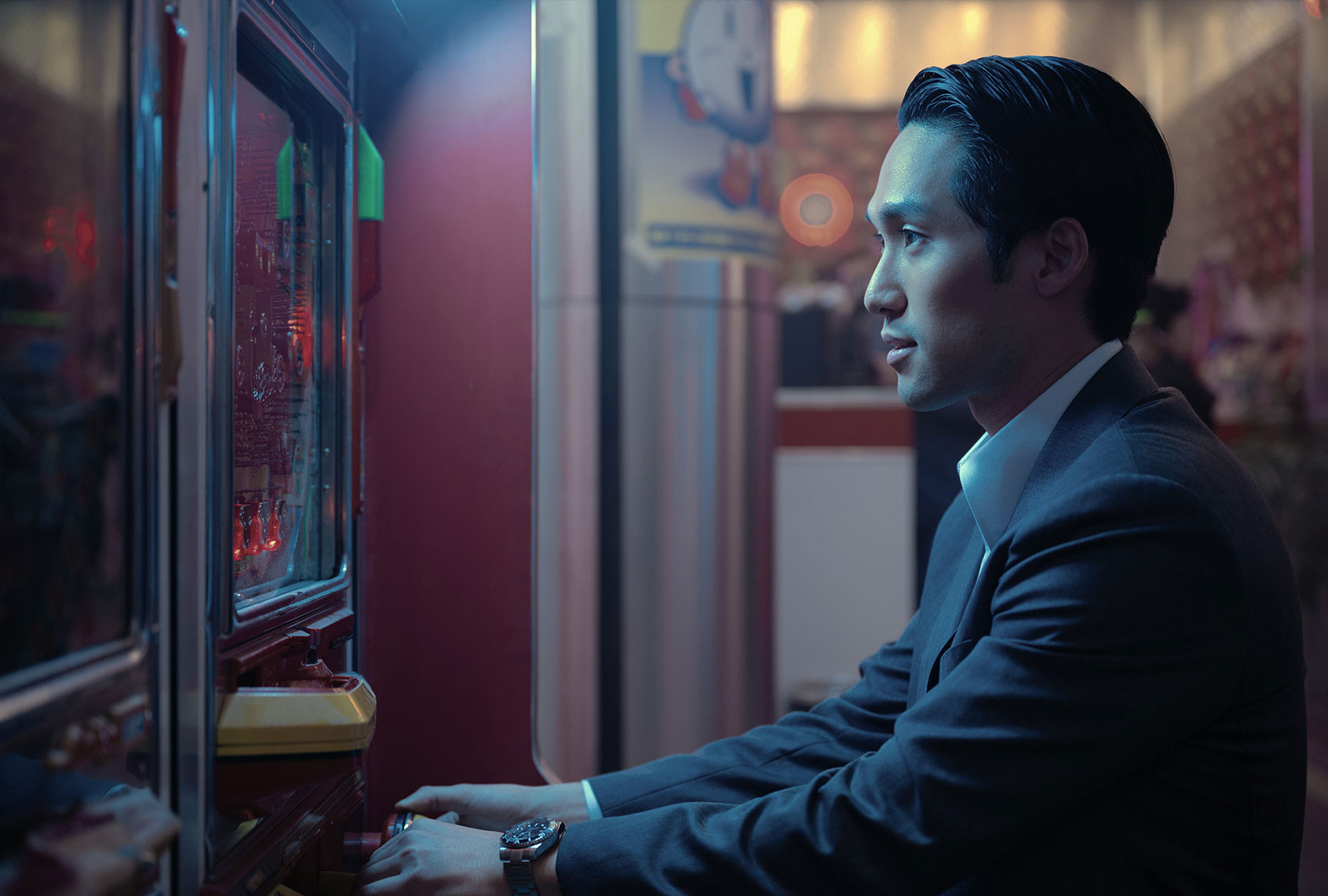
Operating like the game, "Pachinko" bounces between decades, mainly pre-World War II Korea and Japan, and the 1980s, when Sunja's American-educated grandson Solomon (Jin Ha) is focused on closing a career-changing deal at his bank. In that era, his father Mozasu (Soji Arai) provides a comfortable life for Sunja supported by the pachinko parlors he owns – a business that's legal if not entirely viewed as respectable.

Like the game, it's very easy to give oneself over to the unpredictability of where it goes from scene to scene, rolling back and forth through the 20th century. Episodes aren't built around flashbacks, but timelines running in tandem with each other, connected through small choices and interruptions. Hugh rejects the standard broad dramatic sweep in these episodes but gives us the world anyway via an ocean made of moments, each a clarifying drop allowing us to appreciate the ways that one's ancestry travels across generations and through miles of water.

Sunja as a young, uneducated woman in 1920s and 1930s Korea could not fathom the champagne problems her career-driven grandson Solomon deals with. Solomon, as a 20-something battling for his piece of glory in the financial sector, never knew a world where a bowl of rice is a luxury.

PachinkoPachinko (Apple TV+)Time and again through "Pachinko," Sunja's past and her descendants' present align in revelatory ways, crossing oceans of time and memory that, in some moments, Youn physically evokes through simply pausing to allow herself, and the viewer, to sink into the memory of what she's lived that informs her perspective of Solomon's present.

The common nature of Sunja's journey makes "Pachinko" absolutely enthralling. Kim's placid face wears her character's incomparable resilience; she imparts more with her gaze and the subdued tone of her voice than the dialogue alone can say. In the times Chon and Kogonada lock the camera on her as those around her are talking, her silence or a stoic tear tumbling down her cheek are the details that slay the scene.

"It is not a shame to survive," someone tells her in a situation that threatens to make her believe otherwise. Steadily and with sure footing, Kim's performance realizes that wisdom for us.

Youn's Sunja complements this performance, showing her on the other side of a mountain of triumphs and heartaches her young version has yet to travel, and only some of which we see in these hours. Hugh's script makes the most of Youn's talent for finding Sunja's malleability in hard moments, giving her the way of a matriarch who refuses to apologize past circumstances, choose instead to be heard, understood and respected.

Sunja harshly reckons with the long reach of this bigotry and classism in her youth, spent first a Korea colonized by Japan before migrating to Osaka, where Koreans are treated as second-class citizens. Lee Minho's Hansu, a charismatic bureaucrat Sunja first meets in her village, wakes her up to the world's possibilities and its potential cruelties. But Sunja also lucks into relationships with people such as Steve Sanghyun Noh's Isak and Eunchae Jung's Kyunghee, whose kindness staves off any impulses she may have to slide into cynicism.


Want a daily wrap-up of all the news and commentary Salon has to offer? Subscribe to our morning newsletter, Crash Course.


Some of the situations Sunja and her community finds themselves in or the expectations foisted upon her feel similar to my family's assorted personal histories. I suspect this is why so many connected with Min Jin Lee's 2017 novel upon which the story is based; Sunja's history and Solomon's modern frustrations follow live trajectories similar to that of most people.

Colonialism is common enough for many non-white viewers to relate to Sunja's life, but it is just as crucial for "Pachinko" to receive recognition for its heartfelt view of a history with which Western cultures are only familiar from their point of view. 

This is a distinct history about an Asian family moving through three cultures, speaking Korean, Japanese and English (clearly rendered via color-coded subtitles) conveying their experience of discrimination, overcoming and community. It's also a tale with many characters whose stories have only begun to be told. Mozasu is introduced, but much about his life with Sunja hasn't been explored.

PachinkoPachinko (Apple TV+)Another major character receives a full episode devoted to their origin story later in the season, teasing their continued importance in the series' larger arc. In lesser shows their relative lack of development would be a blight. Here, they're among a long list of reasons that this drama deserves a future.

The narrative's refrain reminds us of all the ways that living is a game of chance, and like pachinko itself, every outcome is entirely unpredictable.

This brings us the show's most wonderful constant: a vivid opening credits sequence (seen below) set to The Grass Roots' "Let's Live For Today," where each the main characters rambunctiously dance inside of a polychromic spectacle of pachinko parlor, wearing clothing from their era. There's no clear sense of when this place exists, only that it is where this family won its fortune – mainly by enduring, certainly, but also holding fast to a will strengthened by a woman's lasting love.

The first three episodes of "Pachinko" are available now on Apple TV+ with new episodes premiering Fridays. Watch the opening credits below, via YouTube.

More stories like this:

Rating “The Batman’s” Riddler: Did Paul Dano surpass what’s been done?

When The Riddler was announced as the main villain in Matt Reeves’ “The Batman,” there were Bat fans who were skeptical. It’s not that the Riddler isn’t iconic; he is. But he’s usually portrayed as a purveyor of whimsy, a kind of maniacal trickster who plays second fiddle to the more prominent villains of Gotham City.

The first trailer for the film made it look like an emo punk video on MTV2. So the question was: how would Paul Dano’s Riddler fit in. Obviously, this Riddler wouldn’t be as loud and comic as Jim Carrey’s turn in 1995’s “Batman Forever.” Nor would he don the throwback wardrobe that Cory Michael Smith did to embody a socially awkward Edward Nygma with a split personality on “Gotham.” Those two standout performances are the most recent live-action versions of The Riddler. Dano’s iteration would need to carve out its own lane lest he be unfavorably compared to what came before.

“The Batman,” while it has comedic moments, is a very dark interpretation of Bruce Wayne’s story and Gotham as a whole, and the new Riddler follows suit. He’s more than a pest leaving riddles for Batman to solve; he’s dangerous, a mirror of the real life agents of chaos organizing on the dark web as we speak.

Paul Dano’s Riddler is the “lone wolf'”next door

Unlike the Joker in “The Dark Knight,” Riddler isn’t a man who wants to watch the world burn just to see it go up in flames. He’s a product of a broken system; he’s suffered and wants to spread that pain around to others. Essentially, the Riddler is the lone wolf the news has repeatedly warned the public about every time there’s a shooting or bombing in America.

He’s unassuming, a bespectacled white adult male you’ve passed on the street without looking twice. He’s not an incel, though his followers likely are, and he wants to be noticed. Orphaned and forgotten, the Riddler’s malice is borne of a believe that he’s owed something.

To be fair, the rug was pulled out from under him as a child when the deal Thomas Wayne struck for the city became a funnel for corruption. However, Riddler’s not the only person who’s gotten screwed over by Gotham authorities. And yet instead of trying to make a positive difference, he decides to go on a riddle-based killing spree.

In “The Batman,” the Riddler is clearly a foil to Bruce. While Riddler’s vigilante justice involves murder, he initially only targets those involved in Carmine Falcone’s takeover of the Gotham Renewal Project. But by the time Bruce comes across the villain’s final clue, his scheme has expanded to the entirety of Gotham, which he plans to plunge into chaos.

While Riddler’s plan succeeds, Batman ends up being the hero the city needs. Riddler’s followers, who he’d formed a community with online, are essentially useless, and he’s once again left to his own devices time at Arkham Asylum. Though it’s possible he’s made a friend in Barry Keoghan’s Joker.

How does Paul Dano’s Riddler compare to Jim Carrey and Cory Michael Smith’s?

Dano’s Riddler is right for the times we live in now. Jim Carrey’s was cartoonish and scene-stealing in a way that fit the ’90s. Batman Forever was a comic book movie that didn’t take itself seriously and was meant to be fun.

As for Cory Michael Smith, he got to explore more sides of the character over the course of this seasons-long TV series. “Gotham” gave Edward Nygma a live-action television origin story, one that saw him crossing paths with more than one iconic Batman character.

However, there’s a depth to Dano’s performance that may outshine all previous iterations of the villain. The Riddler is actually terrifying in “The Batman.” We don’t get any of Carrey’s humor or Smith’s fragile humanity disrupted by madness. Dano Riddler is a glass-fogging, vindictive serial killer who finds elaborate ways to murder his victims to create a spectacle. Even when captured, unmasked, and revealed to be mousy, his sinister presence never abates. Sure, he adjusts his glasses with his index finger and looks like Tom from IT, but that’s what makes him so unsettling.

In “The Batman,” Riddler is the man no one would have expected to have committed a crime. Perhaps someone would crack a joke about how you can’t trust the quiet ones, but it wouldn’t be said seriously. Instead, on Gotham City News, they’d say he kept to himself, did his job and went home; we didn’t expect this.

Arguably, that’s the point. Reeves’ Batverse begins with a commentary on government corruption and an indictment of the rich, powerful and ineffective. Riddler is the kind of character who will exploit the faults of society to rile up the masses. And he’s a loner who finds a sense of community among the dregs of society, bringing the story full circle.

“The Batman’s” Riddler is an example of the kind of monster a broken system can create. The duality with which Dano plays him, being a sheep in wolf’s clothing with one hell of a bite, elevates the character. The Riddler has always been fun, but Reeves asks us to imagine him as a nightmare, one that could be having a cup of coffee beside you right now.

The brain’s tendency to see faces that aren’t there may be innate to spiritual experiences

Three thousand years ago, in ancient China, sages stuck red hot pokers into empty turtle shells to study the way cracks developed on the flat side of the shell. Depending on the pattern made by the cracks, the sages would predict the future and speak with the ancestors.

What is the basis for these and other prophetic visions throughout history? Why did Moses see God in the flames of a burning bush and the Greeks hear the voice of Zeus in the wind of the sacred oak tree of Dodona? When people close their eyes to pray or meditate, whose voices are they hearing? 

Cognitive scientists of religion have been trying to answer these questions since the 1980s. They call these practices of finding meaningful patterns in visual information “pareidolia.” Seeing faces in the clouds, animal shapes on tree trunks, and hearing voices in noise are more mundane examples of pareidolia. Unfortunately, scientists have tended to reduce these phenomena to a sort of cognitive short circuit. This is partly because the first scientist to use the term, German psychiatrist Karl Ludwig Kahlbaum, defined it negatively as “delusions of the judgment” caused by “imperfect perception.”

The negative connotation stuck. For instance, in 1995, Carl Sagan, the American cosmologist, argued that pareidolia is an evolutionary adaptation to recognize faces and shapes in poor lighting. When we “fail,” we see things that aren’t there, and this is called pareidolia. Other scientists argue that pareidolia is the result of a natural human tendency called “anthropomorphism” to project human-ness or animacy onto the inanimate world.

Psychologists still treat pareidolia as a clinical pathology or psychosis to see things “where they do not actually exist.” In short, scientists have largely dismissed or tried to explain away religious, supernatural, and aesthetic experiences of pareidolia rather than take them seriously. 

But let’s consider at least one plausible and much less pejorative story about pareidolia. What if it is not a cognitive failure? What if pareidolia images really are there in a different and significant sense? Indeed, what if, thought broadly enough, every pattern that humans have ever found has come to us through some version of pareidolia?

When we see culturally and historically agreed upon pareidolia, we call it “reality,” but when we see patterns made by nature or ones where other people cannot verify them, these are “illusions.” But what would we be missing if artists and scientists had not “seen” patterns no one else had before, like the double helix structure of DNA or the marvelous vortices drawn by Da Vinci and painted by Van Gogh? Humans create culture based on agreements and disagreements over which patterns of pareidolia are real or not. Is there really a face on Mars? Is the big dipper really there? If our shared beliefs and practices involving them are real then yes, in a sense, they really are there.


Want more health and science stories in your inbox? Subscribe to Salon’s weekly newsletter The Vulgar Scientist.


In other words, pareidolia is not a failure but a source of enormous cultural innovation, even if some patterns do not catch on. For example, scientific studies show that artistic, musical, and religious people tend to see more pareidolia than others. Perhaps the negative interpretation of pareidolia as error has more to do with the scientific desire for quantifiably true and false patterns than the phenomenon itself.

But here is the central question left unanswered by most scientific attempts to explain the experience of pareidolia. Why do people experience the patterns as aesthetically and even spiritually meaningful? Indeed, the German psychiatrist Hermann Rorschach’s famous inkblot tests were based on trying to understand just this. But if Carl Sagan is correct, and pareidolia is just a mistake, people should quickly realize their perceptual error and adapt to reality. But instead, the opposite happens. People often treat pareidolia as evidence of prophecy, epiphany, beauty, joy, insight, and even God. Obviously, not all do, but unless we are willing to chalk these experiences up to madness, stupidity, or some unexplained tendency to anthropomorphize, we need another explanation. 

Let’s start with what we know. Studies show that people tend to see more pareidolia in fractal patterns compared to non-fractal patterns. A fractal is an iterative pattern that looks similar across scales, like a tree whose forking pattern repeats in its branches, twigs, and leaf veins. In this kind of natural fractal, each leaf looks like a tiny version of the whole tree. Many natural phenomena, like rocks, mountains, clouds, rivers, plants, trees, animal coloration, waves, and wind, can have similarly fractal patterns.

Furthermore, we know that “nature is traditionally fundamental to divination, whose indigenous metaphorical roots remit to natural phenomena such as stones, water, and animal behaviour,” as anthropologist Patrick Curry writes. The cracks in turtle shells, for example, and the distribution of tea leaves in the bottom of a cup exhibit fractal patterns. Most recorded visions of gods also occur in natural or fractal patterns such as fire, trees, clouds/smoke, or some combination of natural fractal patterns. When people close their eyes and sit still in prayer or mediation, the fractal structure of their spontaneous brain activity enters a slower “alpha” state. This slow state is associated with mind-wandering and creative association or “cognitive pareidolia,” as our thoughts play among the fractal background brain activity. Fractal patterns are also easy on the eyes, endlessly fascinating to see and hear and even inspire feelings of beauty.

RELATED: Most brain activity is “background noise” — and that’s upending our understanding of consciousness

Could there be some connection between fractals and pareidolia? Indeed, it seems that fractal patterns are at the heart of pareidolia, and pareidolia is at the heart of our artistic, scientific, religious, mythological, and even paranormal imagination.

Yet still, in the case of religion in particular, why should fractal pareidolia occasion such spiritual or prophetic meaning? This may be why: Nature uses dynamic fractal patterns across every scale of reality from the distribution of dark matter to the growth of slime mold, including our bodies and brains.

So in the play of pareidolia, we are doing what the world is doing more generally. And this experience is what can occasion feelings of interconnection with the world at the heart of many spiritual sensibilities. It may also suggest a predictive or prophetic intuition about how such patterns will develop, since fractals look similar across scales.  

This, of course, is only a very general source of religious experience. Every fractal pattern and dynamic has a unique cultural, historical, psychological, and geographical context. So not all pareidolia is experienced as religious. But many different explanations, experiences, and religious experiences can emerge from it. Some call religious experience occasioned by pareidolia unity, others plurality. Some might call it God or gods or perhaps aliens, or pure consciousness.

My point here is that at some level, not necessarily consciously, pareidolia reminds us of our interconnection with the world whose fractal patterns and dynamics we use in our bodies and minds to experience that same world. Pareidolia often occasions the feeling that we are not separate from nature, but woven into it.

In short, pareidolia is not a cognitive failure and should not be used to dismiss religious experience. Indeed, pareidolia may be at the heart of all our ways of knowing, not just religious ones. 

Read more from Thomas Nail on consciousness and neurology:

Costco’s instant boba tea is basically magic

In many major cities in the U.S., the fastest way to get boba tea requires simply walking out the door — these days, shops serving the tapioca-sphere-filled plastic cups crowd in alongside Starbucks and Dunkin’ to fight for the country’s drink dollars. But for those times when putting on pants seems too big an obstacle, or for folks that live too far from the rapid proliferation of Taiwanese-style tea shops, Costco offers a solution: instant boba tea. Naturally, I had to try it.

Called Taiwan Boba Milk Tea and made by the company J Way Foods, the Costco pack includes enough boba and flavor pouches to make 10 cups of tea and costs $14.79. The cost works out to about $1.50 per cup, making it a significant savings over buying the drink in a shop, where they usually start at almost three times that.

To prepare the instant boba tea, you microwave the boba inside the plastic packaging for about 20 seconds. Then, for most of the drinks, you empty the flavored powder into two ounces of hot water and mix. Following that, add ice and cold water or milk before adding in the boba themselves. The pack even includes an oversized boba straw, which completes the experience.

The ten-pack includes passionfruit–pineapple green tea with fruity boba, crème brûlée milk tea with caramel boba, classic milk tea with brown sugar boba, and taro milk tea with brown sugar boba. Each cup tastes nearly exactly like the advertised flavor, and the boba plumps up nicely and softens to a pleasant chewiness in the microwave.

It might not have perfectly replicated the tea shop experience, but it came darn close at a fraction of the cost — especially since my kids couldn’t tell the difference at all. Of course, if you don’t live near a Costco, either, you can purchase the tea on Amazon or Walmart at slightly different prices — or enjoy a DIY home boba experience instead. The path you choose may take more than 20 seconds, but you’ll be rewarded no matter what.

Szechuan Sauce, the cult-favorite condiment of “Rick and Morty” fans, returns to McDonald’s

Last week, McDonald’s posted a cryptic tweet, “U should text me about the next sauce drop.” Beneath the caption was a graphic with the phone number 707-932-4826.

People who texted the number received a photo of a box of sauce packets covered with gold film. When lined up in the correct order, they spelled out the word “Szechuan.” (Observant internet sleuths also pointed out that the phone number spelled out 70S-ZEC-HUAN.”) 

On Monday, the fast food giant made it official, announcing via a press release and social media posts that Szechuan Sauce would be returning on March 31. 

“hi from Szechuan Sauce, say it back,” McDonald’s tweeted

Related: How McDonald’s Szechuan Sauce went from a “just fine” ’90s relic to a riot-causing cult condiment

Szechuan Sauce was originally released in 1998 as a promotional tie-in to the Disney movie “Mulan.” It was a dark brown nugget sauce with a touch of acid from the addition of apple cider vinegar and a little nuttiness from roasted sesame oil. This distinguished it from the chain’s OG Sweet and Sour McNuggets dipping sauce.

It was a fine condiment but unassuming enough that there wasn’t much outcry when the chain pulled it from their franchises after the month-long promotion. For almost two decades, Szechuan Sauce was simply a relic of McDonald’s past, such as the McPizza or McSalad Shakers. Then the third season of the adult animated show “Rick and Morty” debuted in April 2017. 

In the first episode, “The Rickshank Redemption,” one of the series’ main protagonists, Rick Sanchez, revisits a memory of going to a McDonald’s drive-thru and ordering Chicken McNuggets with Szechuan Sauce. By the end of the episode, Rick reveals that his only goal in life is to find more of the sauce. He’s not motivated by saving the world or his family, or well, anything other than “that McNugget sauce. I want that ‘Mulan’ McNugget sauce, Morty. That’s my series arc, Morty! If it takes nine seasons!” 

Viewers of the show, which had a cult following of its own, began petitioning McDonald’s to bring back the sauce. McDonald’s acknowledged fans by sending “Ricky and Morty” creator Justin Roiland a four-pound jug of Szechuan Sauce found in “Dimension C-1998 . . . a dimension where it’s always 1998. 1998 every day. No smartphones, no social media. It’s a weird, scary place. But they’ve got Szechuan Sauce on the regular menu.” 

Finally, in October 2017, the chain decided to do a one-day promotion centered around the sauce — and it was an unmitigated disaster. There were riots, an alleged stabbing and lots of angry customers. You can read more about this in the Salon Food archives.

A few months later, to rectify the situation, McDonald’s revived the sauce, with an estimated 20 million portions distributed to locations across the U.S. Reviews were mixed — there was a lot of talk of it tasting like soy-flavored corn starch — and Szechuan Sauce eventually rolled off of the chain’s menu offerings again. 

When it returns on March 31, it will be only the fourth time that Szechuan Sauce has been available in McDonald’s history. Will it be better this go around? Who’s to say — though I’m sure the Ebay sauce collectors will start lining up early. 

More saucy stories about condiments: 

Women prohibited from flying without male “guardian” in Afghanistan

Dozens of women attempting to board domestic and international flights out of Kabul’s international airport were turned away today for not having a male “guardian” with them.

According to The Associated Press, two airline officials who asked to be kept anonymous fearing repercussions from the Taliban said that some of the women attempting to board flights were dual nationals trying to return to their homes overseas.

Related: Congressmen defend clandestine trip to Afghanistan: “We needed to see for ourselves”

The anonymous airline sources say that the order to deny women independent flight access was handed down directly from Taliban officials. 

This new move against women is the second step made by the Taliban in relation to travel restrictions. Last month the Taliban banned women from traveling further than 48 miles without a male guardian. Other restrictions have been put in place, just in the month of March alone, forbidding Afghan women from taking a taxi, entering a government building, or seeing a doctor without being accompanied by a male guardian, according to The Wall Street Journal

“Their [the Taliban] mobile patrol is constantly coming to hospitals in our district to see if there are female patients without male guardians,” said Fahima, a doctor in Ghazni.

Fahima went on to say that she was unable to treat a woman who came in by herself, suffering from pregnancy complications; and another who was suffering from a gynecological issue.

“I had to turn them away,” said Fahima to The Wall Street Journal. “I didn’t have a choice …They threaten us, they tell us that if we treat a woman without a male guardian they will beat us up.”

This tightening on the basic rights of women in Afghanistan comes in conjunction with the Taliban going back on a previously stated promise to allow girls to continue education past the sixth grade. 


Want a daily wrap-up of all the news and commentary Salon has to offer? Subscribe to our morning newsletter, Crash Course.


Read more:

The best and absolute worst onscreen first periods, from “Carrie” to “Turning Red”

Periods are many things: messy, emotional, annoying, normal. And yet periods are at the center of a controversy revolving around Pixar’s animated film “Turning Red,” which depicts 13-year-old Meilin Lee who transforms into a huge red panda when experiencing heightened teenage emotions — a not terribly subtle metaphor for the bodily discomfort preteens experience during puberty. 

And for some reason, people had a problem with it. Parents took to Twitter to complain that the movie’s content was too mature for children to view. One critic argued that parents would have to answer one too many questions after their children viewed the film. And The Federalist griped that “if you aren’t a progressive-leaning teenage girl or suffering from 2000s zombie nostalgia, then this film isn’t likely for you.” It seems odd to be vexed about a phenomenon as universal as adolescent puberty. 

Of course, it’s not just puberty that they’re objecting to, but menstruation specifically. After all, the “Teen Wolf” franchise and similar projects have often explored the physical coming of age through fantasy storytelling. What’s significant is that the “Turning Red” debate speaks to the general underrepresentation of menstruation in Hollywood. Rayka Zehtabchi, the director behind the 2019 Oscar-winning Netflix documentary short “Period. End of Sentence.” found that the best way to spark dialogue around menstruation is through storytelling.

RELATED: How the red panda became the face of cute rebellion, from “Turning Red” to “Aggretsuko”

But what is the quality of that storytelling? As the furor over “Turning Red” reveals, periods – especially the first ones that a pubescent child experiences – are not widely embraced as acceptable on our screens. Or, when they do show up, they’re depicted with an air of secrecy, shame or straight-up horror. What kind of messaging is that?

Despite the naysayers, the depictions of periods have improved greatly over the years, but that hasn’t always been the case. Salon reflects on the effectiveness of portrayals throughout film and TV history of characters who get their first period (aka menarche) on screen — the good, the bad and the very ugly. 

“Carrie” (1976)

The scene: In the chilling 1976 adaptation of Stephen King‘s novel, timid teen Carrie (Sissy Spacek) begins unleashing supernatural powers in response to abuses she suffers by her mother and classmates. Her first period marks the beginning of her unraveling. As bright red blood streaking her hands and legs, Carrie shrieks and huddles naked in a dirty gym locker room as jeering female classmates hurl tampons at her, screaming, “Plug it up!” Even her teacher commands, “Stand up and take care of yourself!” and slaps her. By the end of the film, having Carrie drenched in pig’s blood is a visual reminder of the blood that started it all.
Verdict: Directed by Brian De Palma and written by Lawrence D. Cohen, the scene became one of the best known depictions of a menstrual cycle in popular culture. Thanks, guys! Yet its shock value rests on painting Carrie’s period as alien and crude — the source of Carrie’s discomfort in her body. It also inextricably intertwines menstruation with brutal social humiliation and the onset of malevolent women’s powers. 

“The Blue Lagoon” (1980)

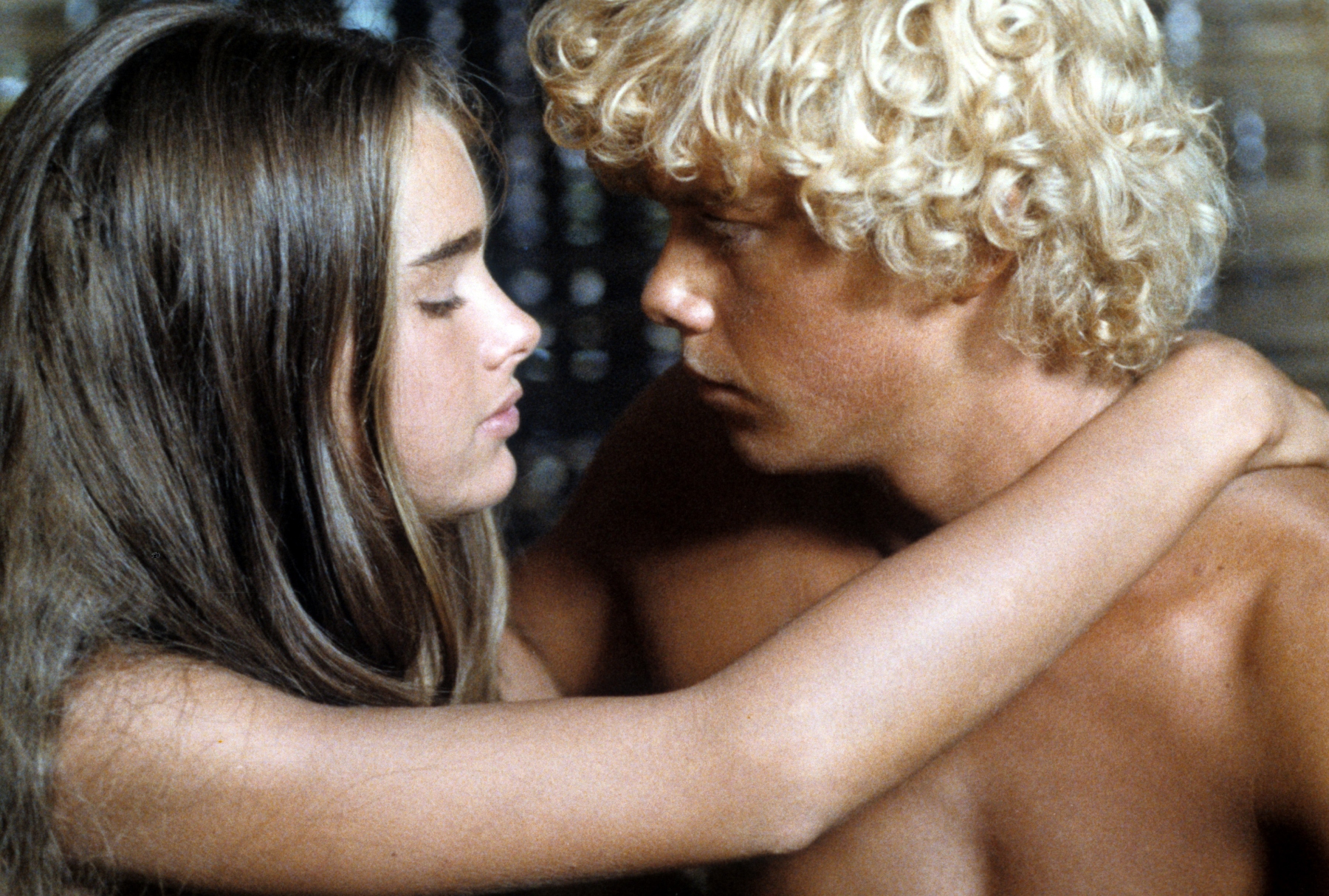
Brooke Shields and Christopher Atkins in “The Blue Lagoon,” 1980 (Columbia Pictures/Getty Images)The scene: Years after a shipwreck leaves young cousins marooned on a tropical island, a teenage Emmeline (Brooke Shields) wades in the waters of an idyllic waterfall, her long hair gracefully tumbling down her torso. It’s a vision of paradise . . . until she looks down at her bloody hands and screams in terror. “Go away, don’t look at me!” she cries to Richard (Christopher Atkins), who is brimming with naive concern. “Em, people don’t bleed like that unless they’ve cut themselves.” Emmeline is mortified, Richard is clueless, and if that doesn’t sum up both puberty and your first preteen relationship, I don’t know what does. 

Verdict: Cut off from human civilization, menstruation seems a freak phenomenon to Emmeline and Richard. The fumbling conversation is the only nod the film makes to Emmeline’s period, and next thing we know, she’s pregnant. From male director and writer duo Randal Kleisler and Douglas Day Stewart, “The Blue Lagoon” is not the film to watch to gain a realistic grasp of a menstrual cycle and its significance. 

“The Cosby Show” (Season 7, Episode 9 – 1980) 

The scene: In “The Infantry has Landed (And They’ve Fallen Off the Roof),” the adorably matter-of-fact Rudy (Keshia Knight Pulliam) gets her period. And in contrast to the horrific embarrassment portrayed in “Carrie” or “Blue Lagoon,” Rudy’s period is treated as a glorious passage through the gates of womanhood. “Just think Rudy, you’re the first one in our group to get it,” her friends whisper conspiratorially in Rudy’s bedroom. “You even look a little more mature.” “Well, I did feel a little older walking home from school today,” Rudy responds, tilting her chin upward with an air of pretension. “Don’t worry, you’ll get yours soon.” 
Verdict: “The Cosby Show” acknowledges the existential anxiety one experiences before their first cycle (“My sister’s friend knew somebody and when she got her period she was so weak, she had to be carried around in a stretcher for three months,” Rudy’s friend warns) while comically poking at its absurdity. For Rudy, her period is a bragging right, something she can use to inform her less-experienced gang of thirteen year old friends. The episode offers a refreshing, confident response to menstruation. 

“My Girl” (1991)

The scene: Eleven-year-old Vada Sultenfuss (Anna Chlumsky) is on the cusp of a summer of firsts — first crush, first kiss, and yes, first period. “Oh my god!” she screeches upon discovering she’s bleeding. “I’m hemorrhaging.” A young Jamie Lee Curtis gives a solemn talk about sex and periods to a comically incredulous Vada. “It’s not fair; nothing happens to boys,” she says, casting a disgruntled look toward the ground. When her best friend Thomas (played by a mini Macaulay Culkin), comes knocking with an ill-fated request for play-time, she shoves him to the ground. “Don’t come back for five to seven days!” she exclaims, slamming the door.
Verdict: From writer Laurice Elehwany, the film’s depiction of menstruation is endearing if unhelpful. It falls into the common period trope of the embarrassed young girl’s sudden bodily shame accompanied by her clueless male counterpart. 

“Degrassi” (Season 1, Episode 9 – 2002) 

The scene: In “Coming of Age,” Emma (Miriam McDonald) gets her first period while she’s wearing a white skirt. Oops! As a Hail Mary, she swaps out borrowed too-large gym shorts that keep slipping down. As the preternaturally confident Emma marches to the front of the class – with best friend Paige (Lauren Collins) holding up the shorts for her – she delivers a book report to an audience of jeering preteen boys. “Ahhh did Emmy pee her pants?” they leer. “No, I just got my period for the first time,” Emma replies with a cutting sweetness. “Menstruation, you may have heard of it. Happens to, oh, 50% of the population. Perfectly natural, nothing to be ashamed of.” Mic drop. 
Verdict: If only I had the confidence at 13 to own my period in shorts dangerously close to ending up in a pool around my ankles to a class full of callous boys! That’s why these sorts of depictions are so important. The period-confident script owes its brilliance to a team of two females and one male writer: Linda Schuyler, Yan Moore and Susin Nielsen. 


Want a daily wrap-up of all the news and commentary Salon has to offer? Subscribe to our morning newsletter, Crash Course.


“Game of Thrones” (Season 2, Episode 7 – 2012) 

Game of ThronesSophie Turner as Sansa Stark in “Game of Thrones” (HBO)The scene: In “A Man Without Honor,” Sansa’s period comes as something of a nightmare – literally. After a dream in which she is dragged by her feet and stabbed by a mob of angry men, Sansa (Sophie Turner) awakens in a pool of her own period blood and begins frantically slashing at her stained sheets with a knife. “Flowering,” as it is called in Winterfell, means that Sansa, now able to get pregnant, might be forced to wed sadistic bully Prince Joffrey. “I thought it would be less messy,” Sansa admits to Queen Cersei (Lena Headey). “You’re a woman now,” Cersei replies. “Do you have any idea what that means?” 
Verdict: Sansa’s period is a horrific experience – a medieval rite of passage forcing her to marry and bear children without her consent. One can only hope their period experience is a step up from Sansa’s. While we may think of this as an archaic point of view, it isn’t in some societies. For a show that dealt in power plays and imbalances, this is the first of many for the women of Westeros and beyond.

“Big Mouth” (Season 1, Episode 2 – 2017) 

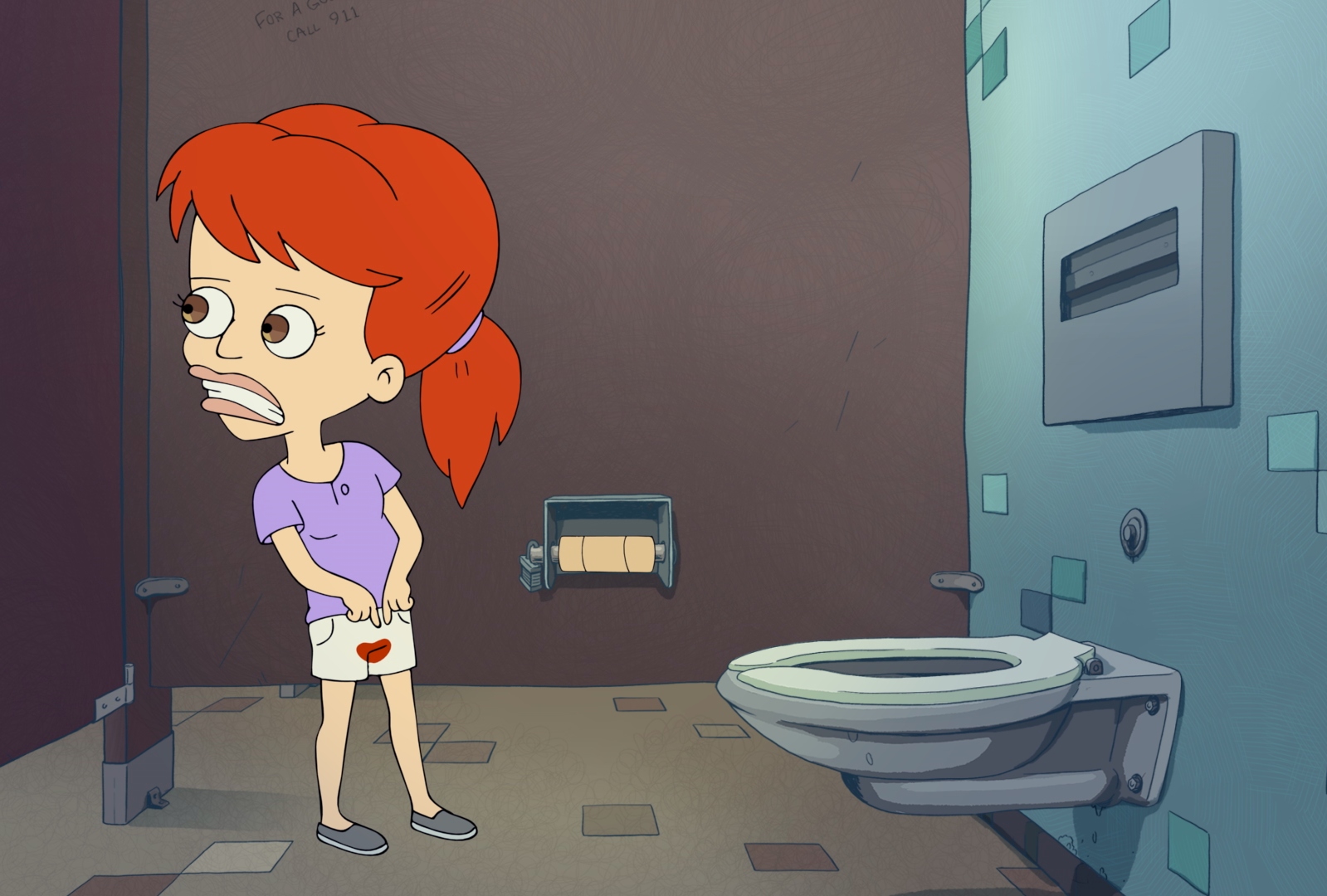
Jessi gets her period in “Big Mouth” (Netflix)The scene: In “Everybody Bleeds,” Jessi (voiced by Jessi Glaser) gets her first period while visiting the Statue of Liberty. As she bends and peers between her legs to witness the bright red blotch expanding on her white shorts, she says what just about anyone would in that situation: “I just got my first period in the f**king Statue of Liberty!” A series of unfortunate events befalls her next: empty toilet paper rolls in the public restroom and a disgusted Andrew (voiced by John Mulaney) vomiting in response to her confession. Eventually he helps her out and buys her a commemorative 9/11 towel for her to wear in lieu of her soiled shorts. Bonus young period content: Three seasons later, Jessi is still navigating her period as she learns to use tampons at camp.
Verdict: “Big Mouth” sums up the righteous indignation one feels upon discovering, as Jessi eloquently phrased it, “blood is coming out of my vagina!” And as we’ve seen time and again, the lack of plentiful period products puts menstruating folks in a position of embarrassment and possibly relying on others. Writer Kelly Galuska earns an A+. 

RELATED: How period humor is changing the world

“Black-ish” (Season 4, Episode 6 – 2017) 

The scene: In “First and Last,” a brave Diane (Marsai Martin) is the first person in her class to get her period and is forced to change into sweatpants sourced from the lost and found. In flashback,  we see how her family’s matriarchs navigate the period talk with their daughters.  First, Ruby Johnson (Jenifer Lewis) gives Rainbow (Tracee Ellis Ross) the “talk” in full shaman garb, blowing a horn and proclaiming, “May the sacred flow of your menses topple the patriarchy and bind you to the goddess!” Years later, Rainbow’s talk with Zoey (Yara Shahidi) is a bit more, well, clinical. “This is a beautiful thing honey,” she says, pointing to an anatomical screen display. “Your uterine lining is decaying and then sloughing off and then turning into blood as it moves out of your vaginal canal.” Zoey looks on in horror.  
Verdict: Written by Laura Gutin Petrson and directed by Linda Mendoza, this episode of “Black-ish” reflects the challenges of mother-daughter dialogue during a formative period and conveys the ways in which generational understanding of gender roles and femininity inform these conversations.

“Baby-Sitter’s Club” (Season 1, Episode 8 – 2020)

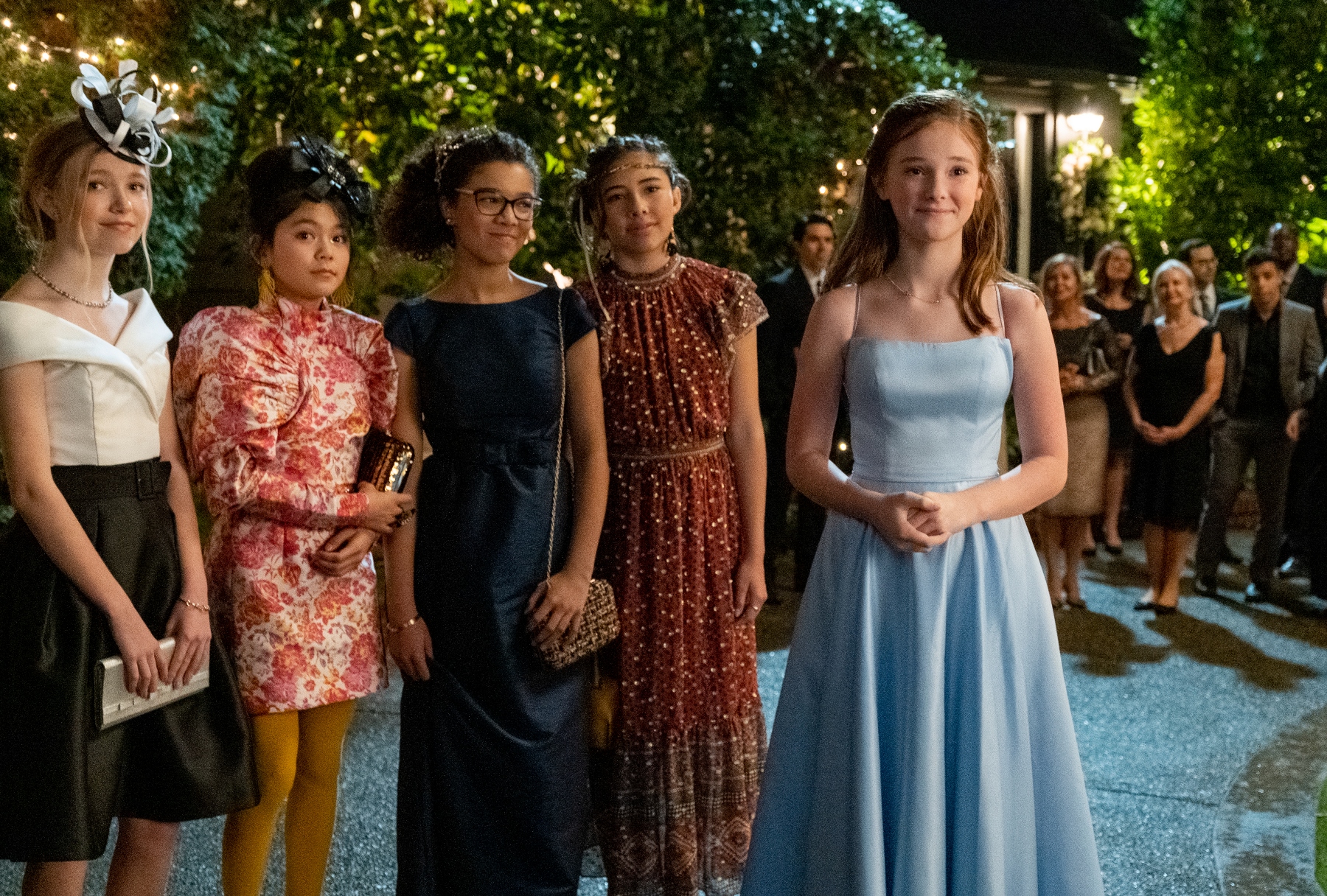
Shay Rudolph, Pomona Tamada, Malia Baker, Xochitl Gomez and Sophie Grace in “The Baby-sitters Club” (Liane Hentscher/Netflix)The scene: On “Kristy’s Big Day,” Kristy (Sophie Grace) receives the full support of her friend group as she faces her first period at a rather inopportune moment – her mother’s wedding, already riddled with tension as Kristy negotiates her role in her mother’s changing personal life. As Kristy rushes to the bathroom, lifting her light blue dress in frustration, her friends crowd outside. “It’s natural,” they whisper, passing her a pad through the cracked door. “We’re your friends, and this is a big moment.”

Verdict: The series portrays companionship in what could have devolved into a moment of isolation and confusion for Kristy. The woman-produced and directed series infuses warmth and a sense of belonging, not alienation and isolation, into its depiction of menstruation. 

“PEN15” (Season 2, Episode 5 – 2020) 

Maya Erskine in the “Sleepover” episode of “PEN15” (Erin Simkin/Hulu)The scene: In the sleepover from hell Maya (Maya Erskine), wearing a scarlet hoodie of course, gets her period and stuffs toilet paper in her underwear to trap her flow of blood. Not willing to tell her friends what’s going on, throughout the night she sneaks off to her host’s bathroom to refortify her toilet paper shield. The anxiety of getting caught is reflected in a sinister scene in which the group of girls lock Maya in the bathroom and force her to play Bloody Mary as lights flicker on and off and streams of blood seep out of a creepy mask on the bathroom wall. When Maura (Ashlee Grubbs) pulls Maya’s pants down in a sadistic form of preteen punishment, the secret is officially out. The girls toss around the makeshift pad screaming bloody murder. “Ew! Is that what you use for a pad?” Maya appears on the verge of tears. “Okay you guys are being really mean,” she says with a heartbreaking pang of embarrassment. “It’s my blood.”
Verdict: Series co-creators Maya Erskine and Anna Konkle do a wonderful job encapsulating the disorienting embarrassment of adolescence and the strain it puts on even the most innocuous of childhood get-togethers. Their depiction of menstruation intentionally verges on the absurd — I can only hope no one is getting pantsed while on their first period – to play on our greatest teenage fears of humiliation, especially regarding menstruation.

“The Queen’s Gambit” (Season 1, Episode 2 – 2020) 

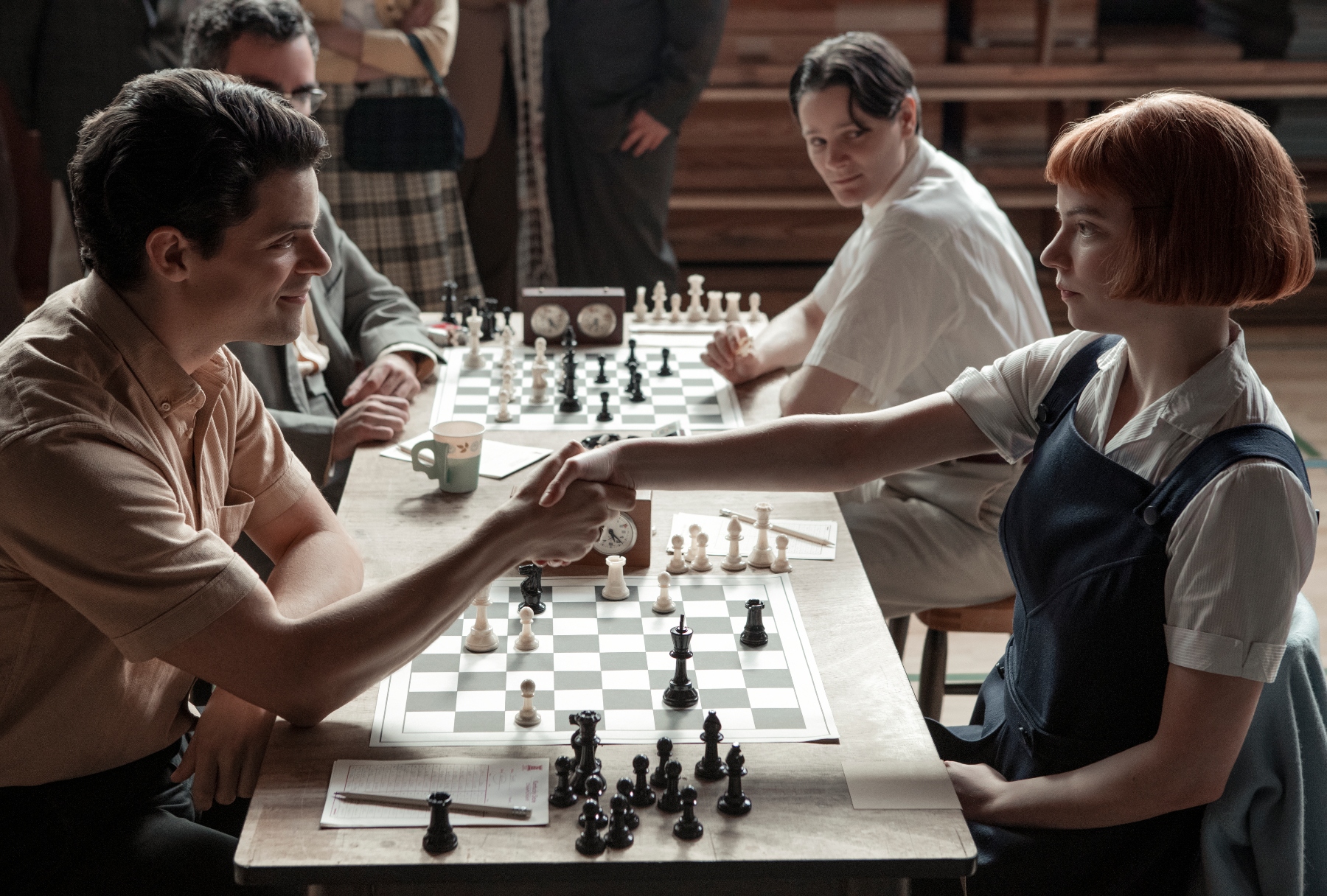
Jacob Fortune-Lloyd and Anya Taylor-Joy in “The Queen’s Gambit” (Phil Bray/Netflix)The scene: A pensive Beth (Anya Taylor-Joy) feels a stabbing pain in her abdomen while competing at a chess tournament. As she runs to the bathroom, she discovers a stream of blood flowing down her leg. An empathetic teenager in the bathroom gives her a tampon — a foreign contraption to Beth, who sticks with the classic faux toilet paper pad. Beth is visibly uncomfortable speaking about the ordeal afterwards. “I just thought . . .” she trails off, “Thought I was sick.” She makes a swift exit from the bathroom. 

Verdict: The limited series created and written by a man mystically connects Beth’s period to other coming-of-age firsts like her first tournament win and first crush. It’s both a little too neat and convenient while simultaneously confirming periods to be a taboo source of shame, spoken in hushed tones even in the bathroom. It’s hard not to grow tired of the narrative; though set from 1958-1968, perhaps the attitude is more of its time. 

“Creamerie” (Season 1, Episode 4 – 2021)

The scene: In this dark and delightful Kiwi comedy set in a future where men have died off from a virus, friends Alex, Jaime and Pip (Ally Xue, J.J. Fong and Perlina Lau) attend Syncfest – an annual celebration of menstruation – that includes the Menstrual Cycle ferris wheel, Mooney the menstrual cup mascot, and best of all, a Menarche Tent where a young person’s “first bleed” is congratulated and feted with a gift bag, including a complimentary hot water bottle. Score!
Verdict: This is the sort of celebration and everyday, transparent treatment that menstruation should have in our real world, instead of teaching young folk that their bodies are scary, foreign or shameful. Imagine what such an open dialogue would do for everyone, such as banishing misconceptions about periods emanating from the butt. Plus: free tote bag!

“Turning Red” (2022)

Mei confronts her new image in “Turning Red” (Disney/Pixar)The scene: Thirteen-year-old Meilin Lee (voiced by Rosalie Chiang) walks in the bathroom one morning and shrieks in terror. “Did the red peony bloom?” her mother asks, armed with a slew of pads and a hot water bottle outside the door, prepared for her daughter’s first period. However, Mei’s problem is that she’s turned into a giant red panda. “I’m a gross red monster! Don’t look at me!” she yells. Throughout the film we see Mei navigate her new normal, hulking out into a red panda each time her emotions run high and trying to understand the parameters of her new body. Yep, that’s puberty and the messiness that comes with it — hormones, periods, body hair and the general experience of one’s body changing beyond one’s control. Yet Mei learns to play her red panda’s vulnerability as a strength. “We’ve all got a messy, loud, weird part of ourselves hidden away,” she muses at the end of the film.
Verdict: Directed by Domee Shi, the first woman filmmaker with sole directing credit on a Pixar feature, “Turning Red” offers an imaginative glimpse into a complex dynamic between a mother and daughter as Mei Lee navigates the myriad of emotions that come with panda puberty. The film is also unabashedly embraces the weird ways that young desire manifests into fandom worship, crushes and really bizarre (but amazing) fan fiction and art.

More stories to read:

Russia’s holy war: Vladimir Putin, Pope Francis, the Virgin Mary and the fate of Ukraine

On Friday evening in Rome, a century-old prophecy was fulfilled, at least in the eyes of some Catholics. At the Vatican, Pope Francis led a prayer for peace in Ukraine, along with a call to free the world “from the menace of nuclear weapons” and a request for forgiveness for humanity having “forgotten the lessons learned from the tragedies of the last century, the sacrifice of the millions who fell in two World Wars.” That’s not a surprising appeal from a religious leader who has spent weeks trying to intercede in the bloody war underway in Eastern Europe. More specifically though, the pope’s prayer consecrates Ukraine and Russia “to the Immaculate Heart of Mary” — a reference to the purported apparition of the Virgin Mary before three Portuguese children in 1917, which has become a touchstone to many conservative Catholics ever since.

It’s heavy inside-baseball to get into what the consecration means, and why it’s causing  consternation among some of Francis’ fiercest critics. But taking a step back, the pontiff’s prayer also amounts to a religious intervention in a conflict that has been widely described as a religious war. 

Holy Mother Russia

The religious undertones of Vladimir Putin’s war against Ukraine were evident before his troops ever stepped across the border. In his pre-invasion speech on Feb. 21, Putin declared, “Ukraine is not just a neighboring country for us. It is an inalienable part of our history, culture and spiritual space.” The people living in Ukraine’s contested eastern regions, he argued, had long considered themselves “Russians and Orthodox Christians.” 

In part, Putin was appealing to the history of the Russian Orthodox Church, which traces its birth back to the 10th Century, when the head of the medieval kingdom of Kievan Rus converted to Christianity in Crimea and subsequently declared his faith the state religion. In 2014, Putin justified his invasion of Crimea partly on these grounds, calling the peninsula “sacred” ground for Russians.

RELATED: Putin’s endgame: Will it be stalemate, nuclear war — or regime change in Moscow?

In service to this mythology, in 2020 Putin oversaw the construction of a new Orthodox cathedral dedicated to Russia’s military and celebrating the annexation of Crimea, and initially intended to include frescoes of both Josef Stalin and Putin himself. 

In justifying the 2022 invasion, Putin has invoked a broader version of this narrative, often known as “Russkiy mir” (“Russian world”) or “Holy Russia,” which lays out a Manifest Destiny-like vision of Russian empire, encompassing Ukraine and Belarus, and perhaps also Moldova and Kazakhstan, as well as other Russian people around the world.  As Daniel Schultz notes at Religion Dispatches, the ideology behind “Russian world” is akin to the Nazi veneration of “blood and soil”: an ethnically-defined religious nationalism, in which Moscow serves as the imperial “administrative center” and Kyiv, the wellspring of the majority faith in both countries, “its spiritual heart.” Russian world is “further held to be unified by a common language, a common church (the Russian Orthodox Church, Moscow Patriarchate) — and a common political leader: Vladimir Putin,” Schultz writes. Against that holy empire stands the corrupted West, with its secularism, liberalism and LGBTQ Pride parades. 

Over the last decade, Jack Jenkins writes at Religion News Service, Putin has increasingly intertwined the Russian Orthodox Church, suppressed under Communism, with his new sense of Russian identity: “Fusing religion, nationalism, a defense of conservative values that likens same-sex marriage to Nazism” with the vision of  “Russkiy mir.” 

In that quest, he has worked hand-in-hand with the Russian church’s leader, Patriarch Kirill of Moscow (alleged to be, like Putin, a former KGB officer). At the outset of the invasion of Ukraine, Kirill offered a tepid appeal to avoid civilian casualties. He soon grew more strident, and by that weekend was calling on God to “preserve the Russian land,” which, he specified, meant “the land which now includes Russia and Ukraine and Belarus and other tribes and peoples.” 


Want a daily wrap-up of all the news and commentary Salon has to offer? Subscribe to our morning newsletter, Crash Course.


In 2019, Kirill also referred to Ukraine as part of his patriarchate’s “canonical territory.” That claim came in response to a move by a subset of Ukrainian Orthodox churches to break away from the Moscow Patriarchate and affiliate instead as an independent church under the Ecumenical Patriarchate of Constantinople, recognized as an authoritative body among the world’s numerous Orthodox configurations. This ecclesial divorce represented a second declaration of Ukrainian independence from Russia in the last decade, following the 2014 “Maidan revolution” that deposed President Viktor Yanukovych, a Putin ally. 

Since then, the Orthodox world has been marked by a number of divisions. There’s a break in communion ties between the Moscow and Ecumenical Patriarchates, and the Moscow church has tried to establish a beachhead in various African countries to compete against other Orthodox branches. There are now two separate Orthodox communions within Ukraine: one following Moscow, and one answering to Kyiv. (In his pre-war address, Putin also embraced a mission of saving the Moscow-affiliated church from alleged Ukrainian plans to destroy it.) 

Since the invasion, however, both branches of the Orthodox church in Ukraine have condemned Russian aggression, and across the world the war is dividing the faith. One Russian Orthodox church in Amsterdam declared it would no longer commemorate Kirill at its weekly worship services. That led to pressure from a Moscow-affiliated archbishop (who reportedly showed up at the church that Sunday in a Russian diplomatic car), and vandals defaced the church with the pro-Putin “Z” symbol, among other threats that forced the congregation to suspend services amid one of the most important periods in the Christian calendar. In mid-March, the Amsterdam church became one of at least 160 Orthodox parishes worldwide that have sought to break ties with the Moscow Patriarchate and join other Orthodox communions. Hundreds of Orthodox leaders recently signed a declaration denouncing the “Russian world” narrative as a heretical and totalitarian form of “religious fundamentalism.” 

Russia vs. the West 

These mini-schisms aren’t the only divides, or even the most important ones, surrounding the Ukraine conflict. On March 6, Patriarch Kirill doubled down on his support for Putin with a sermon charging that the West has imposed LGBTQ Pride parades as a “loyalty test” on any country that seeks to join Western society, with the marches serving as “a passport to the world of excess consumption, the world of visible ‘freedom.'” 

This echoed Putin’s own reasoning, when he tried to justify the coming invasion by claiming that the West seeks “to destroy our traditional values and force on us their false values that would erode us, our people from within, the attitudes they have been aggressively imposing on their countries, attitudes that are directly leading to degradation and degradation, because they are contrary to human nature.” 

RELATED: Putin’s invasion of Ukraine exposes the Fox News-QAnon feedback loop

That kind of talk illustrates how and why — until very recently (and still, in some quarters) — Russia has become a symbol of faith and tradition for many conservatives in the U.S. and elsewhere. Beginning in the late 1990s, the U.S.-based World Congress of Families partnered with Russian oligarchs and Orthodox clerics to build an international “pro-family” movement that proposed overcoming interfaith divisions with a shared emphasis on culture-war issues, especially a common hostility toward LGBTQ equality and reproductive rights. As Bethany Moreton, author of a forthcoming book on American conservatives and Russia, recently wrote, Russia was cast as the sole defender against an “anti-civilization” that was fostering the “sodomization of the world.” 

By 2014, American evangelical leader Franklin Graham had declared that Russia’s notorious “gay propaganda” law, which forbade sharing information about LGBTQ people with children (recently mirrored by “don’t say gay” legislation in some U.S. states), showed that Russia’s moral standards were higher than America’s. The same year, venerable paleoconservative Pat Buchanan argued: “In the culture war for the future of mankind, Putin is planting Russia’s flag firmly on the side of traditional Christianity.”

Today a new crop of what Soviet intelligence once called “useful idiots” abounds, as Michael Sean Winters argued at the National Catholic Reporter earlier this month: Fox News’ Laura Ingraham called Ukrainian president Volodymyr Zelenskyy “pathetic”; Ohio Senate candidate J.D. Vance said he didn’t “really care what happens to Ukraine one way or another”; and Sohrab Ahmari, a writer aligned with the national conservativism movement, argued that a nation’s sovereignty rests primarily on the ability “not to be coerced,” and Ukraine clearly lacks that power. Other religious conservatives, including Eric Sammons of the Catholic right magazine Crisis and American Conservative columnist Rod Dreher, have repeated Russian talking points that reported atrocities in Ukraine had been faked, and could be the work of crisis actors. Steve Bannon more concisely noted his approval of Russia, on the eve of the invasion, by saying, “Putin ain’t woke.” 

RELATED: America is united on the Ukraine war, right? Still, let’s follow the money

Then there’s Archbishop Carlo Maria Viganò, the disgraced former papal ambassador to the U.S. who in 2018 called for Pope Francis’s resignation and has taken, in recent years, to releasing increasingly bizarre manifestos about the “deep church,” COVID-19 conspiracy theories, pro-Trump laments about globalism, and even a suggestion that Catholics should pray for the death of the pope. On March 7, Viganò released another missive — roughly 10,000 words long and so outlandish that even former allies denounced it — charging that the Ukraine war was the West’s fault: Zelenskyy was a puppet whose leadership was akin to a “drag” show, media coverage of the invasion amounted to “brainwashing” and Russian-speaking Ukrainians were unfairly persecuted in the same way as unvaccinated people.

Viganò then went on to suggest that, alongside a fallen Catholic Church and the “silence” of the rest of the Orthodox Church, Russian Orthodoxy might be the only means of saving the word. “Perhaps,” he wrote, “Providence has ordained that Moscow, the Third Rome, will today in the sight of the world take on the role of [katechon]” — that is, the sole force that keeps the Antichrist at bay. “If the errors of Communism were spread by the Soviet Union, even to the point of imposing themselves within the Church, Russia and Ukraine can today have an epochal role in the restoration of Christian civilization, contributing to bringing the world a period of peace from which the Church too will rise again purified and renewed in her ministers.”

The act of consecration 

Pope Francis has been tentatively wading into this fray over the course of the last month, as the Vatican has sought to use its diplomatic corps to broker some sort of peace. On March 16, in a video conference with Patriarch Kirill to discuss the war in Ukraine, Francis appealed to his counterpart to avoid talk of “holy war,” saying that although both churches had used such terms in the past, “today we can’t talk this way.” 

With his Friday prayer, Francis was trying to lead an overture of another kind. 

In the first week of the war, a group of Ukrainian Catholic bishops beseeched Francis to “publicly perform the act of consecration to the Immaculate Heart of Mary of Ukraine and Russia, as requested by the Blessed Virgin in Fátima.” (Although roughly two-thirds of Ukrainians are Orthodox Christians of one variety or another, there is also a significant Catholic minority.) The request was a reference to a set of apocalyptic prophecies that, according to the Catholic church, were revealed to three children in the Portuguese village of Fátima when the Virgin Mary appeared before them in 1917. 

One of the “Three Secrets of Fátima,” as Catholics often call them, concerned the consecration of Russia to the Virgin Mary and the country’s subsequent “conversion.” If that doesn’t happen, according to the prophecy, “Russia’s errors” would spread around the world and a second world war would break out. Since the Bolshevik Revolution had begun just months earlier, the prophecy has long been interpreted as relating to a church-led fight against communism. Among the numerous papal consecrations that have occurred in the subsequent 105 years, one prayer led by Pope John Paul II in 1984 is credited by believers with having helped lead to the fall of the Soviet Union. 

But none of the previous consecrations, at least according to some conservative Catholics, has been quite right: They employed more general language, consecrating the world or humanity rather than Russia in particular, in an effort to avoid giving the impression that a Catholic pope was trying to convert the Russian Orthodox faithful. (There are very few Catholics in Russia today, much less than 1% of the population.) As Katherine Kelaidis writes at Religion Dispatches, that perception was alive and well on the cusp of Friday’s consecration, which she said risks “feed[ing] the fears of the most reactionary elements in the Orthodox world, for whom the fear of Western encroachment is very real.”

Further complicating matters is the fact that many of the conservative Catholics most concerned with Fátima and the consecration are also deeply hostile to Pope Francis over what they perceive as his liberal reform agenda. (Some have even invoked conspiracy theories around the Fátima prophecies to argue that Francis isn’t a genuine pope at all.) In that context, the prospect of another imperfect consecration led to a spate of pre-prayer condemnation, as Molly Olmstead reports at Slate, including warnings that “an anti-pope’s ‘consecration’ of Russia” would lead to catastrophe, or contemptuous dismissals of the idea that “this Freemason” (that is, Francis) would go through with the consecration at all. 

When Francis announced last week that he would indeed specifically consecrate Russia and Ukraine in his prayer, and asked the world’s bishops to join in, some of the pope’s staunchest critics seemed momentarily confused, prompting even non-Catholic conservatives like Glenn Beck to muse about the potential that this not really “Catholic-Catholic pope” might deliver where all others before him had purportedly failed. 

What this all amounts to, of course, depends on what you believe. 

“This prayer of consecration could potentially be a moment of solidarity for Catholics and other Christians to unite across ideological divisions and pray for peace,” said Mike Lewis, founder of the Catholic website Where Peter Is, which frequently covers the Catholic right. “Unfortunately — and, sadly, predictably — far-right conspiracy theorists and many radical traditionalists seem determined to ruin any attempts by the pope to bring Catholics together. No matter what Pope Francis (or any pope, for that matter) does or says, some Catholics will never accept the consecration as valid, and they will continue to blame future wars and natural disasters on the pope doing it incorrectly.”

On Twitter, Catholic theologian Brett Salkeld agreed. “It seems that the strategy here,” among the church’s conservatives, Salkeld wrote, “is to always make it so that we can always claim that the consecration was somehow invalid, in case it ‘doesn’t work.'”

Francis himself said on Friday that the consecration was “not a magic formula, but a spiritual act” made “amid the tribulation of this cruel and senseless war that threatens our world.”

Read more from Kathryn Joyce on religion and the far right:

Elton John at 75 isn’t winding down, but buoyed by his musical curiosity and open-mindedness

Like many musicians, Sir Elton John announced his retirement from touring in recent years so he could spend more time with family. Dubbed Farewell Yellow Brick Road, this trek was to be a three-year tour starting in 2018. The COVID-19 pandemic shifted this timeline slightly, of course, and John is now slated to wrap up his touring days in 2023.

A funny thing happened in between the 2018 tour announcement and the present day, however: Although his touring days are waning, John’s career is anything but winding down. If anything, he’s more in the public eye — and higher in the charts — than he has been in many years. John’s had three No. 1 UK singles in a row, kicking off with “Cold Heart (Pnau remix),” his collaboration with Dua Lipa, and “Merry Christmas” with Ed Sheeran. An accompanying collection of singles, “The Lockdown Sessions,” also topped the UK charts, beating out new releases from Duran Duran and Lana Del Rey.

No doubt a large portion of this popularity bump came from the 2019 biopic “Rocketman.” In recent years, biopics have helped many heritage acts find new audiences — just ask Queen, who received a massive boost to their already formidable reputation after the 2018 blockbuster “Bohemian Rhapsody.” “Rocketman” especially received immense critical acclaim: The movie won the Golden Globe for Best Motion Picture – Musical or Comedy, while star Taron Egerton also won Best Actor – Motion Picture Musical or Comedy. John and lyrical partner Bernie Taupin, meanwhile, won an Oscar and Golden Globe for the original song “(I’m Gonna) Love Me Again.”  

RELATED: “Rocketman” won’t go breakin’ your heart – but maybe it should’ve tried

For John, who turns 75 this week (March 25), comebacks are nothing new. In fact, he possesses a remarkable ability to rebound from career nadirs, something he’s occasionally experienced due to past dalliances with drugs or creative missteps. John’s recent burst of success came after a lengthy absence from the upper reaches of the chart. His previous Top 10 UK hit was in 2009, when the British rappers Ironik and Chipmunk released a high-energy interpretation of “Tiny Dancer,” while his last chart-topper was in 2005, with a featured role on 2Pac’s “Ghetto Gospel.”

That song weaved in elements of John’s 1971 song “Indian Sunset,” which points to a major reason John has remained so relevant: samples, interpolations and reinterpretations. In fact, his music catalog is considered rich source material. The artists who have sampled John’s songs reads like a list of A-list talent: Mary J. Blige, A Tribe Called Quest, The Weeknd, Mariah Carey. Impressively, the Dua Lipa collaboration even interpolated lesser-known corners of John’s catalog — remixer Pnau draws on 1976’s “Where’s the Shoorah?,” 1983’s “Kiss the Bride” and 1989’s “Sacrifice” — which serves as a pleasing backdrop as she prominently sings elements from the familiar “Rocket Man.” 

Writer/director Baz Luhrmann also thanks John profusely for the success of the 2001 film “Moulin Rouge!,” which uses “Your Song” during pivotal moments. As it turns out, John’s enthusiasm for Luhrmann using the song was a catalyst. “I did not know Elton John at that stage,” Luhrmann told Cinema Blend about his initial contact with him. “I mean, we became great friends and we’ve even written stuff together. But I rang Elton, he said, ‘Wow that’s such a great idea. Come around, see me.’ So I flew all the way to London. And when Elton saw the idea, he said, ‘This is brilliant. I’m going to help make this happen.’ And he led the charge, and I’ll forever be grateful to Elton.”

John himself also consistently revamps older moments from his catalog in fresh ways — not necessarily an easy thing to do. He and Lady Gaga also teamed up to cover “Your Song” alongside her “Poker Face” and “Speechless” at the 2010 Grammys. Perhaps the most famous cover and re-do is his update of 1973’s “Candle in the Wind,” which experienced a resurgence in popularity after Princess Diana’s 1997 death. However, his touching, and even wrenching re-do of “Don’t Let the Sun Go Down on Me” with the late George Michael in the early ’90s eclipsed the original. 

Dua Lipa; Elton JohnDua Lipa and Sir Elton John attend the 29th Annual Elton John AIDS Foundation Academy Awards viewing party on April 25, 2021. (David M. Benett/Getty Images for the Elton John AIDS Foundation)Musical open-mindedness is another John hallmark. For example, he still retains insatiable curiosity for contemporary music. His Apple Music show Rocket Hour doubles as a showcase for new artists; a recent episode featured an interview with buzzy UK post-punk duo Wet Leg and songs by Gang of Youths, Fireboy DML and Ed Sheeran, Jvck James, and Emmy Meli. John is known as an avid record collector — his trips to Tower Records back in the 1970s were the stuff of legend — and it’s clear staying current buoys a passion for his own music. 

Want a daily wrap-up of all the news and commentary Salon has to offer? Subscribe to our morning newsletter, Crash Course.


There’s no artifice involved in this attitude. “I’ve never seen a person of any age so excited about music and so inspired,” Brandi Carlile told NME of a musical collaboration the pair did. “He did piano and vocals in under an hour and a half. It was unbelievable. And he told me about a whole bunch of bands I had no idea about and got after me for not knowing them and started sending me records.”

Carlile’s vocal support for John comes from a place of deep admiration: A long-time fan of his music, she has covered “Madman Across the Water” with rustic, soulful reverence. The respect is mutual, however. Speaking about their duet “Simple Things,” John called Carlile “one of the most talented songwriters” and noted their collaboration is “a real bucket list moment for me.” 

That generous praise isn’t rare: John is also unfailingly supportive of younger artists and uses his platform to elevate others who could use a boost. “When I first heard the first thing I ever heard from Lorde, which was ‘Royals,’ I just thought it was unlike anything I’d ever heard before,” John told Zane Lowe. “It just blew my mind. It was so simple and yet so moving. The same thing with Billie Eilish.

During the pandemic lockdown, John reached out and collaborated with many of these younger artists he appreciated. The result was “The Lockdown Sessions,” an eclectic collection highlighted by a deeply moving take on Pet Shop Boys’ “It’s a Sin” featuring the UK electro act Years & Years. (The song was made even more poignant since Years & Years’ Olly Alexander starred in a UK series of the same name that addressed the AIDS crisis with unflinching honesty.) John also included a solemn, piano-driven duet with Lil Nas X, “One of Me,” on which the rapper addressed people who underestimated his talent or staying power. 

Speaking to Bustle, John was extremely complimentary about Lil Nas X’s music, visuals and LGBTQ advocacy. “He’s very smart. He’s very intelligent. He uses his words wisely. And he’s very, very courageous. We need more people like that in the LGBTQ community.” There’s more than a bit of modesty involved there, as today’s openly queer pop stars can look up to John for paving the way for out musicians. 

Among other things, he was also one of the earliest advocates for AIDS research and funding—see his appearance on Dionne Warwick‘s 1985 charity hit “That’s What Friends Are For” — but his friendship with the late Ryan White led to the formation of the Elton John AIDS Foundation, which John recently noted has raised half a billion dollars and saved 5 million lives.

John recently expressed remorse that he couldn’t host his annual Elton John AIDS Foundation Oscars viewing party due to being on tour; instead, Lady Gaga, Billy Porter and Eric McCormack are co-hosting the March 27 gala event. Indeed, he’s slated to be at Pinnacle Bank Arena in Lincoln, Nebraska, that night. Clearly, Elton John still has plenty of work left to do — and songs to sing — before retiring from the road.

More stories you might like: 


Celebrating Benedict Cumberbatch’s best movie misfits

Benedict Cumberbatch excels at playing eccentric geniuses, both real and fictitious. He can be a master of hesitating stammers and tics, but his performances never seem mannered; that is his brilliance. He can play a mastermind who is insidious, or sympathetic, or even goofy — and that is why he has such appeal. The actor makes the uptight misfits he plays downright charming — even when they are bastards. And there is something fans find oddly sexy about his brainy characters; his devotees are known as “Cumberb***hes.”

In his 20 years as a screen actor, Benedict Cumberbatch has amassed nearly 100 credits and two best actor Oscar nominations in addition to winning an Emmy for his work as “Sherlock,” a BAFTA for his performance as “Patrick Melrose” — both signature brainy roles for him. His career, which ranges from indie to prestige, arthouse to popcorn raises the question — is Benedict Cumberbatch incapable of giving a bad performance? (His nonbinary turn as All in “Zoolander 2” might be the sole example of a misfire.)

RELATED: The power of Kirsten Dunst and Jesse Plemons

Here is a rundown of Cumberbatch’s best misfits in movies that prove his genius as an actor.

“The Fifth Estate”

(DreamWorks Pictures)Bill Condon’s juicy drama casts Cumberbatch in one of his first leading roles, and it’s a doozy. As the Wikileaks founder, Julian Assange, Cumberbatch has the charisma of a cult leader; he draws viewers in by being both arrogant and charming, but also cold and calculating. The film may skimp on the personal details — it is not a biopic — but it is impossible not to look away from Cumberbatch whenever he is on screen. It is not just because the actor gets the hair and the accent spot on. He captures how power works as an aphrodisiac to Assange, who goes from the triumph of taking down the Swiss bank, Julius Baer to leaking classified government military records supplied to him by Chelsea Manning. Cumberbatch’s portrayal of Assange is cagey, mercurial — his eyes, even when he dead stares at the camera, insist he is thinking two, three, six steps ahead of everyone else. Cumberbatch leans into Assange’s egotism, but he also makes Assange aloof, and this is why his character is so seductive and his performance is so sensational.

“The Imitation Game”

Benedict Cumberbatch in “The Imitation Game” (Black Bear Pictures)Cumberbatch’s breakout role — it earned him his first Oscar nomination — was another controversial real-life figure, Alan Turing. A mathematician and logician, Turing was super smart but had difficulty communicating with others. In his job interview at Bletchley Park, the home of the World War II codebreakers, it is amusing to see him befuddle Commander Denniston (Charles Dance). His Bletchley colleagues, Hugh Alexander (Matthew Goode) and John Cairncross (Allen Leech), admire his brains, but are wary of his eccentric behavior. However, Turing does befriend Joan Clarke (Keira Knightley), whom he hires to assist him at Bletchley and their scenes together are marvelous.
But Cumberbatch play Turing as someone obsessed with what he knows, and struggles to convince others that he is right. (And yes, they slowly do come around). As Turing succeeds in his effort to crack the Enigma machine and help end the war, “The Imitation Game” sizzles. But the film’s secret weapon is Cumberbatch’s performance, which never feels schtick-y, even when he gets tic-y. In fact, Cumberbatch is most poignant and affecting as the film focuses on the gay Turing’s chemical castration for “gross indecency.” He is completely debilitated, and emotionally inert. His performance is absolutely heartbreaking. 

“Doctor Strange”

Cumberbatch enters the MCU as Dr. Stephen Strange, a condescending neurosurgeon who gets a taste of his own medicine when an accident leaves him with nerve damage and renders his hands useless. Seeking help in Kamar-Taj, The Ancient One (Tilda Swinton), tells him to “forget everything you think you know,” and trains him in the mystic arts. Having an out-of-body experience, Dr. Strange slowly rids himself of stubbornness, arrogance, and ambition, silencing his ego and surrendering his intellect.

Cumberbatch does not let the special effects diminish his performance. He leans into his reborn character with verve and wit — his exchanges with Wong (Benedict Wong) are dryly amusing, and he does have a comic moment with his cape. Moreover, as Doctor Strange becomes righteous, looking to save the world manipulating the space-time continuum even if it means breaking the laws of nature. “Doctor Strange” is hardly an actor’s showcase, but Cumberbatch had fun when his character bargains with Dormammu, cheekily repeating a line and meeting death over and over with different inflections and outcomes. With his smarts and his sorcery, Cumberbatch is cool as a cucumber.

“The Electrical Life of Louis Wain”

The Electrical Life of Louis WainBenedict Cumberbatch and Claire Foy in “The Electrical Life of Louis Wain” (Amazon)Cumberbatch is charming as the title character, a cat painter, illustrator, amateur inventor, hobbyist and would be musician, in this offbeat biopic. He captures Wain’s kinetic energy with his fast-talking, spasmodic swimming, and unkempt hair. He even plays the piano with his feet. His household is chaotic, but he would rather box, draw, and write operas than manage his family. When he meets Emily (Claire Foy) a governess for his siblings, he falls in love, hoping she can ignore his prominent cleft palate. But then various personal and professional tragedies strike, and Wain’s mental state weakens; he develops deep fears and chases electricity causing those who care about him great concern.

Cumberbatch gives an unselfconscious performance here, which is why some folks find his eccentric nature to be admirable and inspiring. But that is also why this cat man is such an outcast — he marches to the beat of his own drum. Talking to cats, that are, as Emily tells him, “Ridiculous, frightened, and brave, like us.” Cumberbatch makes Wain ridiculous, frightened, and brave, and that is why he is so endearing and inspiring. 

“The Current War: Director’s Cut”

In this film, Cumberbatch plays Thomas Alva Edison who is competing with George Westinghouse (Michael Shannon) to control the electricity that will power the Chicago World’s Fair, among other things. Cumberbatch’s cigar-chomping Edison’s brain “runs and runs,” and his confidence is pure arrogance. Negotiating for a half million dollars, he says, “I don’t give you what you want, but you give me everything I want.” Edison never wants to lose, and his is not against playing dirty, lying about his rival and smearing him as well as secretly consulting on the design of the electric chair (despite having a principle about not creating things that kill).

RELATED: “1917” is a luminous, ferociously intense “single-take” wartime experience

But as Edison’s desperation in this battle against Westinghouse grows, Cumberbatch’s performance becomes more internal, as if he is absorbing all of the blows and does not want to admit defeat. His body language changes along with his demeanor. He gets smaller as he is repeatedly humbled. Edison is self-aware of being a bad husband and father, and that his secretary, Samuel Insull (Tom Holland), is “more human” than him. In “The Current War,” Cumberbatch pulls off the nifty trick of earning viewers’ sympathy even as they root for Westinghouse. And a scene near the end, when Westinghouse asks Edison about his feelings creating the filament that changed the world, his response is quietly powerful. 


Want a daily wrap-up of all the news and commentary Salon has to offer? Subscribe to our morning newsletter, Crash Course.


“The Power of the Dog”

The Power of the DogBenedict Cumberbatch in “The Power of the Dog” (Netflix)Cumberbatch’s Phil Burbank commands the screen in Jane Campion’s potent, Oscar-nominated western, and it is easy to see why. He is a smart, shrewd, imposing figure who is as feared as he is admired. He wields considerable power over the men he manages as well as his milquetoast brother, George (Jessie Plemons). A scene where Phil provokes George, who wants Phil to clean up and be polite, is a masterclass in passive aggressive behavior. Phil also toys with Peter (Kodi Smit-McPhee) the effeminate son of Rose (Kirsten Dunst), who soon becomes George’s wife — much to Phil’s chagrin. But Phil tries not to let these developments undermine his superiority. Certainly, when the Governor (Keith Carradine) and his wife come for dinner one night, he taunts them by not cleaning up and making Rose feel so intimidated she cannot perform on the piano when asked.
Phil however is overcompensating for his own self-loathing; he is a repressed gay man who takes to oiling up a saddle belonging to his mentor, Bronco Henry, or frolicking naked and pleasuring himself in a secret, remote area (away from his men, whom he covertly ogles). Phil may act tough castrating a bull with his bare hands, but he becomes vulnerable when he and Peter share a few friendly, tender moments. Cumberbatch exudes power here, sucking all the oxygen out of the room, pushing people’s buttons, and delighting in being in control. It is a tour-de-force performance, and Cumberbatch delivers what may be the best work in his impressive career.

“The Courier”

The CourierBenedict Cumberbatch in “The Courier” (Liam Daniels/Lionsgate/Roadside Attractions)

Don’t dismiss Cumberbatch’s fine turn in this modest Cold-War spy-thriller. As Greville Wynne, a British man who secretly delivered critical intelligence information to America, Cumberbatch transforms from a drab ordinary guy who is obsequious and apolitical to someone who becomes emboldened by his secret agent work. But this also makes him tenser, more coiled, and colder and Cumberbatch is terrific at recalibrating Wynne’s emotions.

With a stake in the action, he becomes morally invested in his work but distant towards his wife (Jessie Buckley). He is no longer the fuddy-duddy who loses at golf to enhance relations with a business client, and drinks too much, but an unlikely spy who takes his frustrations out on his family. And Cumberbatch makes Wynne sympathetic as a result. He is a man trapped in a situation not of his own making, but he understands the importance of his work, even if it comes at the expense of his life. Wynne is the flip side of Alan Turing; he is a reluctant spy who sacrifices his own happiness for the greater good. 

More stories you might like:

Microplastics are so insidious that they have made it into the human bloodstream, study finds

Microplastics, as their name suggests, are typically defined as plastic particles that are five millimeters or less across or in length. Because they often contain chemicals linked to illnesses like cancer and infertility, health experts agree that they should not be in our bodies, although they acknowledge that their exact impact has not been precisely quantified. More importantly, because plastic is used in a wide range of commonly used products, microplastics are absolutely everywhere — even in the plants that we eat, which can absorb them through their roots.

Now a new study reveals that more than three out of four people may have microplastics in their blood.

RELATED: How humanity lost control of plastic pollution

Published in the journal Environment International, the researchers did not have a large cohort of patients — only 22. While this limits the widespread applicability of their findings, it is nevertheless “reasonable to be concerned” as Prof. Dick Vethaak, an ecotoxicologist at Vrije Universiteit Amsterdam in the Netherlands and co-author of the paper, told The Guardian. All of the donors were healthy adults and yet 17 of them (more than 75 percent) had plastic particles in their blood. Half of them had polyethylene terephthalate, ubiquitous in plastic drinking bottles, and one-third had polymers of styrene which is frequently used in food packaging.


Want more health and science stories in your inbox? Subscribe to Salon’s weekly newsletter The Vulgar Scientist.


If the percentages are this high in adults, it raises serious questions about the safety of children. Vethaak also told The Guardian that previous work had found microplastics were 10 times higher in babies’ feces than adult feces, a statistic he attributes to babies being fed with plastic bottles. The findings also raise concerns about how effective the body can be in filtering out dangerous chemicals.

“This indicates that at least some of the plastic particles humans come in contact with can be bioavailable and that the rate of elimination via e.g. the biliary tract, kidney or transfer to and deposition in organs is slower than the rate of absorption into the blood,” the authors write in their conclusion. They later add that this could cause patients to become immunocompromised, a matter that they urged other scholars to examine.

“If plastic particles present in the bloodstream are indeed being carried by immune cells, the question also arises, can such exposures potentially affect immune regulation or the predisposition to diseases with an immunological base?” the authors ask.

Scientists cannot say for sure how microplastics interfere with human health because plastic companies not fully disclosing the chemicals used in their products.

“Plastic is a byproduct of petrochemical manufacturers,” Jacqueline Doremus, an Assistant Professor of Economics at Cal Poly, told Salon last year. “Decreases in demand for oil and gas mean producers betting on plastic. At the same time, more than three-quarters of plastic additives are not disclosed to researchers, the public, or regulators because they are protected as intellectual property or are improperly documented. So we have two forces at work: strong incentives for a powerful industry to increase plastic production and a poor understanding of the sometimes toxic additives they use.”

The dangerous chemicals in plastic include phthalates, which are linked to cancer and help make plastics soft, and Bisphenols, which make plastic hard and are linked to reproductive health issues. Plastics have been found everywhere from the deepest parts of the ocean to the tops of the Rocky Mountains and Pyrenees Mountains. They have also been found inside animals all across the food chain, from microorganisms to whales, turtles and fish of all kinds. Because of their ubiquity, studies have found that the average American consumes a credit card worth of plastic each week. Plastic pollution is also at least partially responsible for the precipitous drop in human sperm counts that started in the 1970s and could lead to an infertility crisis later this century.

Read more on plastic pollution:

Foo Fighters drummer Taylor Hawkins died doing what he loved

Taylor Hawkins, the longtime drummer for the band Foo Fighters, died on Friday night. No cause of death has been given for Hawkins at the time of this post.

The band that Hawkins was a beloved and integral part of issued issued a statement on Friday confirming their bandmate’s death. The statement came just prior to the band’s scheduled show in Bogotá for the Festival Estereo Picnic, which they ultimately had to pull out of.

Related: Foo Fighters’ Dave Grohl has been reading lips since losing hearing, but the pandemic made it worse

Hawkins joined the Foo Fighters as their drummer in 1997, and went on to record eight studio albums with the band, led by former Nirvana drummer Dave Grohl. In addition to his work in the Foo Fighters, Hawkins also previously toured as a drummer for Alanis Morissette, and was heavily featured in the singer’s 2021 “Jagged” documentary.

People light candles in front a hotel for late Foo Fighters’ drummer Taylor Hawkins following his death in Bogota on March 26, 2022. (Photo by JUAN BARRETO/AFP via Getty Images)In 2020, Hawkins formed a “supergroup” called NHC with Dave Navarro and Chris Chaney from Jane’s Addiction. The band released a few singles together, as well as an EP called “Intakes & Outtakes,” and their sole full-length is set to be released sometime in 2022.

Dave Grohl, who was not only a bandmate of Hawkins’ but an extremely close friend, wrote about their relationship in his 2021 autobiography, “The Storyteller: Tales of Life and Music.”

“Part Beavis and Butthead, part Dumb and Dumber, we were a hyperactive blur of Parliament Lights and air drumming wherever we went.”

Following the announcement of Hawkins’ death, friends of the drummer expressed their sentiments via social media.


Want a daily wrap-up of all the news and commentary Salon has to offer? Subscribe to our morning newsletter, Crash Course.


“I wanted to be Roger Taylor and I wanted to be in Queen,” Hawkins said In a 2014 60 Minutes interview with Anderson Cooper. “I wanted to play stadiums when I was 10 years old.”

Hawkins’ last show ended up being with the Foo Fighters while the band performed a headlining set at Lollapalooza Argentina on March 20. Here’s footage from that show.

Read more:

The U.S. truly is an “exceptional nation” — in its devastating impact on the planet

Three years after the end of World War II, diplomat George Kennan outlined the challenges the country faced this way:

“We have about 50% of the world’s wealth, but only 6.3% of its population. In this situation, we cannot fail to be the object of envy and resentment. Our real task in the coming period is to devise a pattern of relationships which will permit us to maintain this position of disparity without positive detriment to our national security.”

That, in a nutshell, was the postwar version of U.S. exceptionalism, and Washington was then planning to manage the world in such a way as to maintain that remarkably grotesque disparity. The only obstacle Kennan saw was poor people demanding a share of the wealth.

Today, as humanity confronts a looming climate catastrophe, what’s needed is a new political-economic project. Its aim would be to replace such exceptionalism and the hoarding of the earth’s resources with what’s been called “a good life for all within planetary boundaries.”

RELATED: Dire UN report warns inaction on climate means death

Back in 1948, few if any here were thinking about the environmental effects of the overconsumption of available resources. Yet even then, however unknown, this country’s growing wealth had a dark underside: the slow-brewing crisis of climate change. Wealth all too literally meant the intensified extraction of resources and the production of goods. As it happened, fossil fuels (and the greenhouse gases that went with their burning) were essential to every step in the process.

Today, the situation has shifted — at least a bit. With approximately 4% of the world’s population, the United States still holds about 30% of its wealth, while its commitment to overconsumption and maintaining global dominance remains remarkably unshaken. To grasp that, all you have to do is consider the Biden White House’s recent Indo-Pacific Strategy policy brief, which begins in this telling way: “The United States is an Indo-Pacific power.” Indeed.

In 2022, the relationship between wealth, emissions and climate catastrophe has become ever clearer. In the crucial years between 1990 and 2015, the global economy expanded from $47 trillion to $108 trillion. During that same period, global annual greenhouse-gas emissions grew by more than 60%. Mind you, 1990 was the year in which atmospheric levels of carbon dioxide (CO2) first surpassed what many scientists believed was the level of safety — 350 parts per million, or ppm. Yet in the 22 years since then, more CO2 and other greenhouse gases have been emitted into the atmosphere than in all of history prior to that date, as atmospheric CO2 careened past 400 ppm in 2016 with 420 ppm now fast approaching.

Inequality and emissions

Growing global wealth is closely associated with growing emissions. But the wealth and responsibility for those emissions are not shared equally among the planet’s population. On an individual level, the wealthiest people on Earth consume — and emit — far more than their poorer counterparts. The richest 10% of the world’s population, or about 630 million people, were responsible for more than half of the increase in greenhouse-gas emissions over the last quarter-century. On a national level, rich countries are, of course, home to far more people with high levels of consumption, which means that the larger and wealthier the country, the greater its emissions.

In terms of per capita income, the United States ranks 13th in the world. But the countries above it on the list are mostly tiny, including some of the Persian Gulf states, Ireland, Luxembourg, Singapore and Switzerland. So, despite their high per-capita emissions, their overall contribution isn’t that big. As the third largest country on this planet, our soaring per-capita emissions have, on the other hand, had a devastating effect.

With a population of around 330 million, the United States today has less than a quarter of either China’s population of more than 1.4 billion or India’s, which is just under that figure. Four other countries — Brazil, Indonesia, Nigeria and Pakistan — fall into the population range of 200 to 300 million, but their per-capita gross domestic products (GDPs) and their per-capita emissions are far below ours. In fact, the total U.S. GDP of more than $19 trillion far exceeds that of any other country, followed by China at $12 trillion and Japan at $5 trillion.


Want a daily wrap-up of all the news and commentary Salon has to offer? Subscribe to our morning newsletter, Crash Course.


In sum, the United States is exceptional when it comes to both its size and wealth. I’m sure you won’t be surprised to learn then that, until 2006, it was also by far the world’s top CO2 emitter. After that, it was surpassed by a fast-developing China (though that country’s per capita emissions remain less than half of ours) and no other country’s greenhouse gas emissions come close to either of those two.

To fully understand different countries’ responsibility, it’s necessary to go past yearly numbers and look at how much they’ve emitted over time, since the greenhouse gases we put in the atmosphere don’t disappear at the end of the year. Here again, one country stands out above all the others: the United States, whose cumulative emissions reached 416 billion tons by the end of 2020. China’s, which didn’t start rising rapidly until the 1980s, reached 235 billion tons in that year, while India trailed at 54 billion.

Having first hit 20 billion tons in 1910, U.S. cumulative emissions have only shot up ever since, while China’s didn’t hit that 20 billion mark until 1979. So the U.S. got a big head start and, cumulatively speaking, is still way ahead when it comes to taking down this planet.

RELATED: Western embargoes of Russian gas offer a real shot at a post-carbon future

The U.S. Climate Action Network (USCAN) argues that excessive emitters like the United States have already used up far more than their “fair share” of this planet’s carbon budget and so, in fact, owe a huge carbon debt to the rest of the world to make up for their outsized contribution to the problem of climate change over the past two centuries. Unfortunately, the 2015 Paris Agreement’s voluntary, non-enforceable and nationally determined limits on emissions functionally let rich countries continue on their damaging ways.

In fact, nations should be held responsible for repaying their carbon debt. The world’s poorest people, who have contributed practically nothing to the problem, deserve access to a portion of the remaining budget and to the sort of aid that would enable them to develop alternative forms of energy to meet their basic needs.

Under the fair-share proposal, it’s not enough for the United States just to stop adding emissions. This country needs to repay the climate debt it’s already incurred. USCAN calculates that to pay back its fair share the United States must cut its emissions by 70% by 2030, while contributing the cash equivalent of another 125% of its current emissions every year through technical and financial support to energy-poor nations.

Bernie Sanders’ Green New Deal proposal adopted the concept of the “fair share.” True leadership in the global climate fight, Sanders has argued, means recognizing that “the United States has for over a century spewed carbon pollution emissions into the atmosphere in order to gain economic standing in the world. Therefore, we have an outsized obligation to help less industrialized nations meet their targets while improving quality of life.”

On this subject, however, his voice and others like it sadly remain far outside the all-too-right-wing mainstream. (And if you doubt that, just check Joe Manchin’s recent voting record.)

Are we making progress thanks to new technologies?

In 2018, the U.N.’s Intergovernmental Panel on Climate Change (IPCC) issued a special report on our chances of limiting global warming to 1.5 degrees centigrade — the goal that the countries involved in the Paris Agreement, including the United States, accepted as their baseline for action. It concluded that, to have a 50% chance of staying below that temperature increase, our future collective emissions couldn’t exceed 480 gigatons (or 480 billion tons). That, in other words, was humanity’s remaining carbon budget.

Unfortunately, as of 2018, global emissions were exceeding 40 gigatons a year, which meant that even if they were flattened almost immediately (not exactly a likelihood), we would use up that budget in a mere dozen years or so. Worse yet, despite a COVID-induced decline in 2020, global emissions actually rebounded sharply in 2021.

Most scenarios for emission reductions, including those proposed by the IPCC, rely optimistically on new technologies to enable us to get there without making substantive changes in the global economy or in the excessive consumption of the world’s richest people and countries. Such technological advances, it’s hoped, would allow us to produce as much or possibly more energy from renewable sources and even possibly begin removing CO2 from the atmosphere.

Unfortunately, there’s little evidence to support the likelihood of such progress, especially in the time we have left. No matter how much new technology we develop, there seems to be no completely “clean” form of energy. All of them — nuclear, wind, solar, hydropower, geothermal, biomass and perhaps others still to be developed — rely on massive industrial operations to extract finite resources from the earth; factories to process them; facilities to create, store and transmit energy; and, in the end, some form of waste (think batteries, solar panels, old electric cars and so on). Every form of energy will have multiple dangerous environmental impacts. Meanwhile, as the use of alternative forms of energy production increases worldwide, it hasn’t yet reduced fossil-fuel use. Instead, it’s just added to our growing energy consumption.

RELATED: UN report warns climate change could spur 50% more wildfires by 2100

It’s true that the world’s wealthiest countries have achieved some gains in decoupling economic growth from rising emissions. But much of this relatively minor decoupling is attributable to a shift from the use of coal to natural gas, along with the outsourcing of particularly dirty industries. Decoupling has, as yet, made no dent in global greenhouse gas emissions and seems unlikely to accelerate or even continue at a meaningful enough pace after these first and easiest steps have been taken. So almost all climate modeling, like that of the IPCC, suggests that new technologies to remove CO2 from the atmosphere will also be needed to counter rising emissions.

But negative emissions technologies are largely aspirational at this point. Instead of counting on what still to a significant extent remain technological fantasies, while the wealthy continue their profligacy, it’s time to shift our thinking more radically and focus, as I do in my new book “Is Science Enough? Forty Critical Questions About Climate Justice,” on how to reduce extraction, production and consumption in far more socially just ways, so that we can indeed begin to live within our planet’s means. Call it “post-growth” or “degrowth” thinking.

Make no mistake: We can’t live without energy and we desperately do need to turn to alternatives to fossil fuels. But alternative energies are only going to be truly viable if we can also greatly reduce our energy needs, which means reconfiguring the global economy. If energy is a scarce and precious resource, then ways must be found to prioritize its use to meet the urgent needs of the world’s poor, rather than endlessly expanding the luxuries of the wealthiest among us. And that’s precisely what degrowth thinking is all about: scaling back the mindless pursuit of production, consumption and profit in favor of “human wellbeing and ecological stability.”

Abandoning exceptionalism

In April 2021, President Biden made a dramatic announcement, setting a new goal for U.S. greenhouse-gas emissions — to reduce them 50% from 2005 levels by 2030 and reach net-zero by 2050. Sounds pretty good, right?

But given that this country’s CO2 emissions had hit a high of 6.13 billion tons in 2005, that means by 2030 we’d still be emitting three billion tons of CO2 a year. Even if we could reach net-zero by 2050, our country alone would, by then, have used up one quarter of the entire remaining carbon budget for the planet. And right now, given the state of the American political system, there’s neither a genuine plan nor an obvious way to reach Biden’s goal. If we stay on our current path — and don’t count on that if the Republicans take Congress in 2022 and the White House again in 2024 — we would barely achieve a 30% reduction by 2030.

At this point, there’s no guarantee we’ll stay on that path, no matter the political party in power. After all, consider just this:

  • In 2010, about half of the new vehicles sold in the United States were cars and half were SUVs or trucks. By 2021, close to 80% were SUVs or trucks.
  • In 2020, more than 900,000 new houses were built in this country, their median size, 2,261 square feet. Most of them had four or more bedrooms and 870,000 had central air conditioning.
  • President Biden’s infrastructure bill, signed in November 2021, included $763 billion for new highways.

And let’s not even talk about the military-industrial-congressional complex and war. After all, the Department of Defense is the single largest institutional consumer of fossil fuels and emitter of CO2 in the world. Between its worldwide bases, promotion of the arms industry, and ongoing global wars, our military alone produces annual emissions greater than those of wealthy countries like Sweden and Denmark.

Meanwhile, in the run-up to the climate-change meeting in Glasgow in the fall of 2021, Special Presidential Envoy for Climate John Kerry insisted repeatedly that the United States must work to bring China on board. Joe Biden too kept his attention focused on China. And indeed, given its greenhouse gas emissions and still-expanding use of coal, China does have a big role to play. But to the rest of the world, such an insistence on diverting attention from our own role in the climate crisis rings hollow indeed.

A 2021 study shows that almost all of the world’s remaining coal, not to speak of most of its gas and oil reserves, will need to stay in the ground if global warming is to be kept below 1.5 degrees centigrade. Back in 2018, another study found that even to meet a 2-degree centigrade goal, which it’s now all too clear would be catastrophic in climate-change terms, humanity would have to halt all new fossil-fuel-based infrastructure and immediately start decommissioning fossil-fuel-burning plants. Instead, such new facilities continue to be built in a relentless fashion globally. Unless the United States, which bears by far the greatest responsibility for our climate emergency, is ready to radically change course, how can it demand that others do so?

But to change course would mean to abandon exceptionalism.

Degrowth scholars argue that, rather than risking all of our futures on as-yet-unproven technologies in order to cling to economic growth, we should seek social and political solutions that would involve redistributing the planet’s wealth, its scarce resources and its carbon budget in ways that prioritize basic needs and social wellbeing globally.

That, however, would require the United States to acknowledge the dark side of its exceptionalism and agree to relinquish it, something that, in March 2022, still seems highly unlikely.

Read more on the climate crisis and the struggle to save our planet:

It was already hard to find Evusheld, a COVID prevention therapy. Now it’s even harder

As immunocompromised people across the country work to get Evusheld, a potentially lifesaving covid therapy, several hundred providers of the injections were removed from a federal dataset on Wednesday night, making the therapy even harder to locate.

White House officials had announced March 15 that a planned purchase of more doses would have to be scaled back without new federal funding.

And federal and state health departments aren’t making it easy to find, leaving patients whose hospitals say they don’t have enough of the drug to write desperate tweets and Facebook posts seeking the shots while unused vials sit in the refrigerators of other providers. Few states list on their websites where residents can find Evusheld — most provide no information or link to an incomplete federal map.

The therapy is a pair of monoclonal antibody injections designed to prevent covid infection. It received emergency use authorization in December for people 12 and older who are moderately to severely immunocompromised or unable to be vaccinated for medical reasons, more than 7 million people. For people who haven’t responded to a covid vaccine, it could offer lifesaving protection.

According to White House officials, the U.S. will likely run out of Evusheld by the end of the year.

The week before the White House’s announcement, the Department of Health and Human Services repeatedly told KHN that the problem was supply, not money. HHS spokesperson Elleen Kane stated multiple times that the federal government had bought every dose of Evusheld that AstraZeneca could supply in 2022. But an AstraZeneca spokesperson who declined to be named told KHN that more was available to buy. HHS did not respond to questions about the planned purchase.

HHS expects to receive enough Evusheld for 850,000 people by year’s end, Kane said last week. Even if all those doses come through, the supply would be nowhere near what is needed to treat the millions of people it could benefit.

So far, enough doses to treat 229,000 people have been sent to providers and about one-quarter of that has been used, according to Kane.

After two years of immunocompromised people being left behind by the federal government, “the very least that the Biden administration could do is procure more than enough Evusheld so that everyone who” is eligible can receive the therapy, said Matthew Cortland, a senior fellow working on health care and disability issues at Data for Progress, a left-leaning think tank.

KHN’s analysis of Evusheld provider data published by HHS found that, until March 16, a data file published by HHS included several hundred providers that were omitted from the more user-friendly Covid-19 Therapeutics Locator map.

On Wednesday evening, HHS updated the downloadable data file for the first time in eight days, removing hundreds of providers that hadn’t reported how many Evusheld doses they had used in the past week. Several data columns were also removed, including the total number of doses that had been delivered to each site and the most recent delivery date. This information was not publicly available elsewhere; now people seeking Evusheld won’t find those providers on any federal website and data analysts cannot track the pace at which the therapy is being used.

KHN had flagged several discrepancies between the map and the data file to HHS as part of an investigation into the Evusheld rollout across the country. The data file is now nearly identical to what is used on the map, albeit with a few days’ lag.

In Mississippi, for example, 35 Evusheld providers were shown on the map on March 11. Only half of those were also included in the data file. And the data file included yet more providers that weren’t shown on the map.

HHS did not explain why providers had been listed on the map but not included in the data file.

KHN found that even if an Evusheld provider hasn’t recently reported its supply to HHS, that doesn’t necessarily mean it didn’t have the shots available.

In Pennsylvania, the federal locator map shows only one-third of the hospitals and clinics that have received Evusheld, according to the KHN analysis.

The University of Pittsburgh Medical Center is offering Evusheld to any eligible person with a doctor’s referral, according to Erin McCreary, the director of antimicrobial stewardship innovation and an infectious diseases pharmacist who helped lead the system’s Evusheld rollout. But until last week, people looking for Evusheld in Pennsylvania would not have found UPMC on the federal locator map.

When the health system, which has 40 hospitals and several hundred outpatient locations, first got Evusheld, its supplies were so limited that it had to run a lottery for about 20,000 of their highest-risk patients.

More than 1,650 people have now received Evusheld at 22 clinics throughout the system. McCreary said the word is now being spread through a webpage, social media, and a flyer and video sent to eligible patients.

McCreary said people from as far away as Seattle, where UW Medicine is still using a lottery system, have reached out to see if they could get Evusheld at UPMC.

HHS requires that providers record how much Evusheld they’ve used into a federal system every business day. McCreary was sending weekly numbers to the state health department, but she said her team hadn’t realized they also needed to fill out the federal form.

Within three days of a KHN reporter asking about the omission, UPMC started reporting its numbers. UPMC can now be found on the HHS map. But because all its doses are sent to a central pharmacy, only that single location appears on the map instead of all 22 clinics where Evusheld is administered.

KHN cannot say how many doses have been used in each state or which states are rolling out the therapy to residents fastest because HHS has declined to make that data public, despite numerous requests. In addition to the hospitals and clinics not shown on the map, all publicly available data omits an unknown number of providers who choose not to be listed because they do not serve the general public, including long-term care facilities and federal agencies.

A bolded disclaimer above HHS’ locator map warns the public against using the map or contacting providers in it directly.

The agency says that people eligible for Evusheld should talk to their doctor, who can find out where patients can get the shots and send a referral.

Jennifer Spring, a registered nurse in the San Francisco Bay Area, took matters into her own hands.

After months of trying to get it at the hospital where she’s treated for multiple sclerosis, she finally received Evusheld at an independent infusion center. “It was such a profound relief, it was almost a little surreal,” she said in an interview the next day.

When a car crash victim is wheeled into the trauma operating room where Spring works, she often doesn’t get a chance to learn the patient’s name before getting to work on saving their life. She certainly doesn’t know if they’re contagious with covid.

The strong immunosuppressant she takes to treat her multiple sclerosis meant that even after four vaccine doses, she had produced no antibodies.

Spring first reached out to her neurologist months ago to make sure he knew she was interested in getting the therapy. Although “he’s a wonderful doctor,” he didn’t have any information about when she’d be able to get it until February, when he said he’d need to send her case for review by the infectious disease team at the hospital where she is treated.

That’s when Spring said she “mentally gave up on the idea of being able to receive it there anytime soon” and looked elsewhere, knowing from her own job how busy that team would be.

Cortland, at Data for Progress, has asked HHS multiple times to remove the warning against patients using the map directly. Cortland said HHS has not responded.

“If HHS is actually concerned about low utilization rates of Evusheld, HHS needs to tear down the barriers they’ve erected to immunocompromised patients directing their own care, and communicate honestly and directly with the American people, instead of hiding behind ‘talk to your provider,'” Cortland said.

And not all hospitals have enough Evusheld to go around.

Dr. Raymund Razonable, an infectious disease specialist at the Mayo Clinic in Minnesota, said his program had enough for its most vulnerable patients until late February, when the FDA announced that to prevent infection against new omicron subvariants patients would need double what had been initially given. Although the federal datasets show that the Mayo Clinic has hundreds of unused vials, they have all been reserved for patients with none to spare.

The Minnesota Department of Health told KHN that every dose HHS allocated to the state has been sent to hospitals and other medical facilities.

The infusion center where Spring finally received Evusheld on March 8 wasn’t listed on HHS’ map because the center last reported how many doses it used just over a week earlier. And California’s Department of Public Health doesn’t publish its own list, instead linking to the incomplete national map.

But the Oakland facility was included in the HHS data table until the recent change. Spring learned that the clinic had Evusheld available from a website created by a Microsoft engineer, which makes that data file easier to navigate.

Once Spring made an appointment online and sent the center’s referral form to her doctor, she got her shots in less than a week. The cost of Evusheld itself is covered by the federal government. But the infusion center was out of network with her health plan, so she had to pay a nearly $200 administration fee.

Spring worries about other immunocompromised people who don’t have the time and ability to find the shots or to pay out-of-network charges. If that was the case, she said, “I would still just be waiting until my health care provider and health care facility were able to figure out when I could get it.”

Two days after she got her shots, the infusion center tweeted that it had extra Evusheld to go around, writing, “So few referrals that we declined shipment this week, no space in the medication refrigerator and over 70% of unbooked appointments.”

Groups Rip ‘Climate-Wrecking’ Biden Plan to Boost US Gas Exports to Europe

Global climate advocates on Friday panned as “misguided and dangerous” the Biden administration’s newly announced effort to ramp up U.S. gas shipments to European Union countries as they look to reduce their dependence on Russian fossil fuels.

Under the new initiative, according to a White House fact sheet, the U.S. will help the E.U. secure an additional 15 billion cubic meters of liquefied natural gas (LNG) in 2022 “with expected increases going forward”—a set-up likely to benefit U.S. gas exporters.

The Wall Street Journal reported Friday that “the U.S. aims to ship 50 billion cubic meters of LNG to Europe annually through at least 2030… making up for about a third of the gas the E.U. receives from Russia.”

“The E.U. imported a record 22 billion cubic meters of LNG from the U.S. last year,” the Journal noted. New gas projects are set to come online in 2025.

While the Biden administration vowed to “undertake efforts to reduce the greenhouse gas intensity of all new LNG infrastructure and associated pipelines,” climate campaigners warned that the planned construction of new import facilities in Europe flies in the face of both U.S. and E.U. vows to slash planet-warming carbon emissions.

“Europe already has enough capacity to import the amount of gas the U.S. intends to supply, and building new import terminals would mean locking in fossil gas imports for years to come, long after the E.U. needs to quit this climate-wrecking fuel for good,” Murray Worthy, the gas campaign leader at Global Witness, said in a statement.

“Doubling down on gas is not the solution, whether it comes from Russia or the U.S.,” Worthy continued. “This announcement does not and must not be used to justify more fossil fuel projects in the U.S.  New gas export terminals would take too long to build to help Europe now, would lead to huge climate-wrecking emissions and only help the fossil fuel industry.”

“Instead of lining the pockets of American fracking companies,” he added, “Europe should focus its energy investments on lasting solutions such as improving building insulation, heat pumps, and renewable energy sources. More investment and reliance on fossil fuels is music to the ears of despots and warmongers all over the world who recognize this is an energy system that benefits them. If Europe truly wants to get off Russian gas, the only real option it has is phasing out gas altogether.”

Grassroots and tribal leaders in the U.S. also made clear that they will fight any effort to construct new gas export infrastructure.

“That is genocidal, and we will no longer allow it to happen,” said Juan Mancias, tribal chair of the Esto’k Gna Nation. “We people of the land, we will stand fast, we are not going away… You are killing our ancestors again when you start building LNG terminals and pipelines.”

Marsha Blackburn mistook the Constitution for the Declaration of Independence

During the Senate confirmation hearings for Judge Ketanji Brown Jackson — President Joe Biden’s nominee to replace the retiring Justice Stephen Breyer on the U.S. Supreme Court — Sen. Marsha Blackburn of Tennessee has resorted to nonstop buffoonery while playing the culture war card. And the GOP senator was clearly pandering to far-right evangelical voters when, on March 23, she tweeted, “The Constitution grants us rights to life, liberty and the pursuit of happiness — not abortions.”

But as Blackburn’s critics are pointing out, “life, liberty and the pursuit of happiness” is not mentioned in the U.S. Constitution. It’s in the Declaration of Independence.

HuffPost’s Ed Mazza notes, “Blackburn has something of a history of constitutional screwups. Last year, she vowed: ‘We will never rewrite the Constitution of the United States,’ seemingly ignoring the 27 times it’s been amended. Blackburn even co-sponsored resolutions in support of three potential amendments.”

After Blackburn confused the U.S. Constitution with the Declaration of Independence on March 23, her critics were quick to call her out. One of them was CNN/Telemundo pundit Ana Navarro, a Never Trump conservative and Florida-based GOP strategist. Navarro tweeted:

Another Never Trumper, former Rep. Justin Amash, posted:

Veteran rocker Gene Simmons, who has been with the heavy metal band Kiss for almost 50 years and leans libertarian politically, slammed Blackburn as well:

Here are some more responses to Blackburn’s embarrassing tweet:

Why Republican cries about Robert Bork still ring hollow

More than two hundred years after the Supreme Court was conceived by Congress as an apolitical branch of government, expected to adjudicate presidential and legislative actions that defied constitutional precedent, it’s common knowledge that this Supreme Court is stacked with conservative justices who are happy to legislate from the bench in service of a much broader Republican agenda. 

Nowhere is this agenda more evident than in the court’s nomination process, which has in recent decades devolved into an open mic for GOP theatricality. Long gone are the days of (relatively) good-faith hearings in which Republicans actually probed the latest nominee’s jurisprudence. Republicans now insist that each nomination starts where the last left off, unloading partisan baggage that overshadows any attempt at substantive questioning.  

Last month, when President Biden nominated Ketanji Brown Jackson to replace the outgoing Supreme Court Justice Stephen Breyer, Republicans vowed to conduct an uncharacteristically “respectful hearing,” claiming that they’d resist the urge to dredge up past grievances. But with Jackson’s confirmation hearings officially over, it’s obvious that the GOP completely reneged on that pledge, in part by incessantly complaining about how Democrats handled the hearings of conservative Justices Amy Coney Barrett and Brett Kavanaugh. Most shocking among their refrains, however, was the lamentation of conservative Supreme Court nominee Robert Bork, whose nomination was famously nixed back in 1987, nearly four decades ago.

RELATED: Borked! America’s creepiest-ever Supreme Court nominee still haunts our broken system

“Apparently in the White House, they were suddenly embarrassed by the constitutional positions that Bork was taking.”

On Monday, Sen. Ted Cruz, R-Tex., spitefully recalled Bork’s case as evidence that the Democrats have always approached Supreme Court nominations with a partisan agenda. 

“It is only one side of the aisle, the Democratic aisle, that went so into the gutter with Judge Robert Bork that they invented a new verb, ‘to Bork’ someone,” Cruz told Jackson. 

Sen. Ben Sasse, R-Neb., grandstanded along similar lines, saying, “We started down this road of character assassination in the 1980s with Judge Bork’s hearings and senators have been engaged in disgusting theatrics ever since.”

RELATED: Gorsuch, Thomas, Rehnquist and beyond: A short history of right-wing lies in Supreme Court confirmation hearings

It’s no secret that Bork was one of the court’s most controversial nominees. After all, his confirmation hearings were one of the first to be televised in U.S. history. But for the most part, Republicans this week completely retconned the circumstances behind his failure to be confirmed, erroneously claiming he was with victim of a smear campaign, even though his political leanings were ill-suited for the court’s milieu at the time.

Lucas A. Powe Jr., a professor for the School of Law in the University of Texas at Austin, told Salon that Bork’s nomination sank because his hardline brand of originalism was “out of the judicial mainstream.”

“President Reagan said a day or so after he nominated Bork, ‘If you liked Justice [Lewis] Powell, you’ll like Justice Bork,'” Powe explained, noting that Americans had thought of Powell, who Bork was set to replace, as a relatively centrist justice. “But everyone knew that was patently untrue. Apparently in the White House, they were suddenly embarrassed by the constitutional positions that Bork was taking.”

Powe, a leading Supreme Court historian, specifically mentioned Bork’s positions on reproductive health, free speech, and minority rights. For instance, on abortion, which had been federally legalized a decade and a half earlier, Bork believed that the practice was an issue for the states to settle, a line of reasoning that’s historically been employed to punt civil rights issues. Bork was also on record for arguing that there should be no mandate on businesses to serve minorities, calling such a law “a principle of unsurpassed ugliness.” 

Meanwhile, when it comes to the First Amendment, Bork felt that free speech protections only applied to political speech, suggesting that the government had the right to censor “any other form of expression, be it scientific, literary or that variety of expression we call obscene or pornographic.” Bork was also adamantly opposed to extending the equal protection clause to women. 


Want a daily wrap-up of all the news and commentary Salon has to offer? Subscribe to our morning newsletter, Crash Course.


In one particularly egregious case he presided over as a D.C. appellate court judge, Bork allowed a chemical company in 1984 to force its female employees to undergo sterilization or be fired after the staff complained that the company’s lead-filled workplace might affect their fertility. Unsurprisingly, that decision became a major sticking point during Bork’s confirmation hearings, as The Los Angeles Times reported

Throughout his hearings, Bork repeatedly claimed that his rulings were being mischaracterized by Democrats, leading Republicans to believe that the former nominee had been personally maligned. But Adam Winkler, a professor at the UCLA School of Law” firmly disputed that narrative in an interview with Salon, arguing that that Bork was “not the subject of personal character assassination.”

“Robert Bork was the subject of significant disagreement with his philosophy … how he thought about particular areas of the law, especially privacy, women’s rights, and civil rights,” Winkler explained. 

https://twitter.com/LarryGlickman/status/1505986455952191488

RELATED: Robert Bork’s nauseating worldview

Compared to Bork, Winkler added, Jackson’s judicial philosophy is well within the mainstream – but that hasn’t stopped Republicans from attempting to put her record in the worst light possible. 

“Basically, [the Republicans] need a Democrat to peel off. And I just don’t think that they’re working the right levers to try and do that.”

During her confirmation hearings this week, Jackson was barraged by accusations of being “weak on crime,” particularly when it comes to child pornography. On Tuesday, for example, Sens. Cruz, Josh Hawley, R-Mo., and Lindsey Graham, R-S.C., castigated the nominee for delivering lower sentences to child porn offenders than the Federal Sentencing Guidelines suggest. But according to Vox, The Washington Post, MSNBC, and smattering of other outlets, those guidelines are widely thought among the federal judges to be outmoded and draconian, particularly when it comes to offenders who did not produce child porn. 

RELATED: Elie Mystal: Our Constitution is “actually trash” — but the Supreme Court can be fixed

As a 2021 report by the US Sentencing Commission states, from the 2005 to 2019, “the majority (59.0%) of nonproduction child pornography offenders received a variance below the guideline range,” suggesting that Jackson’s rulings were not abnormal.

On a number of occasions, Cruz also attempted to bait Jackson, a Black woman and former public defender, into aligning herself with “critical race theory” and anti-racism. On Tuesday, for instance, the Texas senator asked Jackson if she “agreed” with author Ibram X. Kendi, who wrote the bestselling “Antiracist Baby,” asking her whether “babies are racist.”

“I’ve never studied critical race theory, and I’ve never used it. It doesn’t come up in the work that I do as a judge,” Jackson responded. 

https://twitter.com/Forbes/status/1506347875428614145

In another inane line of questioning, Sen. Marsha Blackburn, R-Tenn., this week asked Jackson to define the word “woman,” alluding to the national debate around transgender identity, which has in recent years become politically supercharged by the Republican-led “parents’ rights” movement. 

https://twitter.com/ClayTravis/status/1506462166349606912

Jackson responded that she cannot define the word, since she is “not a biologist” – an apt response, as Salon’s Amanda Marcotte noted this week, because society’s general conceit of “women” actually includes a variety of biological makeups. For instance, while people with two X chromosomes are genetically female, some people who Blackburn would likely be inclined to call “female” are actually genetically male, with one X chromosome and one Y chromosome. 

RELATED: Will uterus transplants change the way we perceive gender?

In any case, all of these attacks fly in the face of what is actually broad Republican support behind Jackson’s nomination, according to the Committee on the Judiciary. In a recent press release, the panel called Jackson a “proven consensus builder” who boasts imprimaturs from the 35 prominent crime victims, survivors, and advocates; 86 bipartisan former state attorneys general; and even the Fraternal Order of Police. 

Benjamin Barton, a professor at the University of Tennessee College of Law, told Salon that congressional Republicans are merely “playing to their base” in Jackson’s confirmation hearings – and that’s a poor strategy, he noted, when they might only need one Democratic abstention to sink her nomination.

“Basically, [the Republicans] need a Democrat to peel off. And I just don’t think that they’re working the right levers to try and do that,” Barton said in an interview. “Maybe they’re taking a throw against the wall and seeing what sticks. But all of the high salience stuff, all of the clips that can be played on the news, or the hot button social issues are not, in my opinion, likely to change the mind of [Sens. Kristen Sinema, D-Ariz., or Joe Manchin, D-W.Va.].”

“Robert Bork was rejected. But the politics of grievance underestimate how successful ‘Bork-ism’ has really been.”

Thus far, no Democrats have signaled any desire to oppose Jackson. But some Republicans, namely Sen. Lisa Murkowski of Alaska and Susan Collins of Maine, have indicated that they might break ranks. And according to Politico, the list might be even bigger. 

Sen. Mitt Romney, R-Utah, a frequent detractor of his own party, said this week that his “heart would like to be able to vote for [Jackson’s] confirmation,” dismissing Hawley’s claims that Jackson was “soft on crime.” Sen. Roy Blunt, R-Mo., also disputed the GOP’s “soft on crime” narrative, saying that his “early inclination was: I’d really like to vote for the first Black woman to go on the court.” 

Other potential wild cards include Sens. Richard Burr, R-N.C., who voted to convict Donald Trump in his 2021 impeachment trial, and Rob Portman, R-Ohio, who will not be seeking re-election in 2022. 

RELATED: Ted Cruz turns Ketanji Brown Jackson’s Supreme Court hearing into rehabilitation of Brett Kavanaugh

All of this is to say that where Jackson has support across the aisle, Bork had bipartisan resistance. In the end, his nomination was overwhelmingly rejected by the Senate, with “no” votes from all fifty Democrats and six Republicans. But while Bork was never appointed to the Supreme Court, that doesn’t mean Republicans haven’t worked tooth and nail to carry on his legacy.

“Originalism is the dominant theory of constitutional interpretation today,” Winkler said. “Bork’s conservatism with regards to race and civil rights is about to be implemented by the Supreme Court next year when they take the Harvard affirmative action case. Bork’s view that Roe v. Wade was hard to justify because privacy rights were not mentioned in the Constitution – well, that’s become a mainstream idea, and the Supreme Court seems likely to overturn Roe v. Wade this year. Robert Bork was rejected,” he added. “But the politics of grievance underestimate how successful ‘Bork-ism’ has really been.”

RELATED: Amy Coney Barrett’s “originalist” doctrine may sound good – but it’s incoherent

J.K. Rowling is once again linked to something terrible

When your name is on the tip of the tongue of the most detested man in the current news cycle, it may be time to conduct a personal inventory. Author J.K. Rowling, best known for being the author of the beloved “Harry Potter” book series, and also for being a Trans-Exclusionary Radical Feminist, otherwise known as a TERF, was mentioned by Putin during a recent broadcast.

During the televised meeting on Friday, Putin made a comparison between the treatment of Russian political figures and that of Rowling stating that, according to the popular mindset, both fall under the category of “cancelled.”

Related: Rowling doubles down on “transphobic” remarks about gender reform bill on International Women’s Day

“Not so long ago, the children’s writer J.K. Rowling was also cancelled because she … did not please the fans of so-called gender freedoms,” Putin said during the broadcast. “Today they are trying to cancel a whole thousand-year culture, our people,” he added. “I am talking about the gradual discrimination against everything linked to Russia.”


Want a daily wrap-up of all the news and commentary Salon has to offer? Subscribe to our morning newsletter, Crash Course.


Rowling, likely desperate to find her way back to a realm in which she’s viewed in a positive light again, fired back against Putin’s statement in an effort to distance herself saying via Twitter “Critiques of Western cancel culture are possibly not best made by those currently slaughtering civilians for the crime of resistance, or who jail and poison their critics.”  

The responses to Putin’s mention of Rowling, and Rowling’s statement in return, were thematically unanimous.

Read more:

Jon Stewart said Harry Potter goblins are Jews, but adds, “I do not think JK Rowling is antisemitic”  

Amazon sales of a transphobic book revives greater free speech debate  

“Harry Potter” & the problematic creator – What’s left for a fandom raised on false tolerance?

6 Republicans who used the Ketanji Brown Jackson hearings to throw out the wildest right-wing memes

Going into this week’s Senate confirmation hearing of Ketanji Brown Jackson for a Supreme Court seat, one might have assumed that the GOP members of the Senate Judiciary Committee would act, well, poorly. Josh Hawley, for one, had telegraphed as soon as March 16th that he would seek to portray the candidate as “soft” on criminals. This seemed to largely stem from the fact that Jackson was once a public defender, a role that is a linchpin of our adversarial justice system. What was increasingly clear once Ketanji Brown Jackson sat down for her official confirmation hearing, however, was that a gang of wing-nut senators (Hawley included) would seek to devolve the proceedings into an abject and pusillanimous circus. Here is a grim round-up of some of their quite unbelievable–and frequently bigoted–buffoonery: 

Marsha Blackburn

Marsha BlackburnSen. Marsha Blackburn, R-Tenn., listens to senators opening statements during the confirmation hearing for Judge Ketanji Brown Jackson, President Bidens nominee for Associate Justice to the Supreme Court, on Monday, March 21, 2022. (Bill Clark/CQ-Roll Call, Inc via Getty Images)

Blackburn, the senior senator from Tennessee, decided that instead of exploring the nuances of law, she’d rather make a few red-meat sops to her base by pursuing the “culture-war” path (i.e. rank transphobia).

On Tuesday, she went out of her way to ask Jackson the now infamously irrelevant question: “Can you provide a definition of the word ‘woman’?”

RELATED: Republicans get the science behind sexual difference wrong during Supreme Court nominee hearing

Jackson’s sensible retort was that she wasn’t a biologist, which unfortunately led to Blackburn rambling further about transgender competitors in college sports as well as a disquisition about the vaporous evils of progressive education. She also went on a bizarre screed about a brief Jackson co-authored at a private law firm twenty years ago, wherein pro-life protestors in a “buffer zone” outside of Massachusetts abortion clinic were described as “hostile” and “noisy.” Blackburn wanted to know if Jackson would describe her that way if, say, they ran into each other at church. Jackson noted she wouldn’t, although it would not necessarily be an off-base judgment. 

Ted Cruz

Ted CruzSen. Ted Cruz (R-TX) holds up a book on antiracism as he questions U.S. Supreme Court nominee Judge Ketanji Brown Jackson during her Senate Judiciary Committee confirmation hearing in the Hart Senate Office Building on Capitol Hill, March 22, 2022 in Washington, DC. Judge Ketanji Brown Jackson, President Joe Biden’s pick to replace retiring Justice Stephen Breyer on the U.S. Supreme Court, would become the first Black woman to serve on the Supreme Court if confirmed. (Anna Moneymaker/Getty Images)Where to begin?
Amusingly, Ibram X. Kendi’s children’s book Antiracist Baby has shot to the top of bestseller charts after Cruz made a point of blowing up individual pages as a visual aid for his questioning time.

“Do you agree with this book that is being taught with kids that babies are racist?” was his big moment to rail on critical race theory, but it seemed as though what people (on the other side of the aisle, at least) could agree on was that Cruz was losing his mind. The stated impetus of this line of questioning was that Jackson serves on the board of Georgetown Day School in Washington D.C., a school that includes the book on its curriculum. Cruz seemed to forget, conveniently or otherwise, that his own children attend a school with a similar mission.

This, amazingly, wasn’t all. He also took the time to dismiss Christine Blasey Ford’s credible accusations of sexual assault against Brett Kavanaugh as simply the result of Kavanaugh’s supposedly excusable “teenage dating habits”–and made a head-scratching digression about whether it would be possible for him “to identify as an Asian man.” This ostensibly had to do with affirmative action, somehow?

Josh Hawley

Josh HawleySen. Josh Hawley (R-MO) holds up his mobile phone as he questions U.S. Supreme Court nominee Judge Ketanji Brown Jackson during her Senate Judiciary Committee confirmation hearing in the Hart Senate Office Building on Capitol Hill, March 23, 2022 in Washington, DC. Judge Ketanji Brown Jackson, President Joe Biden’s pick to replace retiring Justice Stephen Breyer on the U.S. Supreme Court, would become the first Black woman to serve on the Supreme Court if confirmed. (Drew Angerer/Getty Images)QAnon subscribers might have made it to the big stage.

Missouri Republican Josh Hawley’s assertion that Jackson was “soft” on sex offenders started early, where he took to Twitter to preview his line of attack (never mind that Jackson was quick to note that she had, indeed, sent sex offenders to prison). His quick-to-collapse reasoning behind such claims were partly related to Jackson’s time on the U.S. Sentencing Commission, where she participated in a 2012 report that recommended lowering mandatory minimums for two types of child-porn offenses. But she was joined in this by Dabney Freidrich, a Trump appointee and U.S. District Court judge that received an unanimous vote on his nomination by Senate Republicans. In other words, Hawley unsurprisingly manufactured a smear and elided key details. He’s also, wouldn’t you know it, a hypocrite on this very issue.

Tom Cotton

Tom CottonSen. Tom Cotton (R-AR) questions U.S. Supreme Court nominee Judge Ketanji Brown Jackson during her confirmation hearing before the Senate Judiciary Committee in the Hart Senate Office Building on Capitol Hill, March 22, 2022 in Washington, DC. Judge Ketanji Brown Jackson, President Joe Biden’s pick to replace retiring Justice Stephen Breyer on the U.S. Supreme Court, would become the first Black woman to serve on the Supreme Court if confirmed. (Chip Somodevilla/Getty Images)Tom Cotton, pal of convicted sex offender Josh Duggar, picked up the “tough on crime” baton and ran with it into the middle of nowhere. Jackson was, he said, “sympathetic” to a “drug fentanyl kingpin” and needed to increase her sentences across the board. Appealing to a conspiratorial mindset, he offered that “a bunch of elite lawyers – whether they’re judges or federal prosecutors or public defenders or law professors – think that sentences for child pornography are too harsh. I don’t, and I bet a lot of normal Americans don’t either.” Again, Jackson has sent sex offenders to prison. He was lost in his own weeds. 

Lindsey Graham 

Lindsey GrahamSen. Lindsey Graham (R-SC) questions U.S. Supreme Court nominee Judge Ketanji Brown Jackson during her Senate Judiciary Committee confirmation hearing in the Hart Senate Office Building on Capitol Hill, March 23, 2022 in Washington, DC. Judge Ketanji Brown Jackson, President Joe Biden’s pick to replace retiring Justice Stephen Breyer on the U.S. Supreme Court, would become the first Black woman to serve on the Supreme Court if confirmed. (Chip Somodevilla/Getty Images)We all know about Lindsey Graham’s antics this week by now. His vexing equivalent to Cruz’s thought experiment about being Asian was a request that Jackson rank her faith on a scale of 1 to 10, as well as wondering if she could fairly judge a Catholic. The judge appeared distinctly confused, and Graham’s smugness was rather off-putting considering how much he was pushing a theocratic angle in the guise of condemning religious discrimination.
On top of this, he had plenty to say about Jackson’s phantasmagoric leniency towards sex offenders; the irony of this was stunning, given his grievance-laden ranting about what he perceived as mistreatment of Brett Kavanaugh. As Amanda Marcotte wrote for Salon, Graham gave a spirited audition for “Real Housewives” by harrumphing out of the room more than once. 

Mike Braun 

Mike BraunSen. Mike Braun, R-Ind., attends the Senate Health, Education, Labor and Pensions Committee markup on the PREVENT Pandemics Act in Dirksen Building on Tuesday, March 15, 2022. (Tom Williams/CQ-Roll Call, Inc via Getty Images)You might not be used to seeing Mike Braun’s name in the media regularly, but he made an absolutely jaw-dropping entrance into the public consciousness this week by saying that interracial marriage should’ve been left to the states and was the result of overzealous activism. He elaborated that Jackson struck him as supporting said activism. White supremacy was undergirding each and every one of these senator’s questions, far exceeding the level of mere dog-whistles, and Braun’s remarks were profoundly unsettling in their implications and connections to wider right-wing Supreme Court hobby horses. Braun later made a non-apology.

Breakthrough infections highly unlikely to result in hospitalization for the vaccinated: study

Breakthrough infections are the bane of the world of vaccines; no inoculation, regardless of its effectiveness, can ever stop all infections 100% of the time. The good news is that, when someone who is vaccinated gets a breakthrough infection, the symptoms are almost always much more mild.

Now a new study reinforces the good news about vaccines and breakthrough infections. According to an article published in the journal Clinical Infectious Diseases, fewer than 1 out of 1,000 people who were either vaccinated or had natural immunity required hospitalization if they suffered from a breakthrough infection. The rates of hospitalization between different groups was statistically insignificant: 6 out of every 10,000 vaccinated patients, 3 out of every 10,000 previously infected but unvaccinated people and 1 out of 10,000 among patients who were both previously infected and vaccinated.


Want more health and science stories in your inbox? Subscribe to Salon’s weekly newsletter The Vulgar Scientist.


“We found these results to be in line with previous studies, although the interpretation shouldn’t necessarily be that natural immunity provides the same protection as vaccination,” lead author Dr. Benjamin Pollock, a researcher in the Mayo Clinic Robert D. and Patricia E. Kern Center for the Science of Health Care Delivery, said in a press statement. “Rather, this study found that among our primary care population, both natural immunity and vaccine immunity appeared to lead to very low rates of breakthrough hospitalizations.”

Previously, back in September 2021, a study in The Lancet Infectious Diseases journal revealed that, if a patient has been either vaccinated against or previously infected with COVID-19, they are half as likely to develop so-called “long COVID” through a breakthrough infection as someone without that immunity.

RELATED: Do we all need a fourth vaccine dose? Why doctors are not convinced — yet

To conduct the new study, the researchers looked at the medical data of 106,349 primary care patients at Mayo Clinic in Rochester, Minnesota over a period of time, looking for changes. They only analyzed adult patients who had tested positive for COVID-19 and/or had been vaccinated against COVID-19. It was notable that among this cohort, only 69 required hospitalization due to a breakthrough COVID-19 infection.

The statistics highlight the fact that vaccines are essential even if a person develops a COVID-19 infection after being inoculated. Vaccines have the double benefit of reducing chances of infection and reducing symptom severity if an infection does occur.

Notably, each successive variant has required a re-evaluation of statistics around infectivity and capacity for immunity evasion. Certainly the omicron variant proved better able to evade vaccines that previous strains. While initially omicron infections appeared less severe on average, omicron variant BA.2 has been better at evading vaccinations than other strains.

Read more on COVID-19 vaccines: